Casino terms from A to Z
Casino Glossary
51 terms
Anchor
The anchor is the last blackjack playing position to act before the dealer, commonly called third base and usually located at the dealer's far right.
- See also:
- Dealer
Basic Strategy
Basic strategy is a set of mathematically derived decisions for a game under specified rules. In blackjack it normally selects the best available action from the player's hand and the dealer's upcard, without tracking the full history of dealt cards.
- See also:
- Aggressive Play
Blackjack
Blackjack compares player and dealer hands without exceeding 21. Payouts, drawing rules and available decisions affect the game’s mathematics.
Breaking Hand
A breaking hand is an informal blackjack term for a hand that can bust on the next draw. It generally refers to a hard total of 12 or more, rather than every displayed total above 11, because a usable ace can prevent an immediate bust.
Bust
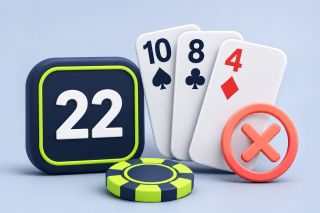
A blackjack hand busts when its total exceeds 21 after every ace has been counted as 1 where necessary.
- See also:
- Bust Card
Bust Card
A bust card is the card that takes a blackjack hand above 21 after any ace has been counted as 1 where necessary. Players also use the phrase informally for a dealer upcard that seems weak; that second meaning is a prediction, not an outcome.
- See also:
- Bust
Card Counting
Card counting tracks dealt cards to estimate changes in a blackjack shoe. Its usefulness depends on dealing conditions and does not guarantee profit.
DAS
DAS means double after split: a blackjack rule allowing an eligible hand created by splitting a pair to be doubled. It is separate from the rules governing resplitting and split aces, which may still impose additional restrictions.
Deadwood
In this blackjack glossary, deadwood refers to used or discarded cards that are currently out of the undealt card supply. The term is informal and context-dependent; it should not be confused with a dead hand or with deadwood scoring in rummy.
Double Down
To double down in blackjack is to add a permitted extra stake to an existing hand, normally equal to the original bet, in exchange for receiving just one further card.