Hit frequency is how often an event counted as a hit occurs. It differs from RTP, volatility and the chance of making a net profit.
What hit frequency measures
Hit frequency describes how often an event defined as a hit occurs in a game. In slot discussions, a hit commonly means a round that produces some payout, but the definition can vary. A game may count any returned amount, including a prize smaller than the stake. The measure should therefore be read with the provider's definition rather than treated automatically as the chance of making a profit.
A stated hit frequency is usually a theoretical or measured proportion, depending on its source. Theoretical frequency comes from the game's model. Observed frequency comes from a sample of play and can differ from that model, especially over a short period. A player reporting several wins in ten spins has described one sample, not established a reliable long-run rate for the game.
Hits are not necessarily profitable rounds
Imagine a $1-per-spin game that returns $0.20 on a particular round. If the game counts any payout as a hit, that round increases the hit count even though the player has lost $0.80 net. Winning lights and sounds can emphasize the paid amount while obscuring the comparison with the total stake. Always compare the return with the full cost of the round.
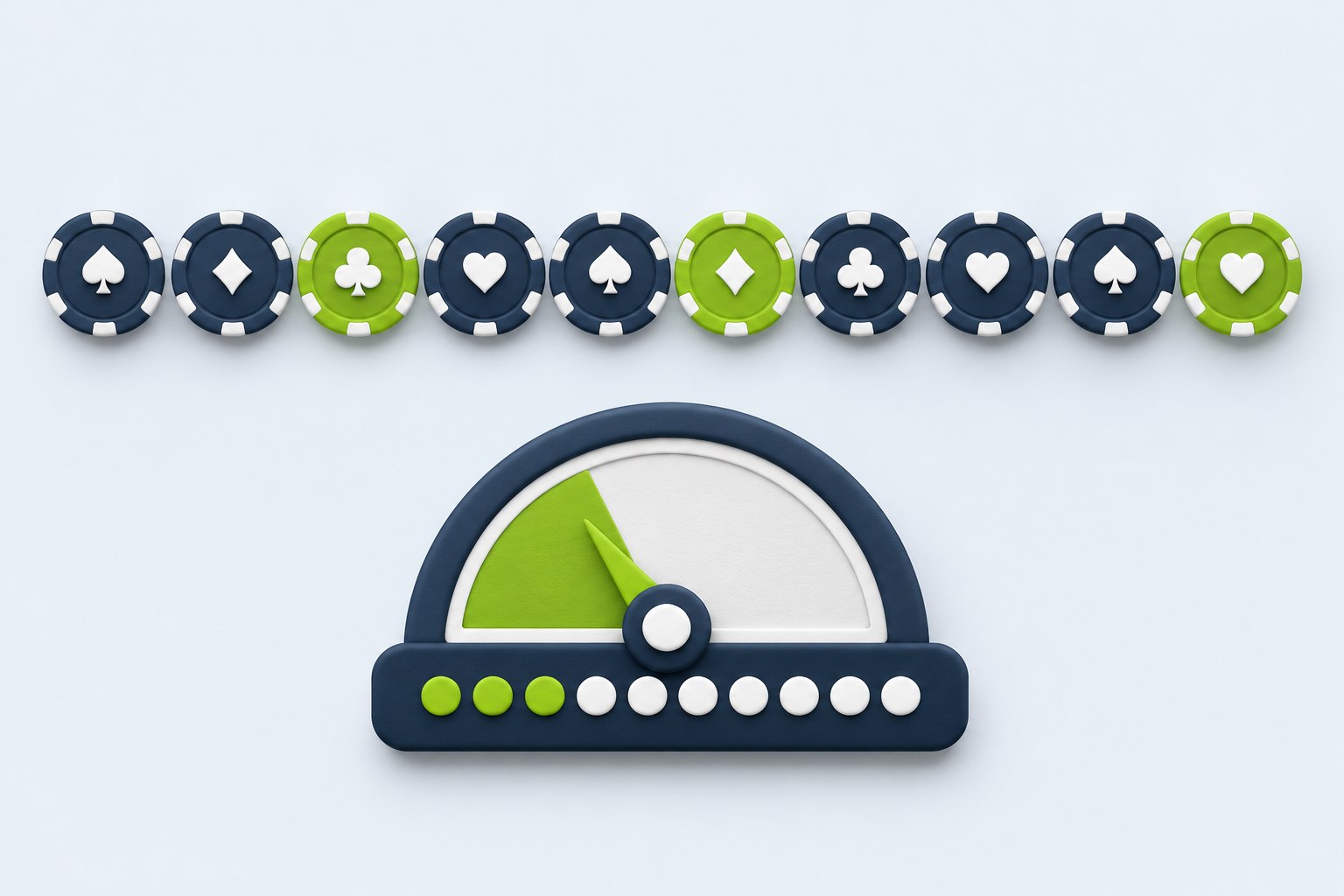
An illustrative 25% hit frequency means that one quarter of rounds meet the specified hit definition in the model. It does not mean every group of four spins contains exactly one hit. It also does not tell you the average size of those hits. The same rate can accompany many small returns, a mixture of sizes or a distribution with substantial value concentrated in rare prizes.
Relationship with RTP and volatility
RTP describes the average proportion of stakes returned, while hit frequency describes how often a defined event occurs. A simplified game returning $0.96 on every $1 wager would have 96% RTP and a 100% payout-hit frequency, yet every round would lose $0.04. The example is deliberately artificial, but it shows why a high hit rate does not establish favorable returns.
Volatility concerns the spread of possible results. It can be influenced by prize size and frequency, but it cannot be inferred from hit frequency alone. Two games with the same hit rate may have very different maximum prizes and distributions among winning rounds. Treat RTP, volatility and hit frequency as related descriptions answering different questions, not interchangeable ratings of how generous a game is.
Feature frequency and changing modes
The frequency of triggering a bonus round is another separate measure. A game may produce ordinary paying hits regularly while triggering its main feature rarely. A published feature rate should specify what event qualifies and whether the figure applies to the base game, a particular stake option or another mode. Extra-bet settings can change the relevant probabilities or costs.
Cascading games also need careful definitions. One paid round can contain several evaluations and payouts. A provider might measure hits per initial round rather than per cascade, or publish another specified measure. Without that denominator, comparisons can be misleading. The question is not only what counts as a hit, but what counts as one opportunity for that hit to occur.
Using the figure responsibly
Do not turn a stated frequency into a schedule. Under independent, unchanged conditions, a run of losing spins does not make a hit due merely because the average interval has been exceeded. An average interval describes a distribution over many outcomes, not a timer. Chasing a predicted next hit can increase losses while leaving the next round's underlying probabilities unchanged.
Look for provider-supplied definitions and the exact game configuration when quoting the figure. If the information is unavailable, it is better to say so than estimate it from a few demonstrations. Hit frequency can help explain why a game produces frequent small returns or long quiet stretches, but it does not tell a player what they can afford, how long a deposit will last or whether the next session will end ahead.