Runners, usually called runner-runner cards, are the consecutive turn and river cards needed to complete a poker hand from the flop.
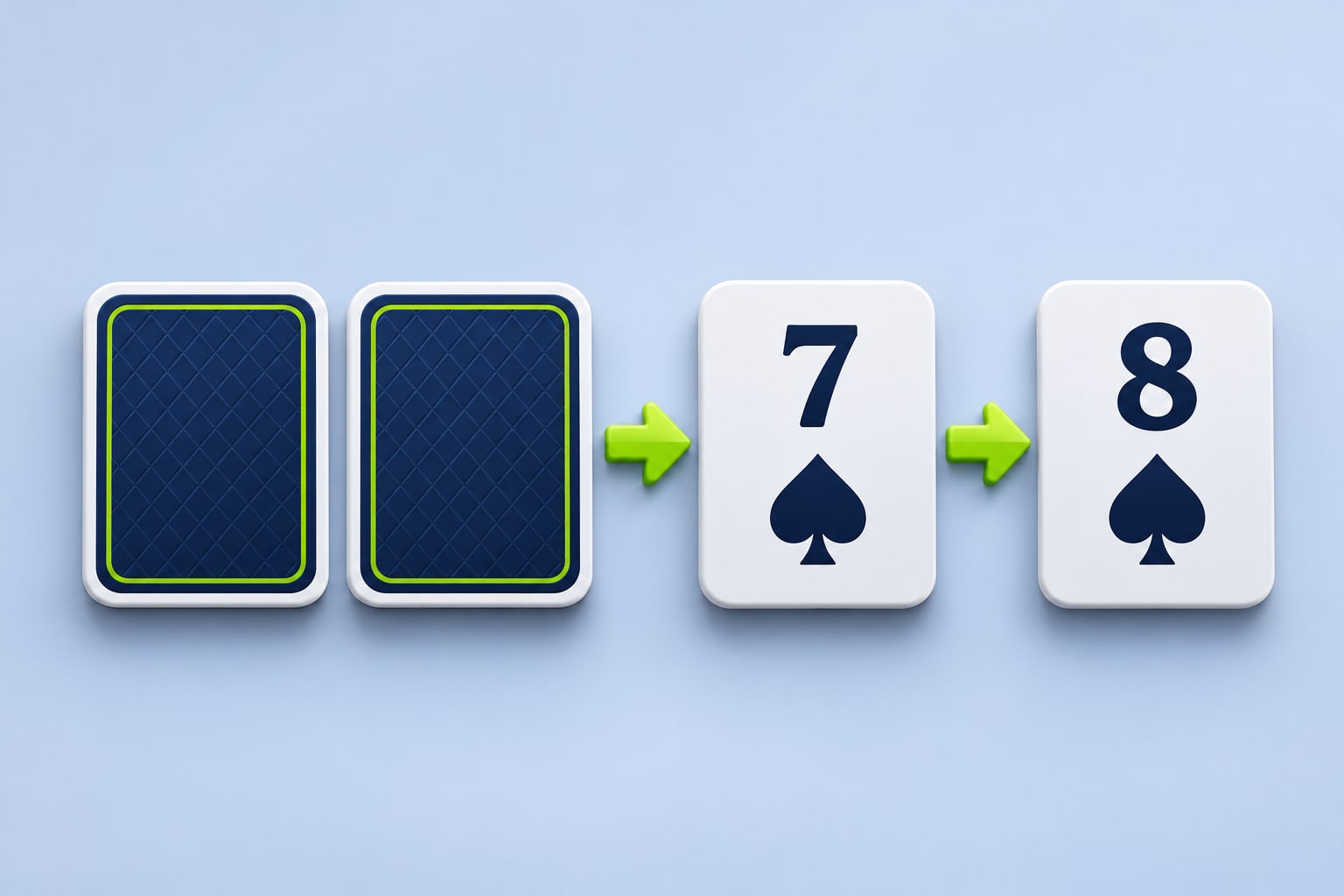
Visual explainer
Runner-runner flush: both cards must help
Texas Hold’em example. Hole cards A♠ K♠; flop 2♠ 7♦ J♣. Only these five cards are known.
1 · Flop · three spades available
2 · Turn · another spade
3 · River · one more spade
From the flop: 10/47 × 9/46 = 90/2162 ≈ 4.16% for two more spades, considering only those five known cards.
This is the chance of completing that spade flush, not the chance of winning the pot. Related: Flush · River.
The runner-runner idea
Runners refers to the successive cards needed to complete a poker combination, most commonly the turn and river in a community-card game. A runner-runner draw needs help on both streets. It is also called a backdoor draw. This is different from a draw that can be completed by one suitable card immediately. From the flop, the player is looking for a two-card sequence rather than a single outcome. PokerStars uses runner-runner for a hand made by catching the necessary cards on both the turn and river. The expression describes the route to the final hand, not a special ranking or separate prize.
A flush example
Suppose a Hold’em player holds ace-spade and king-spade, and the flop is two-spade, seven-diamond and jack-club. There are three spades available across the hole cards and board. To make a spade flush by the river, both remaining community cards must be spades. A spade on the turn creates a conventional four-card flush draw, but it does not complete the flush by itself. The river must provide another spade. If the turn is a heart, a spade on the river cannot repair the missing fifth spade. That dependency is what distinguishes the original backdoor possibility from a one-card flush draw.
Counting the two stages
Using that example and considering only the player’s five known cards, ten spades remain among 47 unseen cards. The chance that the turn is a spade is ten out of 47. After one arrives, nine spades remain among 46 unseen cards, so the chance of another on the river is nine out of 46. Multiplying those fractions gives about 4.16 percent for the two required spades. This is a card-completion calculation under the stated information, not the probability of winning the pot. An opponent’s cards, other winning possibilities and additional information can change the question being evaluated.
Runners are not always suited cards
A runner-runner sequence can produce a straight, a full house, four of a kind or another combination, depending on the starting cards. Some paths permit several rank pairs and either order; others require a very specific sequence. Do not count only one attractive route if you are trying to calculate every way a hand can develop, and do not count the same final route twice. The legal card-use rules also matter. In Omaha, exactly two hole cards and three board cards must form the hand, so a visually appealing board runout may not complete the combination that a Hold’em player would expect.
Completing is different from winning
Two useful cards can improve a hand without making it best. A runner-runner flush may lose to a higher flush, and a straight may be beaten by another available combination. Sometimes a card that helps one player also helps an opponent more. This is why commentary about catching runners should be separated from a full analysis of the hand. It explains an unexpected development, but does not prove the earlier call was sound or unsound. The cost of continuing, opponents’ possible holdings and the number of alternative outcomes are part of that decision. A memorable river result cannot supply all of those missing details.
Reading a hand history
Start with the hole cards and flop, identify the intended combination, and then trace what each later card contributes. If the turn already completes the target hand, the river is not also required to make it, so runner-runner is usually the wrong description for that target. If both cards are necessary, the phrase fits. Record whether the player actually reached showdown and which five-card hand was used. Avoid using runners as a synonym for every lucky card or every two-card improvement. Precise language helps explain why a draw was remote at the flop and how the possibilities changed after the turn.