In Texas hold’em and similar community-card poker games, the turn is the fourth community card and the betting stage after it is dealt. It comes after the three-card flop and before the fifth card, the river.
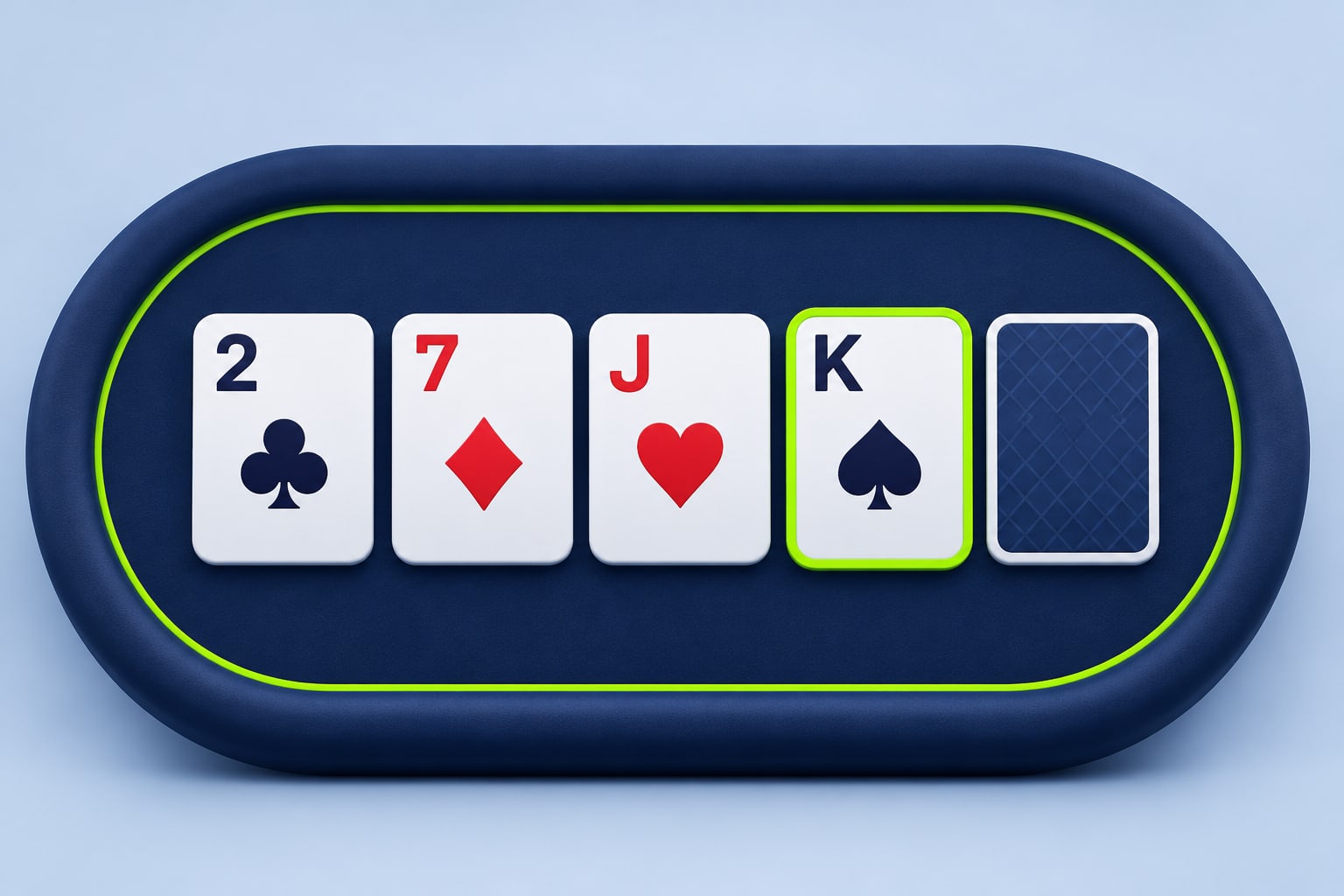
Hold’em card example
The turn adds the fourth shared card
Example: two hearts in your hand and two hearts on the board create a four-card flush draw.
Your hand and flop
Flop: K♥ · 6♣ · 2♦
Turn: 3♥
Four hearts are available in total. You do not yet have a five-card flush.
One community card remains: the river. A completed draw can still lose to a stronger legal hand. Explore: Flop · River · Flush.
The fourth shared card
The turn is the fourth community card in Texas hold'em. It follows the three-card flop and precedes the fifth community card, called the river. Players can also use turn to refer to the betting round that begins after the fourth card is dealt. The context usually makes the meaning clear: catching a king on the turn describes the card, while betting the turn describes an action during that stage. The word should not be confused with a player's turn to act, which can occur in any betting round. State the game and stage when using the term in an explanation.
Where it fits in the hand
In a standard hold'em hand, players first receive two private cards and take part in the preflop betting round. The flop then reveals three shared cards, followed by another betting round. The turn adds one shared card, and the river later adds the last one, with betting at the relevant stages. Not every hand reaches the turn: earlier folds can end the contest. Nor does seeing the turn mean every player must continue to the river. The legal actions and their cost depend on the current betting and the game's limit structure, rather than on the fourth card's name alone.
One card can change several possibilities
A turn card can pair the board, complete a possible straight, add a third card of one suit or leave the apparent hand categories largely unchanged. Its effect depends on the full board and the possible private cards. For example, a fourth club among a player's available cards creates a different situation from a club that completes a valid five-card flush. Count the actual cards used and apply the hand-construction rule. In hold'em, the player can use any valid five-card combination from the available seven at the end; in Omaha, exactly two private cards and three board cards are required.
One community card remains after the turn
With the turn dealt in hold'em, only the river remains to be revealed. A drawing calculation must therefore distinguish one card to come from the two-card possibility that existed on the flop. As an illustrative simplified calculation, if four genuinely winning river cards remain among forty-six unseen cards, the chance of hitting one is four out of forty-six. That assumes the stated information and that each of those cards actually produces the required result. An apparent improvement may still lose to another hand, so identifying a card that improves the player's category is not always the same as identifying a winning out.
Betting decisions need more than the draw count
The price of calling, the size of the pot, possible later action and opponents' likely holdings all matter when deciding whether to continue on the turn. A possible draw does not justify paying any amount to see the river. Likewise, a made hand can be vulnerable even if it currently looks strong. Evaluate the decision using the information available at that moment rather than the river card revealed later. A missed draw does not by itself prove a call was wrong, and a fortunate river does not prove that every expensive call with the same kind of draw is sensible.
Use precise street descriptions in hand histories
A clear hand history records the flop, the turn card and the action in order, with stake sizes and relevant positions where needed. Saying the player improved on fourth street can be ambiguous across poker variants, because stud uses street names for a different dealing structure. The term turn is most useful when the community-card game is already identified. It describes a point in the hand, not a special prize or guaranteed chance to recover earlier losses. Understanding the sequence helps readers follow the changing information and costs while keeping the final result separate from the decisions that preceded it.