A back-door draw in poker needs favorable cards on both remaining streets to complete the intended hand. For example, a back-door flush draw on the flop requires matching-suit cards on both turn and river.
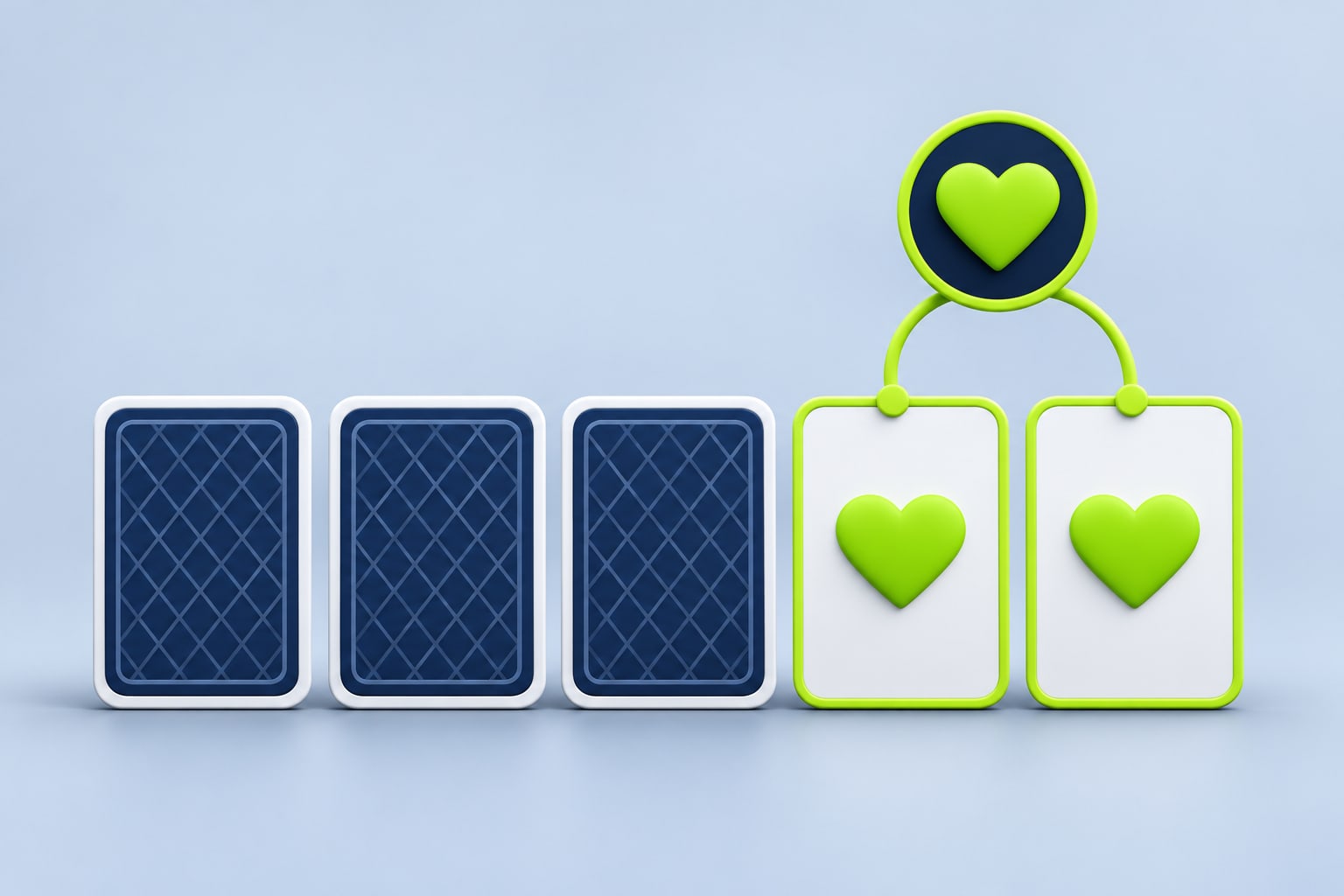
Visual explainer
A back-door flush needs two more hearts
Hold’em example: you hold A♥ K♥ and the flop is 7♥ 4♣ 2♠. Three hearts are available; both later cards must be hearts to complete this flush.
1 · Flop
3 hearts
Two private hearts + one on the board. A single additional heart is not enough.
2 · Turn must be a heart
10 / 47
Ten hearts remain among 47 unseen cards, with no other exposed cards known.
3 · River must be a heart
9 / 46
After a heart arrives, nine hearts remain among 46 unseen cards.
Both required: (10 / 47) × (9 / 46) ≈ 4.16%. A non-heart on the turn closes this particular flush route.
This is the chance of completing the flush across both cards under the stated assumptions, not the chance of winning the pot or a reason by itself to call a bet. Related: Four Card Flush · Draw.
Two helpful cards rather than one
Back-door describes an improvement that depends on two later cards arriving in sequence. In Texas hold'em, a player with three cards of one suit among the hole cards and flop can have a back-door flush possibility: the turn and river must both bring that suit. This differs from an ordinary four-card flush draw, which needs only one additional suited card. The phrase is also used for straights and other improvements that develop through consecutive useful cards. It does not mean a hidden rule or an alternative payout. It describes how the final hand was reached or what future cards would be required.
A concrete flush example
Suppose your hole cards are the ace of hearts and king of hearts, and the flop contains one heart plus two cards of other suits. You have three hearts available, so two more hearts are needed to form a five-card flush. A heart on the turn creates a conventional four-heart draw; another heart on the river completes it. If the turn is not a heart, that particular back-door flush route is no longer available in standard hold'em. Your hand might still win or improve in another way, but the original two-card suited requirement has not been met.
A probability illustration with clear assumptions
In that flop example, ten hearts remain among forty-seven unseen cards from your perspective. Ignoring any further information about opponents' cards, the chance of a heart on the turn and another on the river is ten divided by forty-seven, multiplied by nine divided by forty-six. That is about 4.16 percent. The calculation concerns completing the flush, not necessarily winning the pot. Another player can make a stronger legal hand, and betting can prevent you from seeing both cards. Known exposed cards or a different game format can change the available-card count, so the assumptions should accompany the number.
Back-door straight possibilities need care
A back-door straight draw can involve more than one possible pair of turn and river ranks. Count complete legal paths rather than multiplying a vague number of helpful-looking cards. Some cards create only a partial draw, some duplicate ranks already held, and some produce a straight that an opponent can beat or share. An ace also has specific high or low uses in ordinary straight rankings; it does not wrap around from king to two. Evaluating these possibilities is more complex than noticing that the hole cards look connected. The final best five-card hand and the game's card-use rules still govern the outcome.
Why a possible draw is not an automatic call
A small chance of improving does not by itself justify paying to continue. Consider the current price, the pot, possible later bets and whether the completed hand is likely to be best. Calling a flop bet can lead to another costly decision on the turn even when the first needed card arrives. A back-door possibility may add value to a hand that already has other prospects, but it should not be treated as a guaranteed rescue. Money invested earlier is not a reason to ignore the new cost. The decision concerns the available information and future risk at the moment of action.
Reading the term in commentary
When a commentator says a player back-doored a flush, the statement usually describes the final runout after the necessary later cards arrived. It does not establish that the earlier decision was correct or incorrect by itself. Good decisions can lose, and weak decisions can sometimes receive favorable cards. Review the price and information available at the earlier street rather than judging solely from the result. Keep back-door and one-card draws distinct when reading a strategy discussion, and verify the game being discussed. The term is a useful description of a two-stage route to improvement, not a promise that a disappointing flop will recover.