To make a hand is to form a recognised poker combination, often by completing a draw. It does not necessarily mean winning the pot.
Visual explainer
Completing a draw is not the same as winning
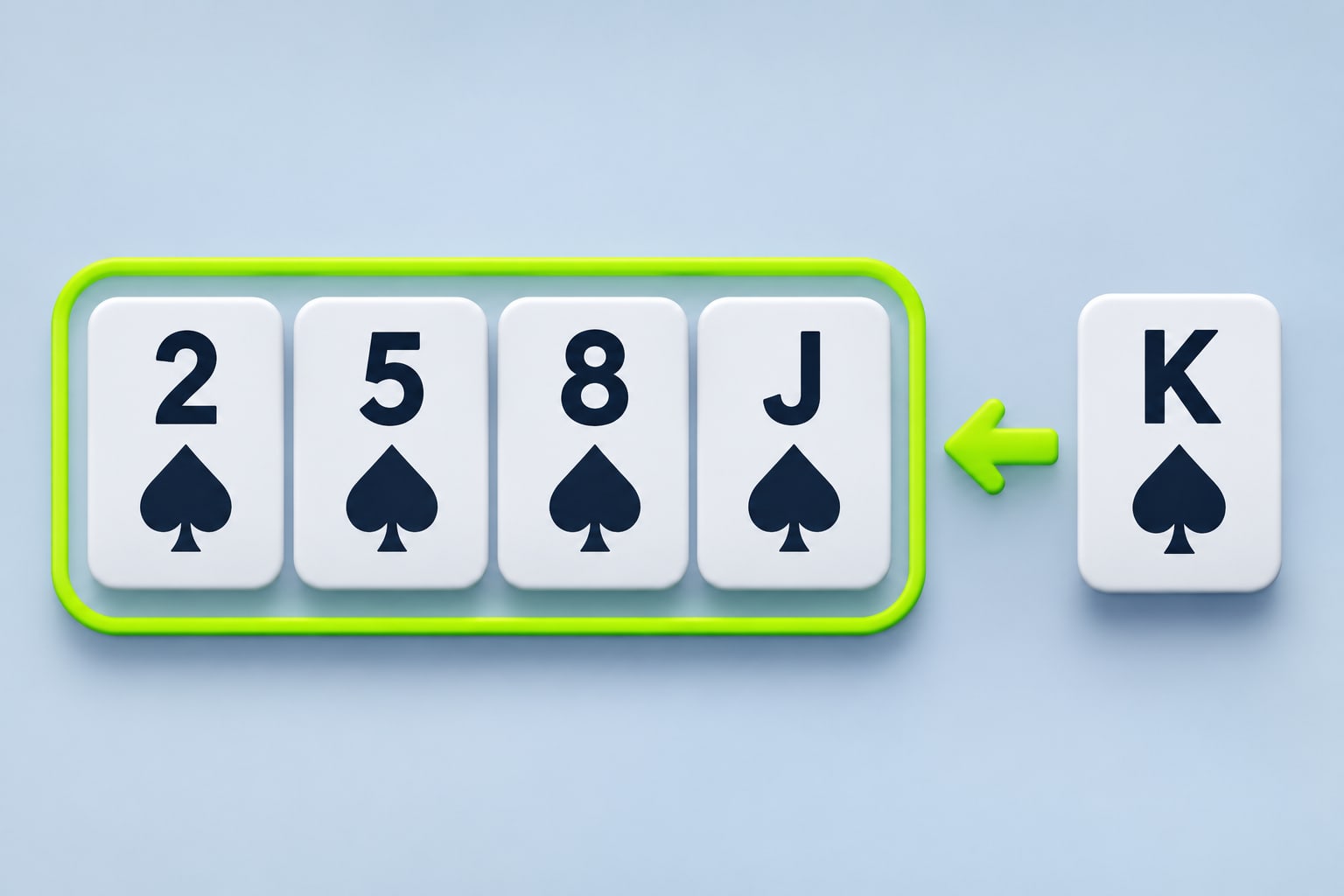
Hypothetical five-card draw: hold four spades and discard the diamond.
Initial five cards
Replacement: K♠
Alternative: K♥
The made king-high flush can still lose, for example to an ace-high flush. “Make a hand” identifies the completed combination; winning requires comparing all eligible hands.
The branches are illustrative outcomes, not a probability calculation or a recommendation about which cards to draw. Related: Flush · Hand.
What the expression means
To make a hand usually means forming a recognised poker combination, especially when a new card completes something that was previously a draw. A player might make a flush, make a straight or make a pair. In casual discussion, the phrase often contrasts a completed combination with an unfinished holding that still needs improvement. It does not establish that the hand is best, and it does not automatically describe a profitable decision. Context matters: a player can make the combination they wanted and still lose to a stronger hand. Naming the actual combination is therefore more informative than saying only that a hand was made.
Completing a flush
Consider a five-card draw example in which a player holds two, five, eight and jack of spades with an unrelated diamond. If the diamond is discarded and replaced by king of spades, the final five cards form a flush. The player has made the flush draw. If the replacement is king of hearts instead, the flush has not been completed. The king may change the high-card value, but it does not satisfy the suit requirement. This simple example separates improving some aspect of a holding from completing the particular combination being pursued. The game’s legal draw procedure must still be followed.
Making a hand on a shared board
In community-card poker, a new board card can complete combinations for more than one player. A turn card that gives one player a straight may give another a higher straight or a flush. It can also improve a player who was already ahead. Evaluate the best legal five-card combination rather than focusing only on your own desired card. In Hold’em, players can use zero, one or two hole cards with the board. Omaha instead requires exactly two hole cards and three board cards. The same visible cards can therefore produce different legal hands depending on the variant being played.
Made does not mean unbeatable
Suppose a player completes a king-high flush while an opponent can form an ace-high flush in the same suit. Both players have made a flush, but the ace-high hand is stronger under ordinary high-hand rules. A completed straight can similarly lose to a higher straight, flush, full house or another superior combination. This is why descriptions such as made hand and drawing hand are useful categories rather than final verdicts. A made pair can still improve, and a draw can have several possible ways to develop. The showdown result depends on the completed legal hands and the applicable rankings.
Probability and the price of continuing
Knowing which cards would complete a combination is only part of evaluating a decision. The number of unseen cards, the number of cards still to come, the cost of continuing and the possibility of making a second-best hand can all matter. A card that completes your draw is not automatically a clean winning card. Avoid assuming that an appealing possibility justifies any call. Conversely, failing to make a draw does not by itself prove the earlier decision was wrong. Individual outcomes and the quality of a decision are different questions. The expression make a hand describes what happened, not a complete strategy calculation.
Using the phrase in different games
In video poker, a made combination is checked against the machine’s paytable. A pair may be a recognised poker hand without qualifying for a payout in that version. In lowball, the objective and ranking rules differ from ordinary high-hand poker, so a card that looks like an improvement in one game may damage the holding in another. When reviewing a hand history, identify the variant, the cards before and after the change, and the exact combination completed. That keeps the explanation factual. Making a hand is a useful way to describe improvement, but neither the phrase nor the excitement of completing a draw guarantees a return.