A flush is a five-card poker hand whose cards all share one suit. In standard high poker it ranks above a straight and below a full house, unless the cards form a straight flush.
Standard high-poker comparison
Compare flushes from the highest card down
Both players have five cards in one suit. Equal top ranks move the comparison to the next card.
Flush A
Wins this comparison. A and J tie; the 9 is the first higher rank.
Flush B
The 8 loses to the 9 before the lower cards are considered.
Under standard high-poker rules, the suit itself does not decide which flush wins. Five matching ranks tie. Explore: Straight · Full House.
One suit across five cards
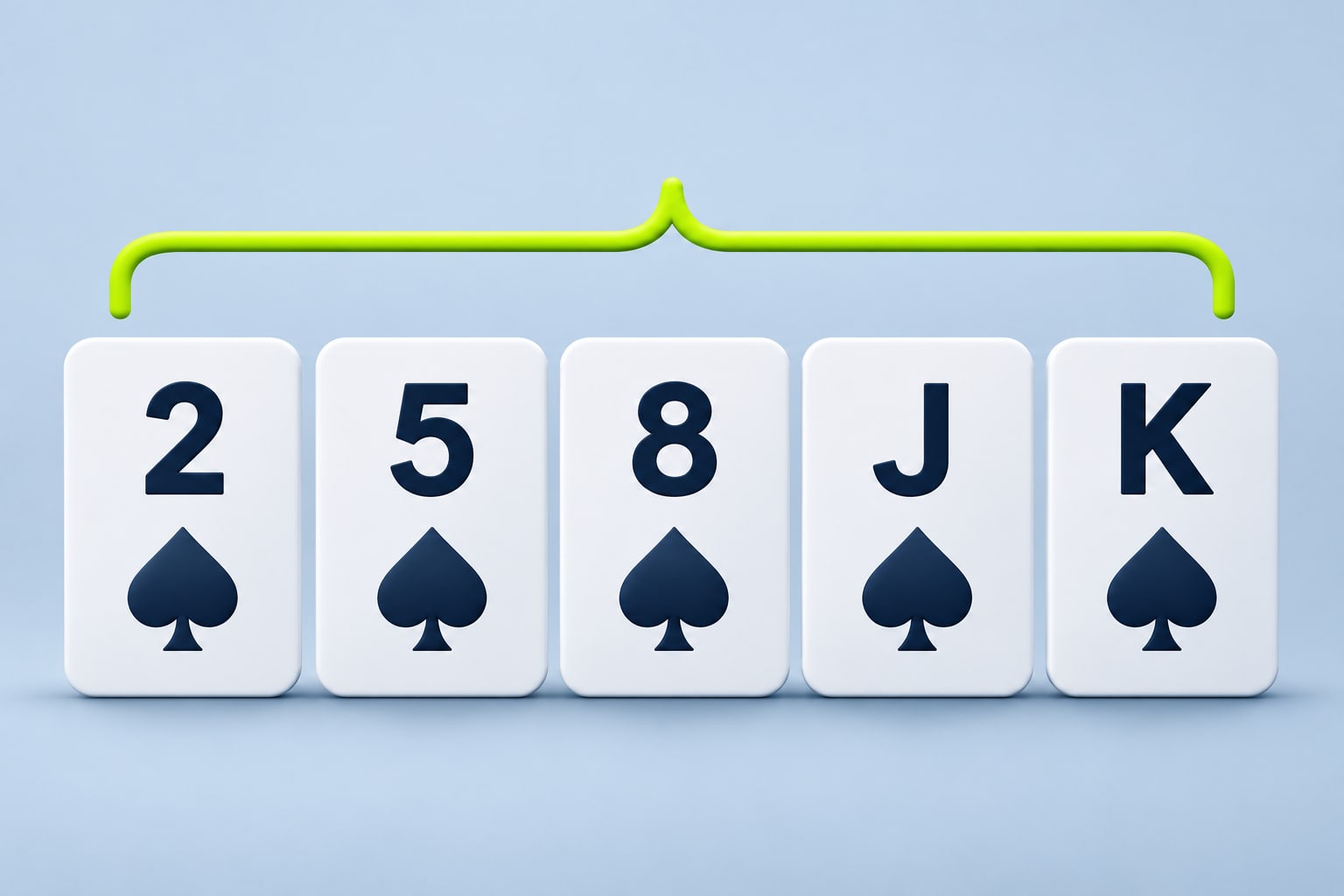
A flush consists of five cards of the same suit: all hearts, all diamonds, all clubs or all spades. Their ranks need not be consecutive. For example, 2♠, 5♠, 8♠, J♠ and K♠ form a king-high flush. Five cards that are merely the same colour do not qualify: hearts and diamonds are different suits even though both are red. If the five same-suit cards also form a consecutive sequence, the hand is classified as a straight flush, a stronger category under standard high-poker rankings. The relevant unit is a legal five-card hand, not an arbitrary collection of every card visible on the table.
How two flushes are compared
Compare the highest card first. If those ranks match, compare the next highest, continuing through all five cards until a difference appears. Consider A, J, 9, 6, 2 against A, J, 8, 7, 3, with each set entirely in one suit. The first flush wins because the nine beats the eight after the equal ace and jack. A lower unmatched card does not reverse that result. In ordinary poker showdown comparisons, one suit is not inherently stronger than another. If the complete five-card ranks are identical, the hands tie under the standard comparison rule, even if the particular game's dealing structure makes that situation unusual or impossible.
Hand construction still matters
In Hold'em, a player selects the best five cards from two hole cards and five community cards without a fixed requirement to use a hole card. If five spades are on the board, the board itself supplies a flush, although a player's spade can improve its five-card ranking. Omaha is different: exactly two hole cards and three board cards must be used. One spade in an Omaha hand is not enough to make a spade flush, even with four spades showing on the board. Always establish a legal combination before comparing its strength. The suit pattern alone does not override a variant's card-use requirements.
Four suited cards are a draw
A four-card flush draw still needs another card of the suit to become a five-card flush. In a simplified Hold'em example, suppose four cards of one suit are among the five cards you know after the flop: your two hole cards and the three board cards. Nine of the 47 unseen cards share that suit, giving a 9/47 chance of seeing that suit on the next card under the usual unknown-card model. This is a completion calculation, not a guarantee of winning. An opponent can make a higher flush or another stronger hand, and later cards can change the situation. Additional known cards would also change the count.
Rankings and paytables can differ
A flush beats a straight and loses to a full house in conventional high poker. Some short-deck variants use a different ordering, and lowball games can treat flushes in ways that make an ordinary high-poker ranking unsuitable. In video poker, the flush award is a row in the paytable and can vary between versions of the same named game. That award affects drawing strategy but does not turn a four-card draw into a completed hand. When reading a rule sheet, separate three questions: what cards form the hand, where the hand ranks, and what it pays. Those answers need not be identical across every casino game using poker cards.
Avoiding common misreadings
Check the exact suit symbols rather than relying on red and black colouring. Sort the five selected ranks mentally when comparing flushes, and ignore an unused sixth card unless it changes the legal best five. A phrase such as “ace-high flush” identifies the top card but may leave lower-card comparisons unresolved against another ace-high flush. Finally, a made flush is a strong category in many games, not an automatic winning ticket. Pot size, opposing hands, game rules and fixed-payout conditions still determine the result. Understanding the category helps read the table accurately; it does not remove the uncertainty of the remaining cards or justify exceeding a planned spending limit.