A brick is poker slang for a card that fails to help a particular hand or draw, or appears not to change the relevant situation. In eight-or-better low games, a high card cannot form part of a qualifying low, but its effect on the whole hand still depends on context.
Visual explainer
A brick is relative to the draw being discussed
Texas hold’em illustration focused only on whether a spade flush is completed.
Private cards
Flop
Turn: 2♣
Alternative turn: 6♠
The 2♣ may be called a brick for this flush draw, yet it can help another player. Missing one draw does not establish that the card changes nothing for the whole table.
The river has not been dealt in either branch. The diagram identifies a combination, not the eventual winner. Related: Flush · Make a Hand.
A card that does not provide the hoped-for help
Brick is informal poker language for a card that fails to improve a relevant hand or draw, or appears to leave the important situation largely unchanged. A player may say that the turn bricked or that they bricked a draw. The description is relative to the hand and the analysis being discussed. It does not mean the card is physically defective or has no possible value to anyone. A card that misses one player's draw can improve an opponent, pair the board or affect another part of a split-pot game. The term is useful shorthand, but it should not replace a careful account of what the card actually changes.
The low-hand meaning needs a qualifier
In an eight-or-better high-low game, a qualifying low requires the specified low-card structure, with no card above eight in that five-card low. A nine or higher therefore cannot be used as one of those five qualifying low cards. That makes a high card an obvious disappointment when a player needs a low card to complete a particular draw. However, the complete game may also award a high half, and a player may have other legal low combinations available. Calling the new card a brick does not automatically mean the player has lost the entire pot or can no longer form any qualifying hand.
A simple draw example
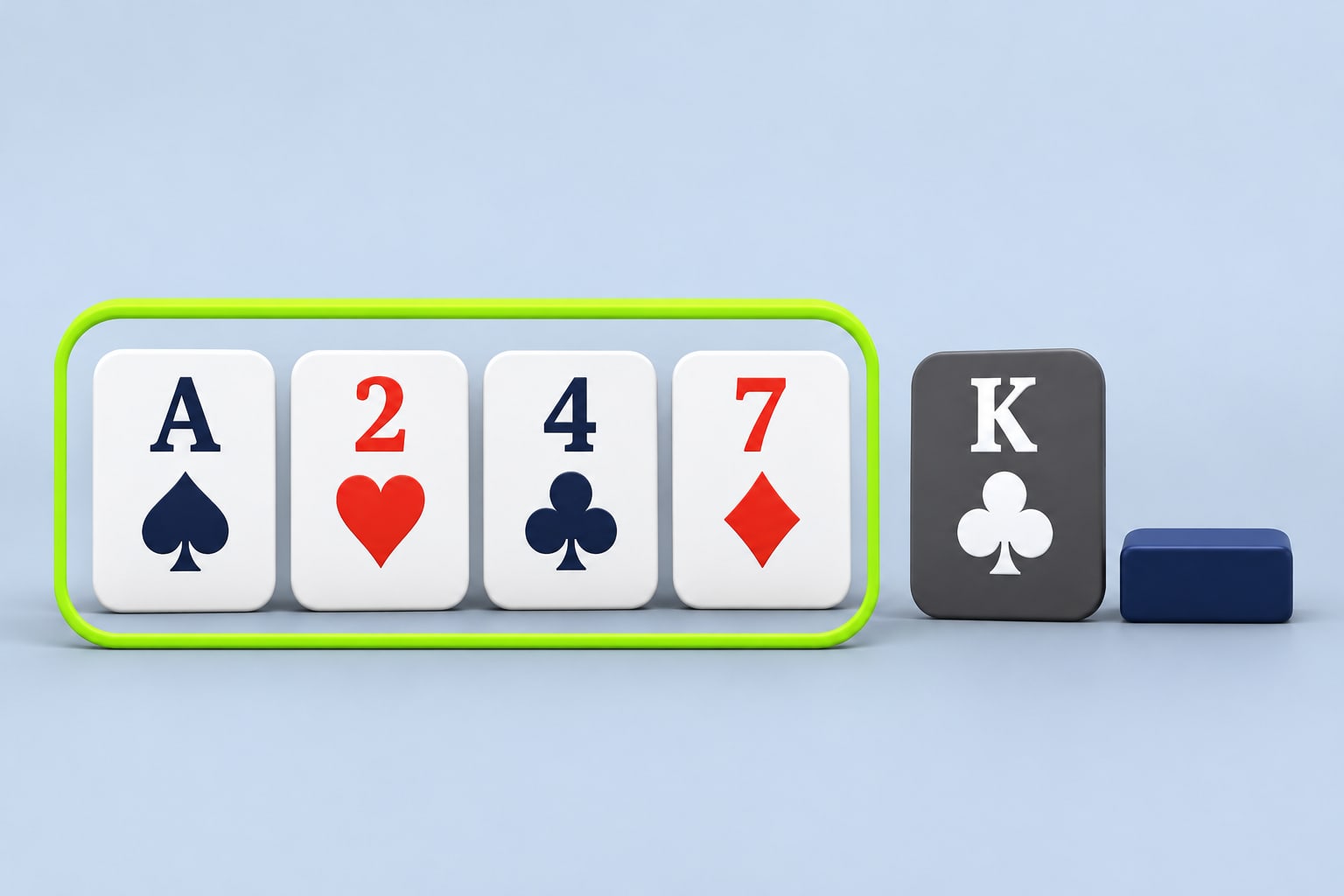
Imagine a draw-game illustration in which a player retains ace, two, four and seven while seeking a fifth distinct low rank under an eight-or-better condition. Drawing a king does not complete that qualifying low. Drawing a duplicate two would also fail to create five distinct ranks, even though the replacement is a low card. These examples show that high versus low is not the only relevant distinction. The rules for pairs, the qualifier and the specific cards held must all be considered. The illustration is about that stated draw situation, not a claim that every poker variant allows the same number of replacements or uses the same low ranking.
A harmless-looking board card may matter to someone else
In community-card poker, analysts sometimes call a turn or river a brick when it seems unlikely to complete the draws under discussion. That is an assessment of likely holdings, not a certainty about every possible hand. A small card might pair an opponent's private card, complete an unexpected straight or alter a low possibility. The correct interpretation depends on the board, the game and the ranges being considered. Saying that a card looks unimportant is therefore weaker than proving it cannot affect the winner. When reviewing a hand, explain which draws missed and which new combinations remain possible instead of treating brick as a mathematical classification.
Card-use rules still apply
Omaha requires exactly two private cards and three board cards for each five-card hand. A player cannot repair a disappointing draw by using an otherwise attractive combination that violates that rule. In a high-low version, the best legal high and low combinations may differ, but each must satisfy the construction requirements. Other poker variants use different arrangements. This is why a picture of several low cards is not enough to establish the final result without knowing where those cards came from. A brick describes how a card affects an intended hand; it does not relax the rules for building that hand or determining which portion of a pot it can win.
Describe the consequence rather than assuming a decision
Missing a draw does not by itself dictate one universal betting action. The pot, price, remaining cards, opponents and game format still matter. Nor does a missed draw make a future helpful card due. For an accurate hand history, record the actual card, street and relevant holdings, then explain why it failed to help the draw being discussed. Distinguish that meaning from unrelated expressions such as brick-and-mortar casino, which refers to a physical venue. Clear context prevents the slang from doing too much work. A precise explanation tells the reader what changed, what did not change and which possibilities remain, without pretending to know hidden cards.