Low poker refers to formats that reward a low-ranking hand, either for the whole pot or a share of it. The ranking system matters: ace-to-five and deuce-to-seven treat aces, straights and flushes differently.
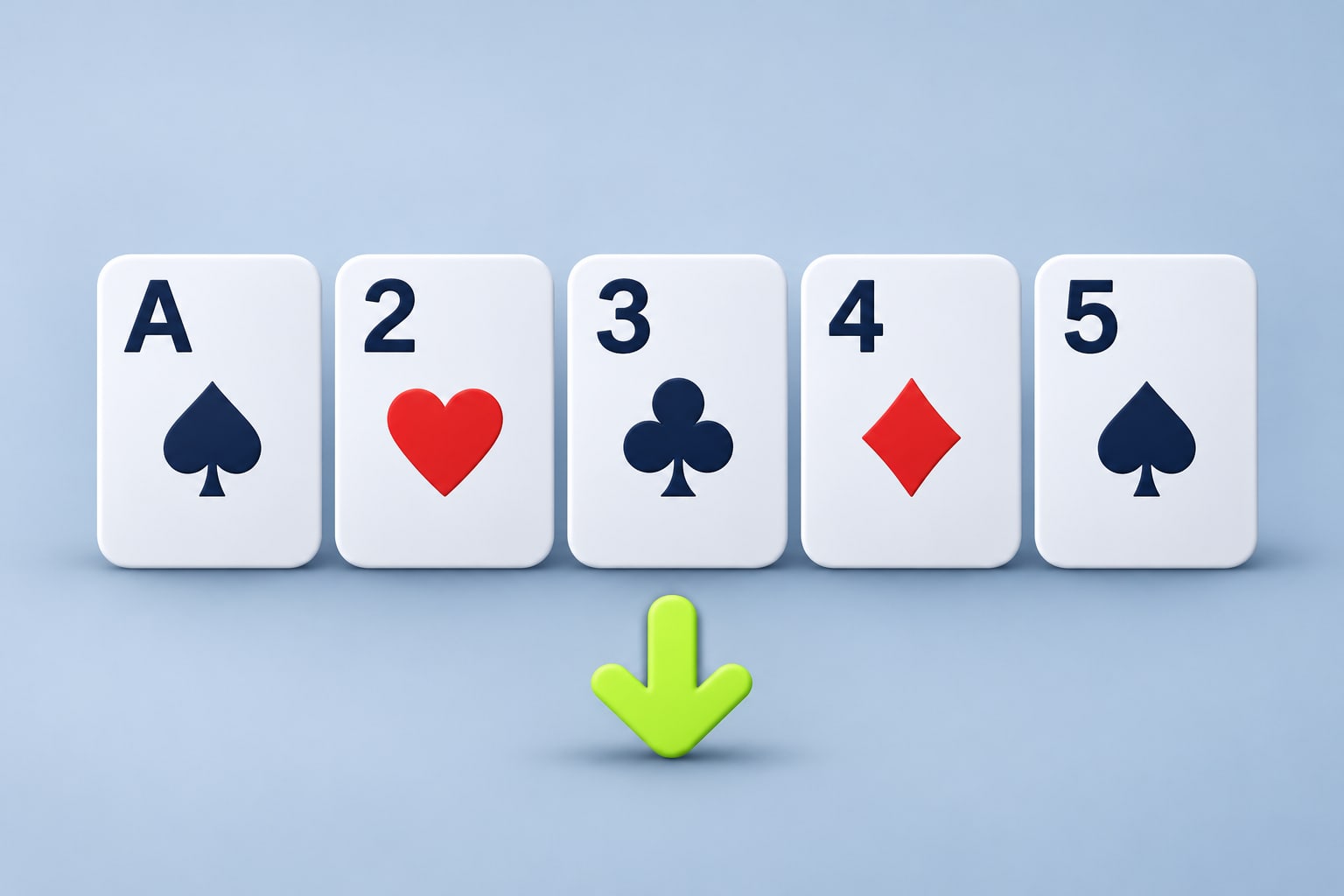
Lowest depends on the rules
Low poker is a broad description of poker formats in which a low hand can win. It is not one universal game, and saying that the worst ordinary poker hand wins is an unreliable shortcut. Some formats award the whole pot to the best low hand; others divide it between high and qualifying low hands. The relevant rules must explain how aces, pairs, straights and flushes are treated. They must also identify which cards may be used. A player who knows standard high-hand rankings still needs to learn this separate comparison system before assuming that a particular collection of small cards is strong.
Ace-to-five rankings
Under ace-to-five low rankings, aces are low and straights and flushes do not count against the low hand. The strongest five-card low is therefore 5–4–3–2–A, often called a wheel. Five distinct ranks are important because pairing a rank does not create another useful low card. To compare unpaired low hands, begin with the highest card and move downward only when necessary. For example, 7–6–4–2–A beats 8–4–3–2–A because seven is lower than eight. The second hand's attractive small cards do not overcome its higher top card. Adding the numerical ranks together is not the method used to decide the winner.
Deuce-to-seven rankings
Deuce-to-seven uses a different system. Aces are high, and straights and flushes count against the hand. The strongest low is 7–5–4–3–2 with mixed suits, rather than the ace-to-five wheel. The missing six prevents the cards from forming a straight. This illustrates why a familiar label such as lowball is not enough to settle a showdown. A hand that is excellent under one system may be poor under another. Check the complete game name and rules rather than relying on the visual impression that the cards look small. The drawing structure and betting limits are additional features, separate from the hand-ranking system itself.
A qualifier is a separate requirement
Some split-pot games use an eight-or-better qualification for the low share. Under that structure, the low hand needs five different ranks of eight or below, with the ace treated as low. A collection containing a nine does not qualify merely because it is lower than an opponent's cards. If no player makes a qualifying low, the rules determine that the high side takes the pot. Qualification and comparison are separate steps: first establish that a legal low exists, then compare it with other qualifying lows. Do not assume every low-only game uses an eight qualifier, or that every game described as hi-lo uses identical construction rules.
Card construction and split pots
How cards are selected matters as much as their ranks. In Omaha hi-lo, for example, a hand uses exactly two private cards and three board cards. Seeing four low board cards does not allow a player to ignore that requirement. A player may use different legal card selections for high and low, but each selection must satisfy the game's construction rule. The low share can also be tied, so having the best low does not necessarily mean receiving half of the entire pot alone. Multiple players may split that share. Keep the distinction between qualifying, winning a share and winning the whole pot clear when reading a result.
Reading a low hand correctly
Name the ranking system first, identify the legal five-card selection, check any qualification threshold and then compare from the highest relevant card downward. If there is a tie, continue through the remaining cards according to the rules rather than declaring a winner after the first matching rank. This orderly approach prevents common mistakes involving aces, paired ranks and straights. Low poker rewards a different hand structure; it does not make a wager risk-free or eliminate uncertainty about opponents' cards. Learn with examples or a demonstration before risking money, and keep betting decisions within a limit that does not depend on winning a particular pot.