To play the board in Texas hold’em is to use all five community cards as the best five-card hand, without improving it with either private card. This is not permitted in games requiring private cards, such as standard Omaha.
Visual explainer
The board can be your whole hand
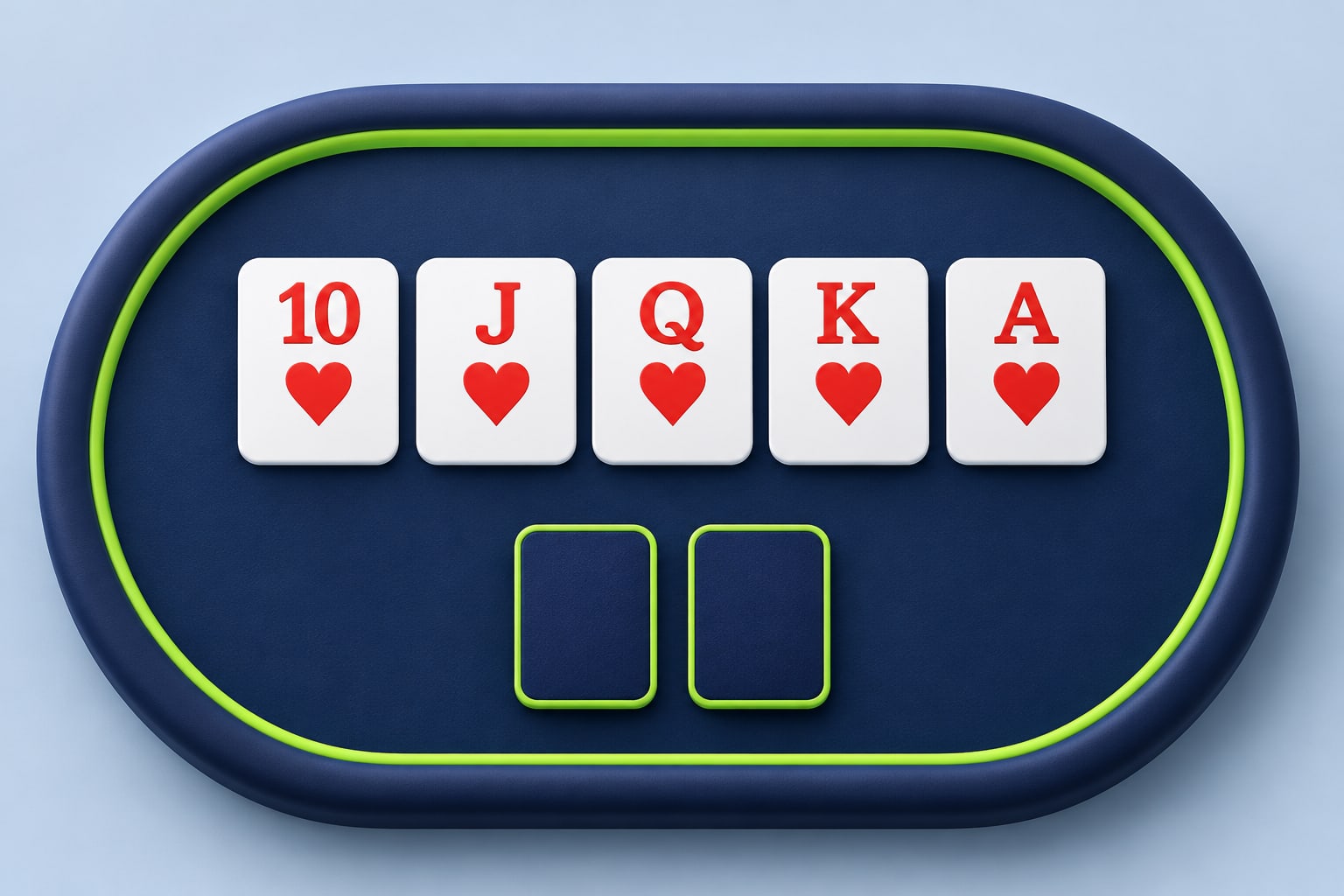
Texas hold’em allows the best five-card hand to use zero, one or two private cards. Here the board already forms a royal flush.
Player A: 2♣ and 3♦
Uses all 5 board cards
Neither private card improves the royal flush.
Player B: A♣ and K♦
Uses all 5 board cards
The private ace does not supply a sixth-card tiebreaker.
Eligible players at showdown share the tied pot under the game’s settlement rules. Standard Omaha is different: exactly two private cards and three board cards must be used.
Illustrates hand construction, with any fees and odd-chip allocation handled separately. Related: Texas Holdem · Royal Flush (Also, Royal Straight Flush or Royal).
Using the five shared cards
Playing the board means that a player's best five-card hand consists entirely of the five community cards. In Texas hold'em, the final hand can use both, one or neither of the two private cards, so this is a legitimate possibility. The private cards still belong to the player, but they do not improve the five-card combination being evaluated. The phrase describes the completed hand rather than a betting action. It does not mean the player has folded, automatically won or received a special payment. The result depends on whether another eligible player can make a stronger hand using their own cards.
A board that everyone can use
Suppose the five community cards are ten, jack, queen, king and ace of hearts. Under standard hold'em ranking, that board is a royal flush and no private cards can improve it. Every eligible player remaining at showdown can use the same five-card hand. The pot is then shared under the game's settlement rules, including any applicable treatment of odd chips and fees. This example is unusually clear because the board already contains the strongest high-poker category. Other boards require more care: a player who is using the board may still lose to someone whose private card improves the available combination.
A visible straight may be improved
Imagine a board showing five, six, seven, eight and nine of mixed suits. A player with two cards that do not improve that sequence can play the nine-high straight on the board. Another player holding a ten can instead make a ten-high straight using six through ten, and a suitable jack-ten holding can make a still higher straight. The board's apparent strength therefore does not guarantee a split pot. Inspect the best five cards each player can actually form. Also consider suits, because a possible flush can change the comparison even when the community ranks look like a simple shared straight.
Kickers must come from the best five cards
A common mistake is to compare private kickers after the board already supplies the entire best hand. Standard poker evaluates five cards, not a sixth-card tiebreaker. If both players' best five-card combinations are identical in rank, an unused private card does not break the tie. On the other hand, a private card that replaces a lower board card in the best five can matter. Write out each complete five-card hand before deciding. This method avoids the vague claim that an ace in the hole must always win, even when that ace is not part of a superior final combination.
Omaha has a different construction rule
Standard Omaha requires a player to use exactly two private cards and exactly three community cards. That requirement prevents playing all five board cards as the final hand. A royal flush appearing entirely on the board does not automatically give every Omaha player a royal flush. The player must still form a valid hand using the required combination. Other variants can have their own construction rules, so the phrase play the board should not be treated as universal poker terminology with identical consequences everywhere. Name the game first, then apply its card-use rule before comparing categories or kickers.
The hand description does not settle the procedure
Knowing that the board supplies a hand does not remove the need to follow the table's showdown and action procedures. A player should not assume that an informal declaration substitutes for whatever card presentation the room requires. Likewise, betting before the final cards are known involves uncertainty that the eventual board may conceal when reviewing the hand later. A useful explanation distinguishes the decision made at the time from the final five-card result. Playing the board is a precise hand-construction description: it tells the reader where the player's best cards came from, while leaving eligibility, comparison and settlement to the applicable rules.