Texas Holdem, usually written Texas hold'em, is a community-card poker game in which each player combines two private cards with five shared cards to make the best available five-card hand.
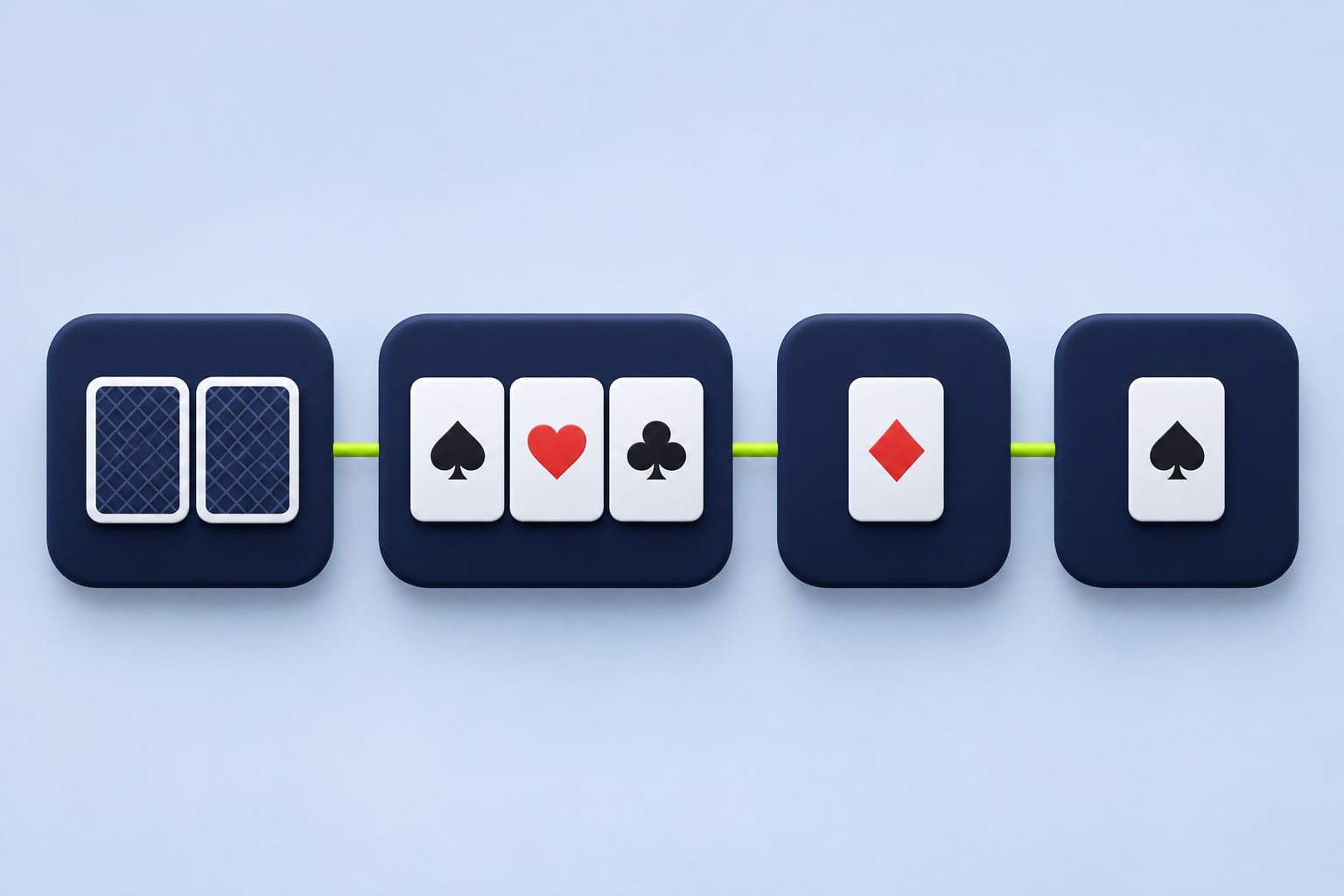
Texas hold’em sequence
Two private cards, five shared cards
Community cards arrive in stages. A hand can end before every stage if the remaining opponents fold.
Preflop
2 private
Players receive their hole cards. The first betting round follows.
Flop
3 shared
The first three community cards appear together.
Turn
4 shared
One more community card is added.
River
5 shared
The final community card is added, followed by the last betting round.
At showdown, use the best legal five-card hand. Hold’em allows zero, one or both hole cards; Omaha has different card-use rules. Explore: Flop · Turn · River.
The cards that belong to each player
A standard Texas hold'em hand begins with two private cards for each participating player. These are called hole cards or pocket cards. The dealer later exposes community cards in the centre of the table, where every remaining player can use them. Your private cards do not have to appear in your final combination: you may use both, one or neither when selecting the best five cards from the seven available to you. This flexibility is a defining rule. It separates hold'em from games such as Omaha, where the number of private and community cards used is prescribed differently. Always identify the variant before applying its hand-selection rules.
Following the four betting stages
The initial betting round takes place after the private cards are dealt and before the community cards appear. The flop then introduces three community cards together. Another betting round follows, after which the turn supplies one more community card. The river supplies the fifth and final community card, with betting after each of these later stages. A hand can finish earlier if everyone except one player folds. That remaining player takes the pot without needing to display a stronger combination at showdown, subject to the applicable house procedures. The sequence therefore describes the maximum ordinary progression, not a requirement that every hand reaches all five shared cards.
Understanding the available actions
Calling matches the amount needed to stay in the current betting round. Raising increases the wager that other players must address, while folding gives up the current hand and its claim to the pot. Checking passes the action without adding chips when no outstanding wager must be called. Whether a player can check depends on the actual betting situation, not on how attractive their cards look. Forced blinds create an initial pot and influence the first decisions. No-limit, pot-limit and fixed-limit structures set different restrictions on raises. An advertised buy-in is the amount brought to the game; it is not a substitute for reading its betting structure.
Reading the board at showdown
Imagine the community cards are ace, king, queen, jack and ten, all of different or mixed suits without a flush available. Every remaining player can use that board to make an ace-high straight. Holding a pair privately does not automatically improve it, because only the best five-card combination counts. Conversely, on a board with four hearts, a heart in your private cards may help make a flush that a player without a heart cannot match. Compare complete five-card hands, including any relevant kickers. When eligible players have identical best hands, they share the appropriate pot under the table's rules rather than receiving a preference based on seat or suit.
Separating poker from casino adaptations
In ordinary player-versus-player hold'em, opponents compete for money in the pot and the operator may charge rake or tournament fees. A casino game with hold'em in its title can instead pit each player against a dealer using prescribed wagers, qualifying rules or bonus payouts. Those rules cannot be imported into a poker-room game. Similarly, tournament chips represent participation in a tournament structure rather than a freely withdrawable cash balance at their printed value. Before joining, establish who the opponent is, how the operator charges, what stakes apply and how a winning hand is settled. The familiar two-card deal alone does not identify the entire product.
Using the term in guides and reviews
A review referring to Texas hold'em should identify the format when it matters: cash game or tournament, betting limits, number of seats and any unusual rules. Beginners can first practise reading the community board and selecting exactly five cards without attaching money to the exercise. Knowing the rules does not remove uncertainty, and a strong starting hand can still lose after later cards arrive. Choose an affordable spending limit independently of the size of an enticing pot. If a table's instructions differ from a general glossary explanation, consult the specific rules before participating. This entry describes the game structure; the related Hold'em entry provides the shorter terminology connection.
Related glossary terms
Sources and further reading
- Synonym:
- Hold’em