Top pair in community-card poker is a pair formed by matching a private card with the highest-ranked card on the board. Its strength depends on the kicker, other available cards and the betting situation.
Visual explainer
Top pair describes the board match
Texas hold’em example. Your private cards are K♠ Q♦; the flop is K♥ 8♣ 2♦.
Your king matches the highest board rank: you have top pair, kings. The queen is your highest unpaired card.
A different starting hand
A♠ A♣
On the same flop, pocket aces are an overpair, not top pair.
If the turn is A♥
Board changes
With K♠ Q♦, the king pair no longer matches the highest board rank.
A description of the pair is not a guarantee of winning. Related: Kicker · Two Pair.
Matching the highest board rank
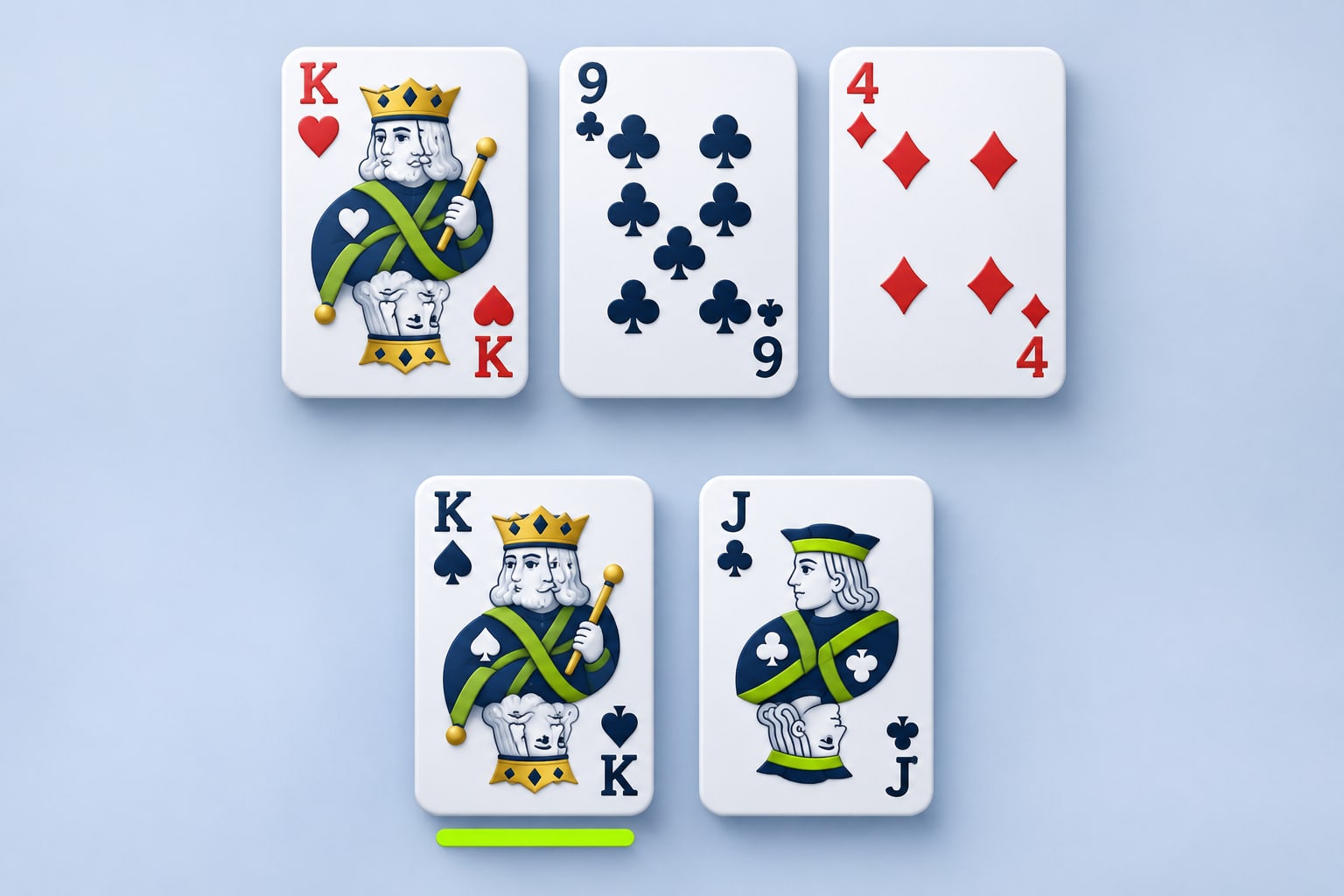
Suppose the flop is king of hearts, nine of clubs and four of diamonds. A player holding king of spades and jack of clubs has top pair: the private king matches the highest-ranked card on the board. The pair is kings, and the jack can be an important side card. A player holding a nine instead has a pair of the middle board rank, while a player holding a four has bottom pair on this flop. The term top describes the pair's relationship to the board ranks. It does not mean that the hand is automatically the best possible holding or that no opponent can have a stronger combination.
The kicker can decide the comparison
Two players can both have top pair but different side cards. On the king-nine-four flop, king-jack and king-ten both make a pair of kings. If the complete final hands otherwise leave the jack and ten relevant, the higher kicker can decide the result. The phrase top pair top kicker usually describes matching the highest board rank while holding the best available accompanying private rank for that situation. However, final comparison always uses the best legal five-card hand. A private kicker does not matter if better community cards replace it in both players' final combinations, and an unused sixth card cannot break a genuine five-card tie.
Top pair and an overpair differ
An overpair is a pocket pair higher than every card on the board. On a nine-seven-three flop, two queens in the player's hand form an overpair, while a private nine matching the board makes top pair. Both are one-pair holdings at that stage, but they are constructed differently. A pocket pair below the highest board card is not top pair simply because it is the player's strongest pair. For example, two eights on a king-nine-four board remain a pocket pair of eights. Naming the construction accurately helps a hand discussion distinguish the information visible to opponents from the information contained in the player's private cards.
Later cards can change the description
Top pair is a description of the current board, so it can change as more community cards arrive. A king paired on a king-nine-four flop is top pair, but an ace on the turn places a higher rank on the board. The player's pair of kings no longer matches the highest board card. The hand might still win, but the original label is no longer a complete description of the new situation. Later cards can also create two pair, three of a kind, straights or flushes. Review the current five-card possibilities after each new community card instead of carrying the flop's description forward unchanged to the river.
One pair is not the strongest possible hand
Top pair can be useful, especially on some uncoordinated boards, but opponents may have two pair, a set, an overpair where possible or a completed straight or flush as the board develops. A board with several connected or suited cards creates different possibilities from a widely separated mixed-suit board. The number of opponents, effective stacks and earlier actions also affect the decision. A glossary term cannot supply a universal instruction to call, raise or commit all remaining chips. It identifies a hand feature that must be considered alongside the actual cards and betting information. Strong-sounding vocabulary should not replace that assessment or conceal uncertainty about opponents' holdings.
Describe the full situation
When recording or discussing a hand, include the private cards, board, position, stakes and action rather than writing only had top pair. That detail makes it possible to evaluate the kicker and the stronger hands available. It also avoids confusing the highest pair currently held with the highest pair that could exist on the board. If a game imposes special card-selection requirements, use those rules when constructing the final hand. The phrase is most useful as a concise description within a complete account. It does not guarantee a payout, protect against an unfavourable later card or justify increasing the stake beyond the limits set for the session.