Two pair is a five-card poker hand containing two cards of one rank, two of another rank and one kicker. Under standard high-poker rules, compare the higher pair, then the lower pair, then the kicker.
Visual explainer
Compare two pair in this order
Independent five-card examples under standard high-poker rules; these are separate comparisons, not one shared deal.
A-A-2-2-3 beats K-K-Q-Q-A. Aces outrank kings before the lower pairs matter.
K-K-Q-Q-2 beats K-K-J-J-A. The king pairs tie; queens beat jacks.
K-K-Q-Q-A beats K-K-Q-Q-9. Both pairs tie; the ace kicker wins.
If the two pairs and kicker all have equal ranks, the hands tie. Suits do not break the tie in standard high poker.
Only the best legal five-card hand is compared. Related: Rank · Kicker.
Two different pairs and one remaining card
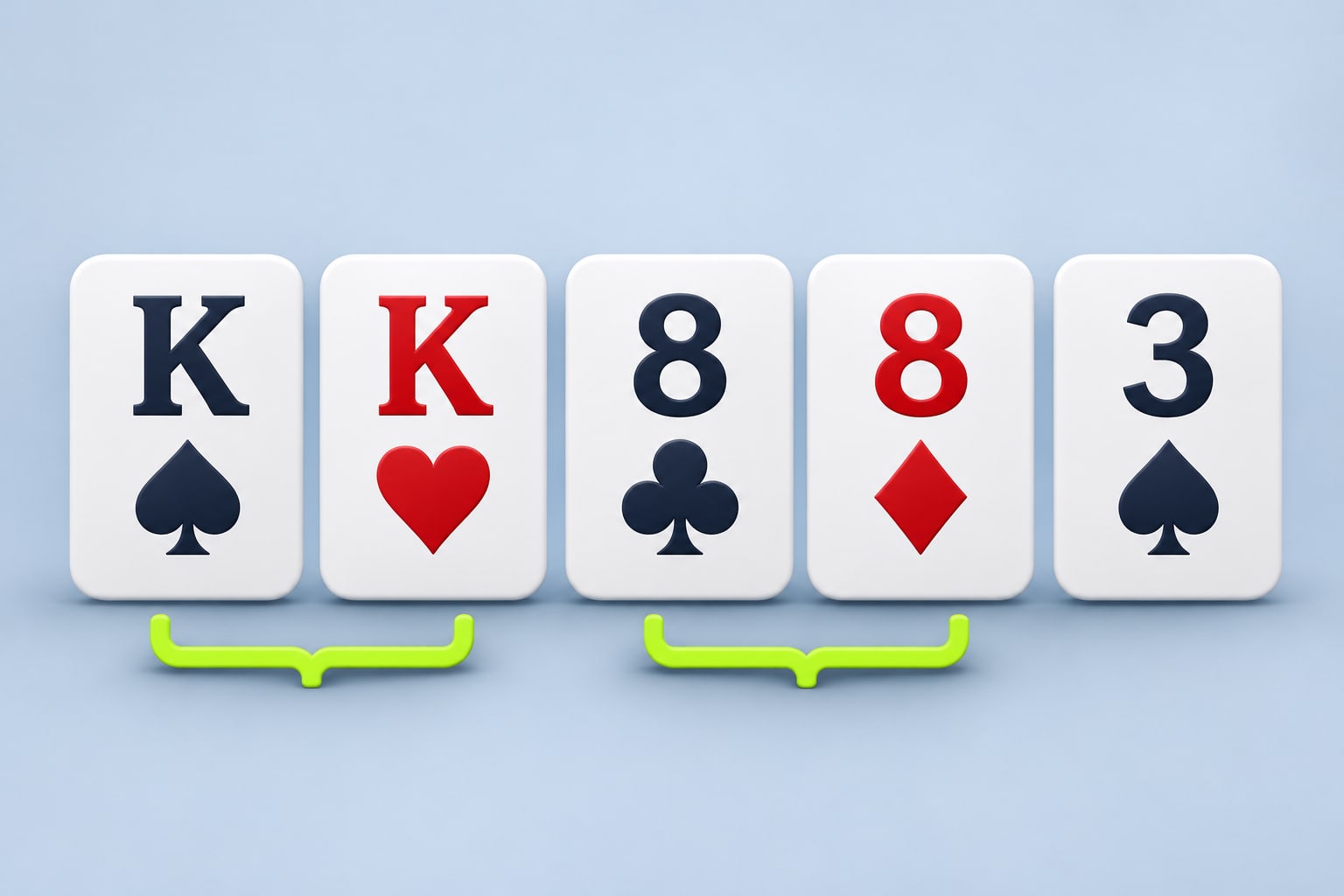
Two pair is a poker hand made from two cards of one rank, two cards of another rank and one unrelated card. For example, king of spades, king of hearts, eight of clubs, eight of diamonds and three of spades make kings and eights with a three kicker. The two pair ranks must be different. Four kings would be four of a kind, not two pair described as two separate pairs of kings. Under standard high-poker rankings, two pair beats one pair and high card but loses to three of a kind and the stronger categories above it.
Compare the higher pair first
When two players both have two pair, compare their higher pair before considering anything else. Aces and twos beat kings and queens because aces outrank kings, even though the losing hand's second pair is much higher than twos. If the higher pairs match, compare the lower pairs. Kings and nines beat kings and eights. Only when both pair ranks are equal does the fifth card decide the result. This ordered comparison prevents a common mistake: adding the ranks together or choosing the hand with the most impressive-looking kicker before checking the pairs. Poker ranking uses a defined sequence, not a sum of card values.
The kicker can come from the board
In Texas hold'em, the best five-card hand can use shared community cards as well as private cards. If the board supplies two pair, a player's private card may serve as the kicker, but only if it improves the best available fifth card. Suppose the board is king-king-eight-eight-queen. A player holding an ace can use it as the kicker, while a player holding only lower unpaired cards may have to use the queen on the board. The exact private cards can also create a stronger category, so check the full hand. Do not assume that every board showing two pair produces a split pot.
There is no three-pair category in a five-card hand
Seven available cards can contain three different pairs, but the final high-poker comparison still uses five cards. The player selects the two highest useful pairs and the best remaining kicker unless another category is stronger. For example, with pairs of aces, kings and fours plus a nine, the best five-card hand is aces and kings with a nine kicker. The extra pair of fours is not added as a third pair to create a new category. Write the chosen five cards explicitly when a result is confusing. Cards left outside that combination do not break a tie between identical best five-card hands.
Variant rules still control which cards can be used
Hold'em allows different combinations of private and shared cards, while Omaha requires exactly two private cards and three board cards. A two-pair-looking arrangement must satisfy the relevant construction rule before it counts. Lowball and split-pot games can also assess hands differently from standard high poker. In video poker, two pair is typically a paytable category rather than a hand compared against another player's cards. Its award depends on the named game and stake column. Do not assume that the same category receives the same payment in every machine or that poker pot values can be read from a video poker paytable.
A made hand is not a promise of winning
Two pair can be strong on one board and vulnerable on another. Later cards can improve it to a full house, allow an opponent to overtake it or change which five-card combination should be used. The cost of continuing and the possible opposing hands matter when making a betting decision. A label alone is not an instruction to raise or call. For settlement, identify the final valid five cards and apply the ranking order. For budgeting, remember that an appealing hand can still lose and that money already committed is not a reason to risk more without evaluating the current decision.