Bottom pair in community-card poker means pairing the lowest-ranking card on the board with a private card; its strength depends on the board, opponents and betting situation.
Recognising bottom pair on the flop
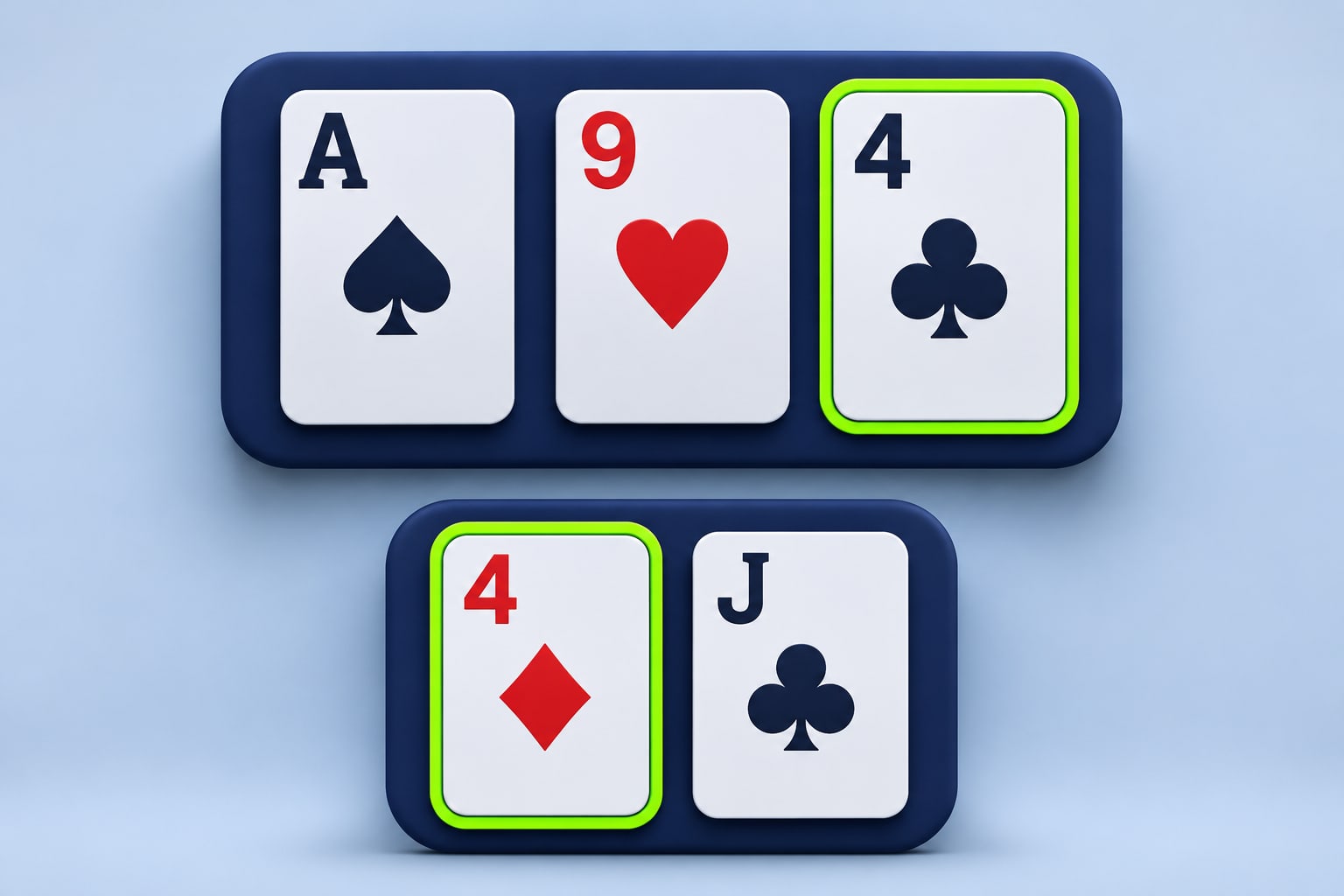
In Texas hold'em, bottom pair usually describes a private card matching the lowest rank among the community cards. Suppose the flop is ace, nine, four and you hold jack-four. You have a pair of fours, pairing the lowest board card. A player holding nine-seven has middle pair on that flop, while ace-six has top pair. These descriptions compare the pair with the board rather than changing the official ranking of poker hands. All three examples are one-pair hands until additional cards improve them. The expression is most straightforward on an unpaired flop with three different ranks, where the relative labels are easy to distinguish.
Why it is not automatically a losing hand
Bottom pair can be ahead of opponents holding only unpaired cards or draws, and it can lose to higher pairs or stronger made hands. Its result therefore cannot be determined from the label alone. Against king-queen on an ace-nine-four flop, jack-four currently has the better made hand, although later cards may change that. Against ace-six on the same flop, the fours are behind a pair of aces. These comparisons assume ordinary high-hand hold'em and do not include other players or additional cards. Describing bottom pair as generally losing skips the very information needed to evaluate it: what other hands are possible and how the board develops.
Kickers and the best five cards
When two players have the same pair, their remaining cards can decide the result. A kicker is a side card used in comparing otherwise similar hands. However, hold'em awards the pot using each player's best five-card combination from the available seven cards, so a private kicker does not always play. If the board eventually supplies better side cards to both players, two different holdings can tie. Do not compare only the paired card and the second private card in isolation. At showdown, identify the full five-card hand first, then compare the pair and remaining ranks in order under the game's standard ranking rules.
Later streets can change the description
Bottom pair is a snapshot of the current board, not a permanent identity for the hand. A turn card lower than the original lowest flop card changes which rank is now lowest. A second card matching your private four can make three of a kind, while a jack can make two pair in the example above. Other developments may improve an opponent even more or create shared board combinations. Track the actual cards instead of assuming that a familiar label still captures the position. The next action should account for the updated board, available draws and previous betting, rather than relying on how the hand was first described on the flop.
Decisions depend on more than the pair
Whether to check, bet, call or fold depends on factors such as position, the number of opponents, bet size, stack depth and the hands opponents might reasonably hold. A small bet against one opponent presents a different decision from a large bet into several players. Potential improvements also need care: a card that gives you two pair may complete someone else's straight or flush, so it is not necessarily a clean winning out. Bottom pair alone cannot supply a universal rule to continue or fold. Use any strategy example only within its stated assumptions, and distinguish current hand strength from the probability of winning after future cards.
Reading reports and playing responsibly
Poker commentary often uses bottom pair as convenient shorthand for a marginal made hand. Read the accompanying board and action before drawing a conclusion about whether a player's decision was sensible. A fortunate showdown does not prove the decision was profitable, and an unlucky loss does not by itself prove the decision was wrong. For your own play, keep stakes within a fixed budget and avoid paying increasingly large bets merely to recover money already committed. Chips placed in the pot earlier do not make a future call obligatory. The useful lesson of the term is to describe relative pair strength accurately while preserving the uncertainty that remains.