An overpair is a pocket pair higher than every card on the board. For example, two kings are an overpair on a nine-high flop, but the label does not guarantee the strongest hand.
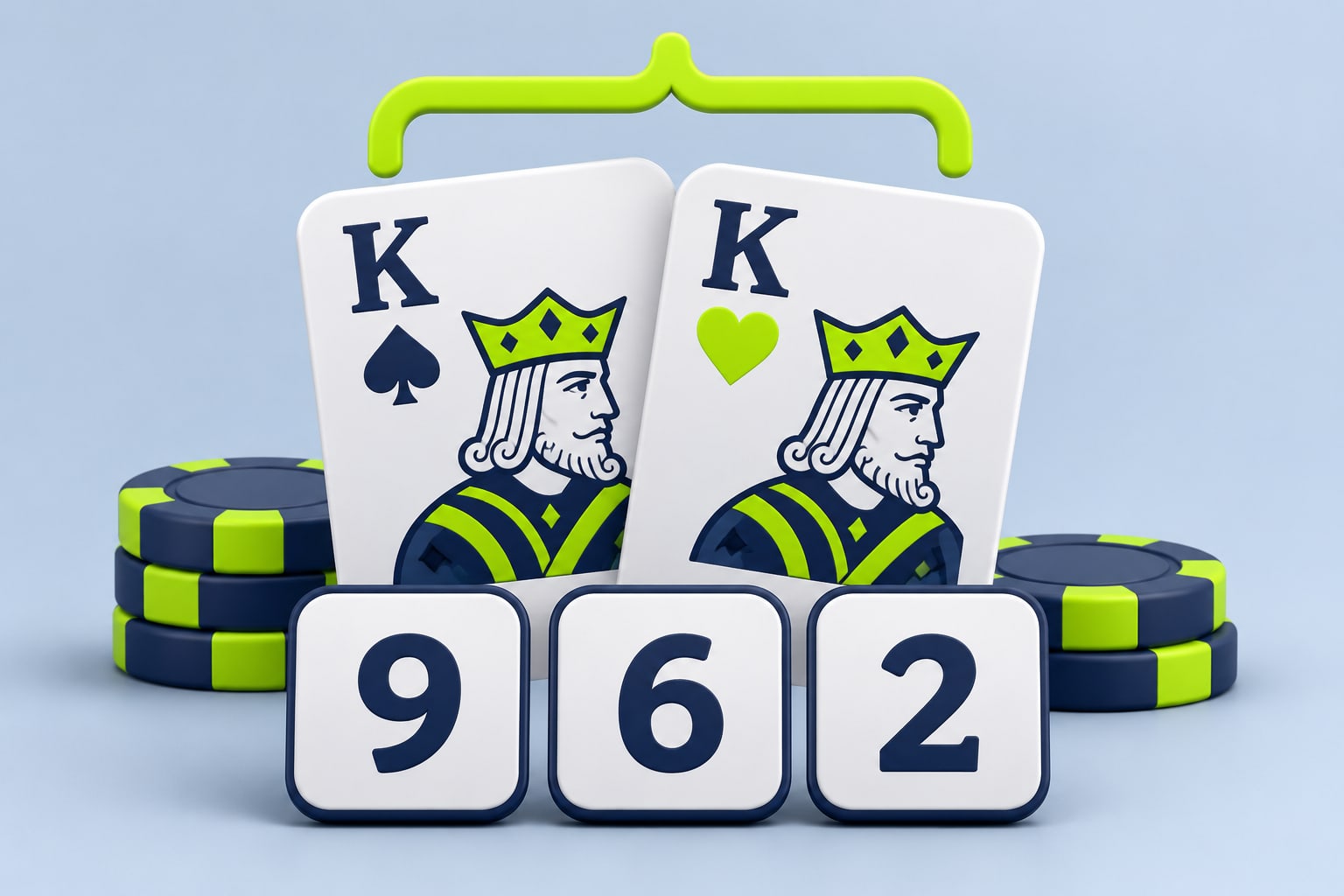
Visual explainer
An overpair is higher than the board
Hold’em example: your private cards remain K♠ K♦ while the community cards develop.
Flop
9♣ 6♥ 2♠
Kings exceed every board rank: your pocket pair is an overpair.
Turn
9♣ 6♥ 2♠ A♣
The ace is higher than a king: your kings are no longer an overpair.
The label describes the relationship to the board. Even on the flop, another player could hold a set or a stronger hand.
An ace on the turn does not by itself prove you are losing. Top pair is different: a private card pairs the highest board rank. Related: Top Pair · Kicker.
A pocket pair above the board
In hold'em, an overpair is a pair in a player's own two cards whose rank exceeds the highest rank on the community board. Two kings on a nine-six-two flop are an overpair. Two eights on that same flop are not, because the nine is higher than the eights. The definition concerns the relationship between a pocket pair and the board. It does not compare the player's cards with an opponent's hidden cards and does not by itself establish who is winning. Another player can have a higher overpair, a set or some other stronger combination while the description remains correct.
How it differs from top pair
Top pair is ordinarily made by matching the highest board rank with one of a player's hole cards. On a nine-six-two flop, a player holding ace-nine has top pair with an ace kicker. A player holding two kings has an overpair instead. Both descriptions involve a pair, but the cards creating it are different. A pocket pair that matches a board card can form three of a kind, commonly called a set when the pocket pair is involved. Describing every strong pair as an overpair loses useful information about the player's actual holding and the ways the board can develop.
The description can change on later streets
Suppose the player with two kings sees an ace on the turn. The kings are no longer an overpair to the board because the board now contains a higher rank. That change does not automatically mean the kings are beaten: an opponent may have no ace or stronger combination. Conversely, the absence of an overcard does not guarantee safety. A low turn card could complete a straight, flush or full house for another player. Reassess the complete board as each card arrives. The label is a convenient snapshot of one relationship, not a permanent assessment attached to the hand from the flop onward.
Board texture matters
An overpair on a disconnected board with several suits faces a different set of plausible opposing hands from an overpair on a coordinated board with several cards of one suit. Connected ranks can support straight draws, while repeated suits can support flush draws. Paired boards create additional possibilities involving trips and full houses. These observations do not produce a universal betting instruction, but they explain why the same pocket kings can require different decisions in different hands. Position, stack sizes, pot size, opponent behaviour and the betting sequence also matter. Hand strength cannot be reduced to whether the pocket pair is above the board's highest card.
Avoid confusing a category with certainty
Players sometimes become attached to an overpair because it began as a strong starting hand. That can make later warnings harder to evaluate. Imagine two kings against two nines on a nine-six-two board: the kings satisfy the overpair definition, but the nines have a set. The example shows why the term must not be interpreted as the best hand. On the other hand, folding every overpair whenever an opponent bets would ignore the possibility of weaker pairs and draws. Decisions require a range of plausible opposing hands and the price being offered, rather than a slogan based on one category.
Recording an overpair hand clearly
A useful hand history includes the pocket pair, all board cards and suits, positions, effective stacks and each betting amount. Saying only that an overpair lost leaves too little information to judge the decisions. Keep the outcome separate from the earlier information: a later bad card does not prove an earlier bet was mistaken, and a lucky win does not prove it was sound. If discussing a variant other than hold'em, state its hand-construction rules as well. The practical purpose of overpair is to describe a specific rank relationship accurately so that the rest of the analysis can begin from a shared understanding.