High card can mean an ace, king, queen or jack in common Jacks or Better strategy language. In poker hand rankings, a high-card hand is a five-card hand with no pair or higher combination.
Two meanings that need context
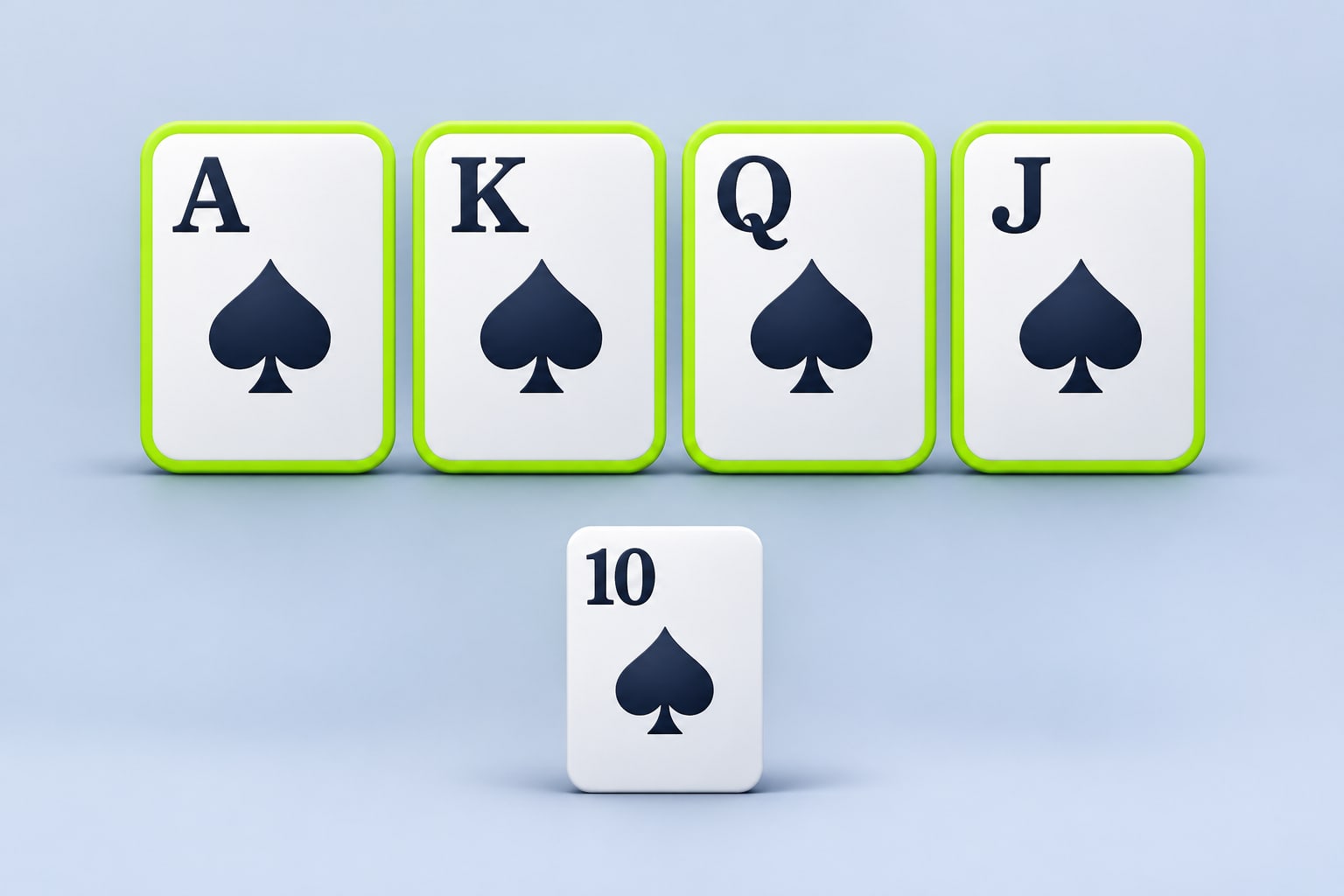
High card has two related but distinct uses. In many Jacks or Better video-poker strategy charts, high cards are jacks, queens, kings and aces because a pair of any of those ranks reaches the lowest ordinary paying pair category. In poker hand rankings, a high-card hand means a hand that has no pair and does not form a straight, flush or stronger combination. The first meaning identifies individual ranks that may be useful to hold. The second classifies a complete five-card hand. Read the surrounding explanation before deciding which meaning applies, especially when a glossary mixes casino games and player-versus-player poker.
Why a ten may be excluded
A ten is valuable in straights and royal flushes, but a pair of tens does not ordinarily pay in Jacks or Better. That is why a chart can exclude tens from its high-card shorthand while still recommending some holds containing a ten. The definition is tied to the game's payout threshold rather than to a universal division of the deck. Tens or Better and other variants may use a different threshold or strategy vocabulary. Wild-card games introduce further distinctions. Always read the chart's legend rather than assuming that the same phrase identifies exactly the same group of ranks across every video-poker game.
A high card is not a paying hand by itself
Holding an ace in ordinary Jacks or Better does not earn a payment merely because an ace is a high card. The final hand must reach a paying category in the displayed schedule. A lone ace may contribute to a possible pair, straight or flush, but those possibilities are still draws. Similarly, a dealt hand containing several high cards can have competing hold choices, especially when suits and consecutive ranks are involved. Do not select cards solely because their ranks look impressive. The expected return of a hold depends on every possible replacement outcome and the amount awarded for each qualifying final hand.
Comparing high-card poker hands
In ordinary high poker, a high-card hand loses to any one-pair hand. When two high-card hands are compared, their highest cards are checked first, followed by the next highest cards as needed. For example, ace-queen-nine-seven-three beats ace-jack-ten-eight-four because the queens and jacks decide the comparison after the tied aces. This assumes neither hand forms a straight or flush. A hand's suit does not normally break an otherwise equal showdown tie. In games using more than five available cards, identify each player's best legal five-card hand before applying the comparison, rather than comparing every card they happen to possess.
High cards, overcards and kickers
An overcard is high relative to another card or board, not necessarily part of the video-poker high-card group. A ten can be an overcard to a board topped by nine. A kicker is a card used to separate otherwise equal ranked hands when it belongs to the best five-card combination. These concepts overlap but are not interchangeable. An ace can be a high card, an overcard and a kicker in different explanations of the same deal. Clarify the relationship being described: a rank threshold, a comparison with the board or a tie-breaking role. Precise language makes hand histories and strategy advice much easier to follow.
Use the definition with the actual rules
Check the game name, paytable and strategy legend before following an instruction to keep one or more high cards. A shortcut for one variant can be inappropriate in another, even if the interface looks similar. When reviewing a decision, record all dealt ranks and suits, not just the highest card. In player-versus-player poker, also record the board and legal hand-construction rules. A high-card label describes the available cards; it does not establish that a bet is profitable or that a future card will improve them. Keep the terminology separate from predictions about luck and from decisions about how much money to risk.