Hold’em usually means Texas hold’em, a poker game in which players use any combination of two private cards and five shared community cards to form their best five-card hand.
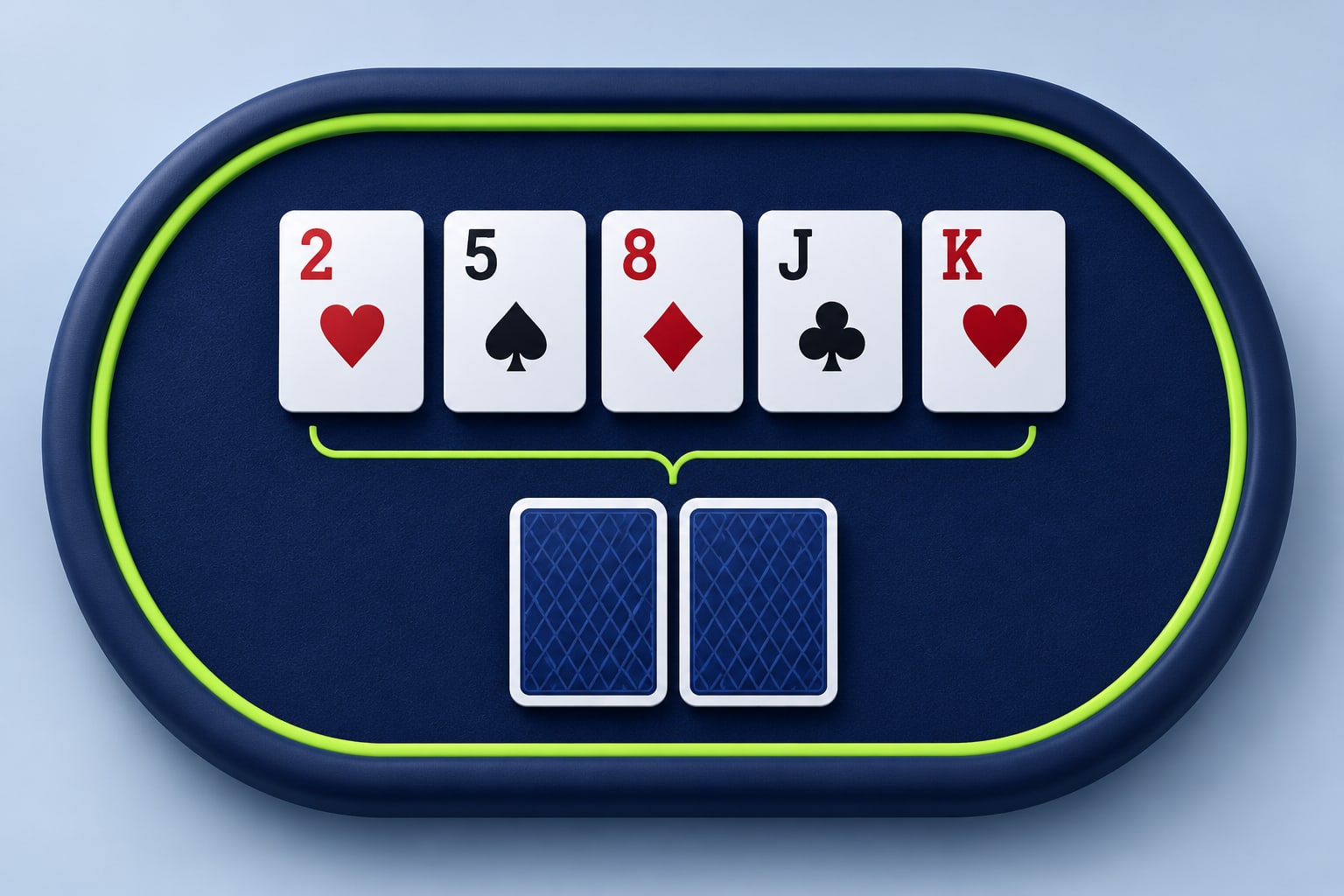
Two private cards and a shared board
In standard Texas hold'em, each player receives two private cards, often called hole cards. Five community cards are then made available in the middle of the table over several stages. Each player forms the best possible five-card poker hand using any combination of the seven available cards: both private cards, one private card or neither. This flexibility is a key distinction from games that require an exact number of private cards. The same community cards belong to every remaining player's possible hand. Having a powerful private pair does not make it automatically superior to combinations another player can form with the shared board.
The sequence of betting rounds
A typical hand begins with forced blinds and a round of betting after the private cards are dealt. The flop reveals three community cards, followed by another betting round. The turn adds the fourth community card and another round; the river adds the fifth and final community card before the last betting round. A hand can end earlier if every opponent folds to the remaining player. When more than one player reaches showdown, the eligible hands are compared under the game's ranking rules. Tournament structures, antes and betting limits can vary, so this general sequence does not specify every forced payment or permitted wager size.
Choosing the best five cards
Suppose your private cards are ace and nine, and the board contains ace, king, queen, jack and ten with no flush available. The board itself makes an ace-high straight. Your nine does not turn that into a six-card straight, because only five cards form the final hand. Another player unable to make a stronger hand also shares that board straight, producing a tie among equally ranked hands. In other situations one or both private cards improve the board. Always construct the complete best five-card combination before comparing holdings; looking only at the two cards in front of each player can produce an incorrect result.
Betting structures change the decisions
No-limit hold'em allows a player to wager their available eligible stack, subject to the table's rules and minimum-raise requirements. Fixed-limit hold'em uses specified bet and raise increments, while pot-limit uses a maximum linked to the pot calculation. These versions share the card sequence but create different decisions about pressure, price and future exposure. Cash games and tournaments also differ in chip value and objectives: a tournament chip is not simply a cash chip that can be redeemed whenever desired. Check the structure before joining a table, including blinds, antes, buy-in, fees and any rules affecting all-in situations or side pots.
Hand strength depends on context
A pair, draw or strong starting hand has meaning only in relation to the board and the hands opponents might hold. Position affects how much information is available before acting, while bet sizes and stack depth affect the cost of continuing. A draw that could improve is not automatically worth calling any price to pursue. Likewise, a made hand can become vulnerable as later community cards arrive. Strategy examples should state their assumptions rather than offering a rule that applies to every table. For learning, review the information available at the time of each decision and separate that from cards revealed only after the action was complete.
Common beginner misunderstandings
You are not required to use both private cards in standard hold'em, suits do not break otherwise equal poker hands, and a winning starting hand is not guaranteed to win at showdown. The dealer button marks position rather than ownership of the pot, and folding gives up your claim to the current pot even if your cards would later have improved. Online interfaces can help display legal actions, but they do not remove the need to understand their cost. Use practice play to learn the sequence, keep real-money stakes within a fixed budget and avoid chasing losses. Clear rules knowledge improves understanding without eliminating uncertainty or financial risk.
Related glossary terms
Sources and further reading
- Synonym:
- Texas Holdem