Bet sizing is the choice of how much to wager within the permitted rules. In poker it concerns the stake relative to the pot, stacks and situation; it does not guarantee that opponents will make mistakes.
Choosing the amount of a wager
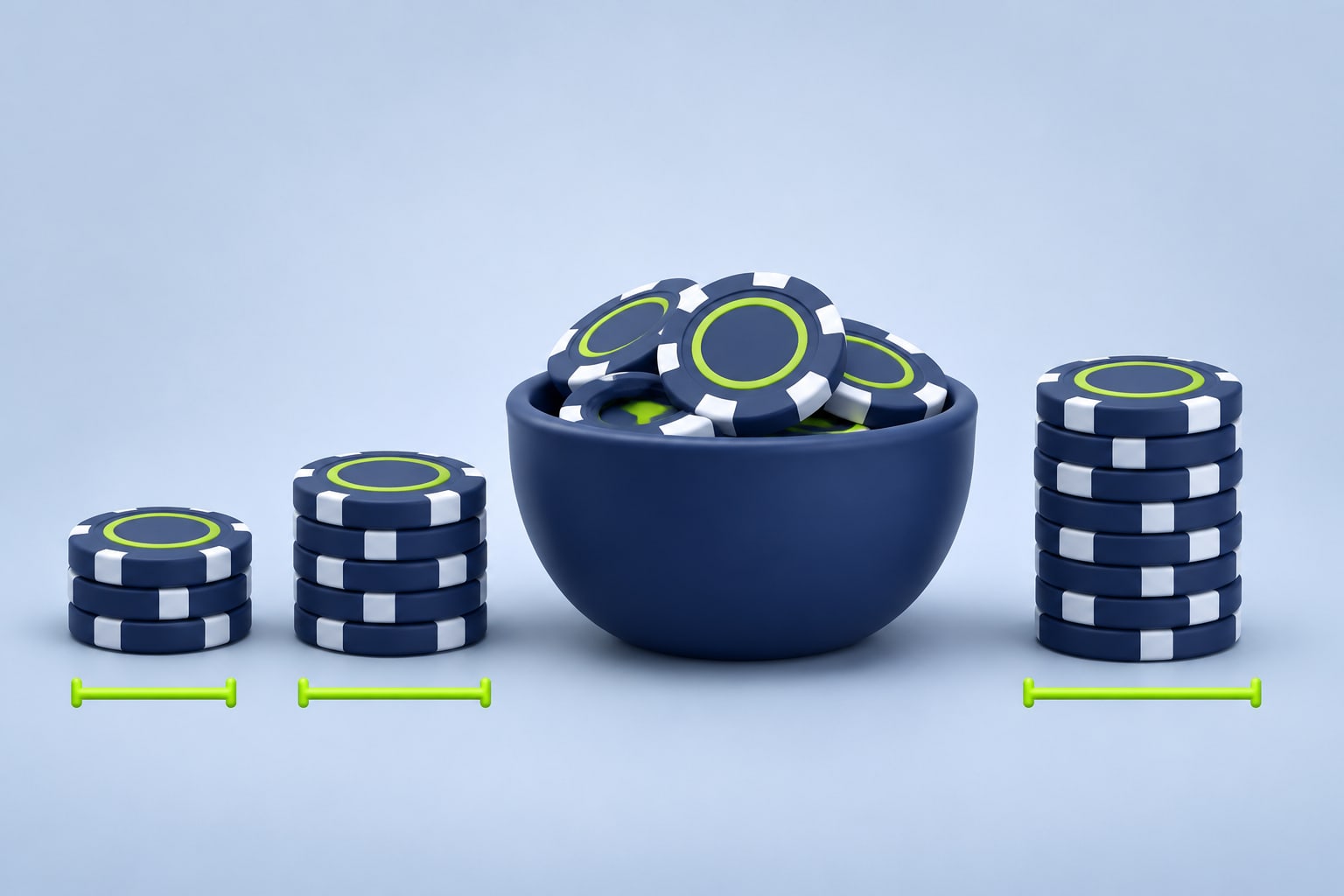
Bet sizing is the decision about how much money or how many chips to put at risk on a particular wager. In poker, the phrase usually means choosing a bet or raise in relation to the pot, available stacks and hand situation. In other casino games it can simply describe the stake selected for the next round. These contexts differ. A poker bet can influence another player's decision, whereas increasing a wager on an unchanged random slot does not persuade the machine to respond differently. The rules determine which amounts are legal before any strategic discussion begins.
Visual explanation
A pot fraction needs a reference point
Illustrative poker pot of $40 before the player bets.
Half-pot bet$20
$40 × 0.5
Three-quarter-pot bet$30
$40 × 0.75
Pot-sized bet$40
$40 × 1
These are size labels, not advice to use a particular bet. Calling, raising and pot-limit calculations can use different reference amounts. See bet.
Measure poker bets relative to the pot
A ten-unit bet can be small in one poker situation and large in another. Into a forty-unit pot it is a quarter-pot bet; into a five-unit pot it is twice the pot. Relative size is therefore more informative than the chip amount alone. The available stack also matters, because an amount that leaves substantial money behind differs from a wager committing all remaining chips. When discussing a raise, clarify whether the quoted amount is the total wager or the extra amount added above the previous bet. Ambiguous wording can make two descriptions of the same action appear inconsistent.
Different sizes offer different prices
Suppose a pot contains one hundred units and a player bets fifty. An opponent who must call fifty would be contesting a final pot of two hundred units after that call, ignoring any rake. In a simplified final-street situation with no further betting, the call needs twenty-five percent equity to break even. A larger bet changes that price. This arithmetic explains one effect of sizing, but it does not reveal the opponent's actual hand or guarantee a fold. Earlier streets introduce possible future betting and changing hands, so a simple immediate-price calculation is only part of the decision.
The purpose and situation matter
Poker bets can seek value from weaker hands, apply pressure through a bluff, or serve other tactical purposes within a broader strategy. A size should be assessed alongside the range of hands being represented, the board, position, effective stacks and the opponent's possible responses. There is no universal amount that always extracts maximum value or always forces an error. Even a well-reasoned wager can receive an unexpected call or lose at showdown. Describing bet sizing merely as an amount that disadvantages opponents misses the central point: it is a choice under uncertainty whose merit depends on the information and assumptions available.
Rules constrain the available sizes
Fixed-limit games prescribe the betting increments, pot-limit games restrict the maximum according to their pot-limit rules, and no-limit games allow a wider range up to the available stack subject to minimum-bet and raise rules. Those labels do not mean that every amount is legal in every situation. Table stakes, prior action and all-in exceptions can affect the available options. An online interface may calculate permitted amounts, but the player still needs to understand what the displayed number means. A slider or preset percentage is an input tool, not an assurance that its suggested size is strategically appropriate.
Keep affordability separate from tactics
A technically plausible poker size can still be unsuitable if the money at risk is unaffordable. Set financial boundaries outside the hand and avoid increasing stakes simply to recover earlier losses. In casino games with an unchanged house advantage, a progression that changes stake sizes does not remove the underlying expected disadvantage. Larger wagers magnify the amounts that can be won or lost, while a fixed bankroll can be depleted more quickly by larger losses. Bet sizing is useful vocabulary for describing exposure and poker decisions. It should not be presented as a guaranteed method for controlling opponents, overcoming chance or securing a profitable session. The amount remains a real financial exposure.
Related glossary terms
Sources and further reading
- See also:
- Playing Strategy