A straight draw is an incomplete poker sequence that can become a five-card straight with further cards. Open-ended and inside draws require different completing ranks, and making the straight does not guarantee winning.
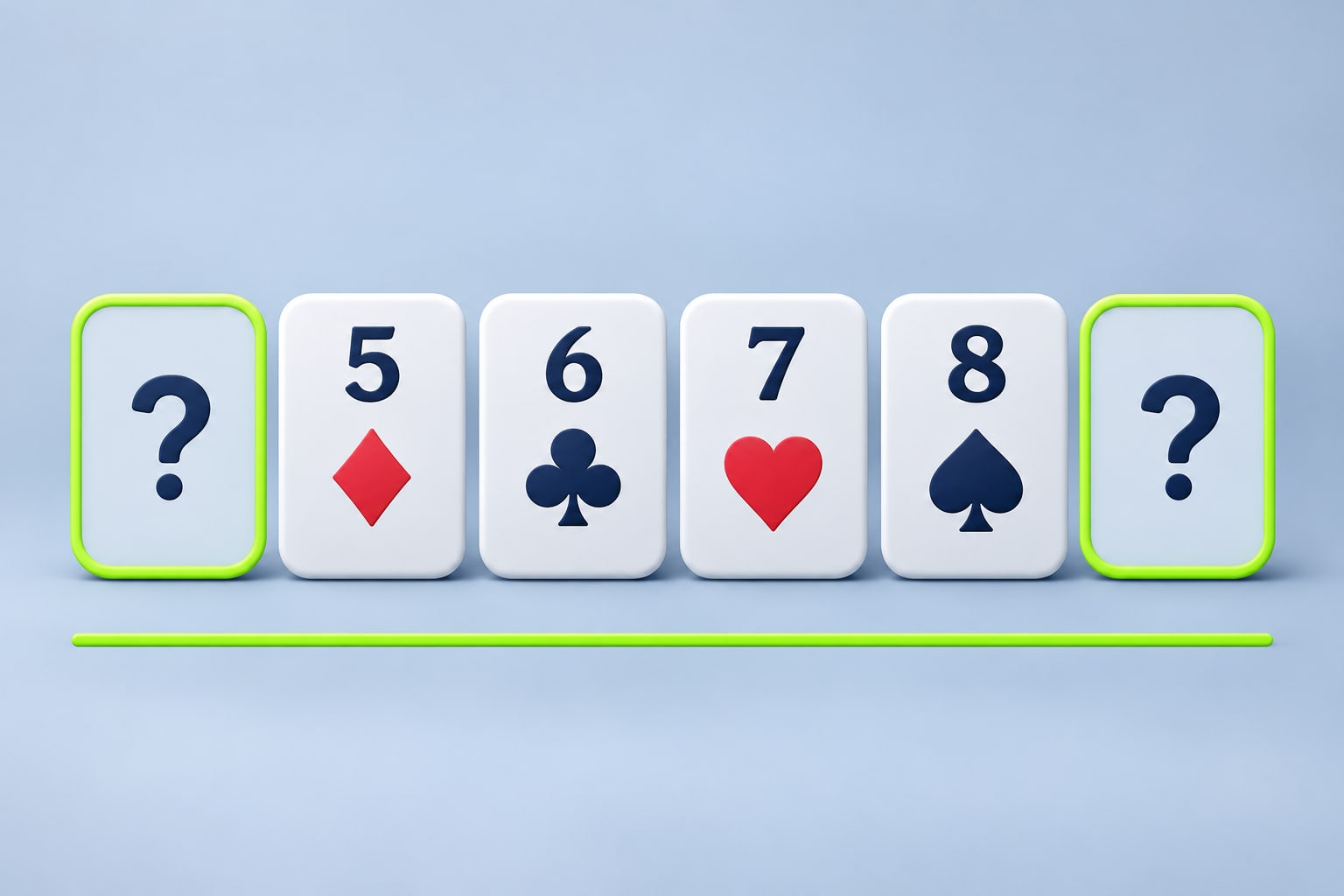
Poker draw comparison
Two ends or one missing middle rank?
These are incomplete sequences. The counts below assume a standard deck and no completing cards already known elsewhere.
Open-ended: 5–6–7–8
Completing ranks: 4 or 9. Up to eight cards across those two ranks.
Inside: 5–6–8–9
Completing rank: 7 only. Up to four cards of that rank.
These are potential completions, not guaranteed winning outs. Known cards, game rules and an opponent’s possible stronger hand affect the situation. Explore: Straight · Turn · River.
A possible hand rather than a made hand
A straight draw is a set of cards that can become a five-card sequence if suitable additional cards arrive. It is not yet a completed straight. The phrase can describe a draw in community-card poker or a hold being considered in draw poker and video poker, but the number of available replacement cards and the decision rules differ. Identify the game and stage before counting possibilities. Four useful ranks alone do not always establish the same draw: an ace near the end of the ranking, a gap in the middle or a requirement to use specific hole cards can change which completions are legal.
Open-ended draws
An open-ended straight draw has four consecutive ranks that can be completed at either end. With 5, 6, 7 and 8, a four makes 4–8 and a nine makes 5–9. In a standard 52-card deck with none of those completing cards otherwise known, there are four fours and four nines, giving eight potential completion cards. The familiar example K, Q, J, 10 can be completed by a nine or an ace. However, A, 2, 3, 4 is not open at both ends in ordinary high poker; it needs a five because a king cannot wrap around below the ace. Rank boundaries matter.
Inside draws and multiple gaps
An inside straight draw, also called a gutshot, needs a missing interior rank. The ranks 5, 6, 8 and 9 need a seven to form 5–9. If all four sevens are unseen and usable, there are four potential completing cards. Some larger sets of available cards create two separate inside routes, often called a double gutshot, so not every draw fits a simple four-versus-eight comparison. Count distinct cards rather than adding labels together. If one card completes more than one useful feature, it remains one card in the deck. A draw involving a flush as well as a straight therefore needs careful counting to avoid duplicating shared completion cards.
From cards to probabilities
In a simplified Hold'em flop situation, a player knows five cards: two hole cards and three community cards. With eight usable unseen completion cards among 47 unseen cards, the chance of completing on the next card is 8/47, about 17%. This calculation applies to the next card only. Seeing both the turn and river requires a different calculation and may involve further betting before the second card is available. Known dead cards, different deck sizes or a changing set of useful outcomes alter the arithmetic. Do not use a two-card completion percentage to justify a price that buys only one card without accounting for that difference.
Completion is not the same as victory
A card that makes a straight may also give an opponent a higher straight, complete a flush or leave a stronger made hand already ahead. Such possibilities are why apparent outs need evaluation rather than automatic counting as winning cards. In Omaha, exactly two hole cards and three board cards must form the final hand, so a visually attractive sequence can be unusable if it violates that rule. A draw can also share its final straight with another player, producing a tie rather than a sole win. Distinguish the chance of forming the category from the chance of winning the relevant pot after all legal comparisons.
Deciding what the draw is worth
A poker decision involves the price of continuing, the pot available, possible later action and the strength of opposing hands, not merely the draw's name. In video poker, the relevant comparison is expected return from alternative holds under the exact paytable; there is no opponent's pot to win. These are different problems even when the same four ranks appear. Record the actual cards and rules when reviewing a decision. A straight draw can be promising without making a call or discard automatically correct. Understanding its structure helps evaluate the possibilities, while a sensible spending limit remains necessary regardless of how many cards might improve the hand.