An inside straight draw, or gutshot, is a four-card sequence that needs a missing rank within the sequence to become a straight; one-gapper is another descriptive name for this gap.
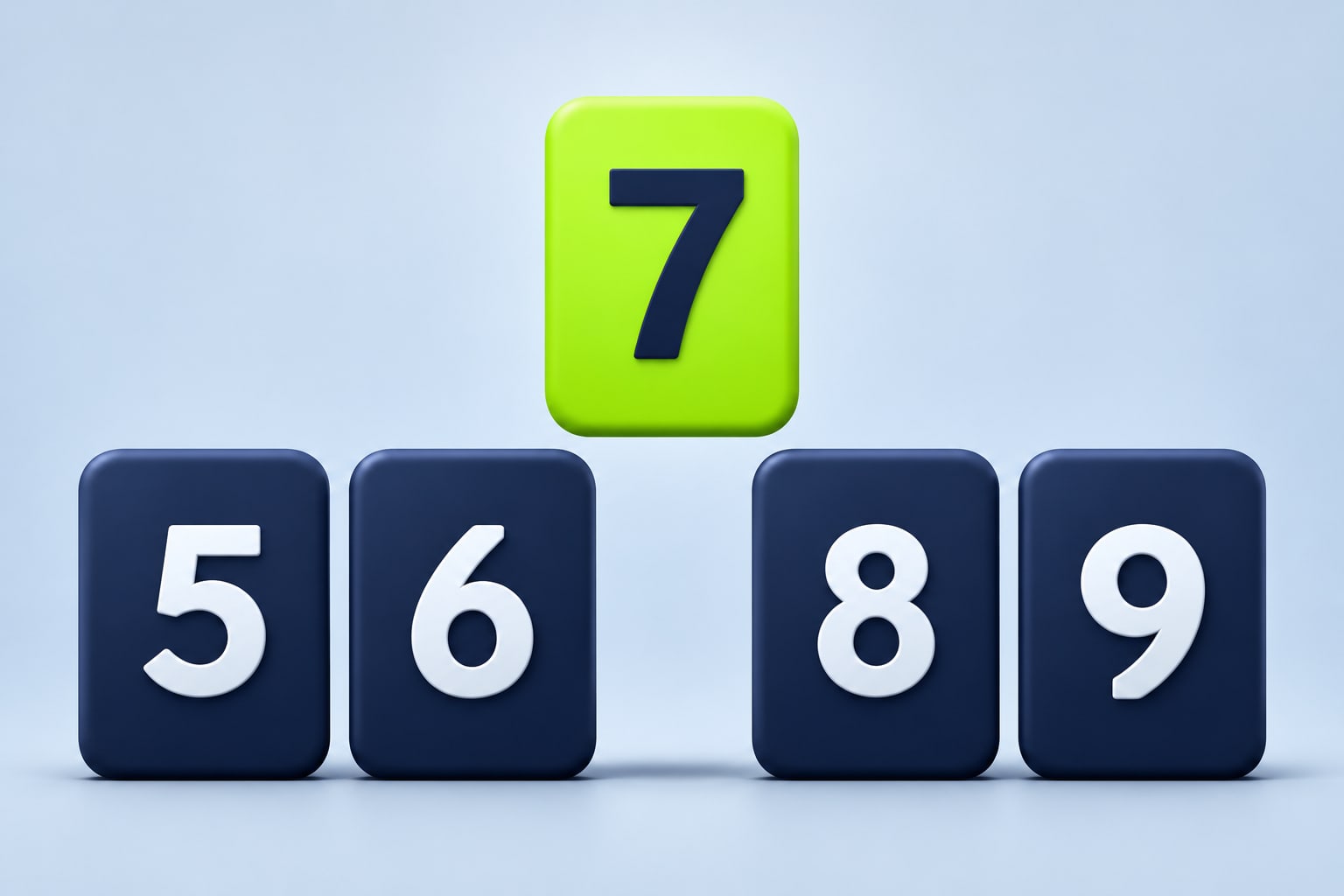
Visual explainer
A gutshot has a missing rank inside the sequence
Standard single-deck video poker example: hold 5, 6, 8 and 9; discard one unrelated card; draw one replacement.
Completing cards
4 sevens
Assume all four remain among the undealt cards.
Available draw cards
47
52 cards minus the five originally dealt.
Completion chance
8.51%
4 ÷ 47 ≈ 0.0851.
This is the chance of completing the stated straight in this one-card draw. It is not the chance of winning every poker game or a recommendation for the best hold.
Paytables, other possible awards and wild cards can change the decision and the calculation. Related: Straight Draw · Video Poker.
Recognizing the missing middle card
The ranks five, six, eight and nine contain an inside gap: a seven completes five through nine. In an ordinary 52-card deck, four sevens exist, one in each suit. That gives the basic draw four potential completing cards before accounting for cards already seen or unavailable. The phrase describes an unfinished straight, not a made hand. Until the missing card arrives, the player's actual holding might be high card, a pair or another combination. The existing glossary title includes One-Grapper, an uncommon spelling; one-gapper and gutshot are the more recognizable expressions for a sequence with this kind of gap.
Inside and open-ended draws
With five, six, seven and eight, either a four or a nine can complete a straight. That is an open-ended draw rather than the ordinary inside draw. The distinction concerns available ranks, not whether the cards are arranged attractively on screen. Aces require special care because they can be low in ace through five or high in ten through ace, but cannot connect king to two in a wrapping straight. Count the actual legal completions instead of assuming every group of four ranks has eight outs. Some more complex combinations create two separate inside completions and need to be counted on their own.
A video poker probability example
Suppose a standard single-deck video poker hand contains five, six, eight and nine plus an unrelated card, and you hold the four straight cards. There are 47 undealt cards available for the one-card draw. If all four sevens remain available, the chance of completing that straight is 4 divided by 47, approximately 8.51%. This calculation is specific to the stated deal and draw. It is not the probability that a general casino poker hand will win, and it does not include other payouts or alternative holds. A wild-card game can have different completing cards and requires a different count.
An out is not always a clean winner
In a shared-board poker game, completing a straight does not necessarily win the pot. The completing card might also give an opponent a flush, or the board might allow a higher straight. An opponent can already hold a stronger hand as well. These possibilities distinguish a card that improves your hand from a clean winning out. Hidden cards also mean the denominator differs from a video poker draw where the relevant five-card starting hand is known. State the game, the board, the cards in hand and the number of cards still to come before using a quoted percentage.
Whether drawing is worthwhile
A draw's chance of success is only part of the decision. In poker, the price of continuing, the existing pot, later betting and possible losses after improvement all matter. In video poker, compare the expected return of holding the draw with other available holds using the exact paytable. A pair or a suited high-card combination can be more valuable than an apparent route to a straight. The fact that a draw can succeed does not make it the best choice. Nor does a missed draw prove that the decision was wrong: evaluate the information available when the choice was made.
Reading the term in game advice
A useful explanation names the missing rank and shows the cards. For example, needs a seven is clearer than simply calling a hand close to a straight. Check whether an article means four cards of any suits or four cards in one suit, because a straight-flush draw has additional possible value. Also check whether the advice assumes ordinary high-hand rankings; lowball variants use different goals. The nickname is a quick way to describe the shape of a hand. It does not justify chasing losses, increasing a bet or treating a needed card as overdue after previous failed draws.
Four possible cards of one rank are different from four missing ranks; keep those two counts separate.