A straight is a five-card poker hand with consecutive ranks. In standard high poker it ranks below a flush and above three of a kind; a same-suit sequence is a straight flush.
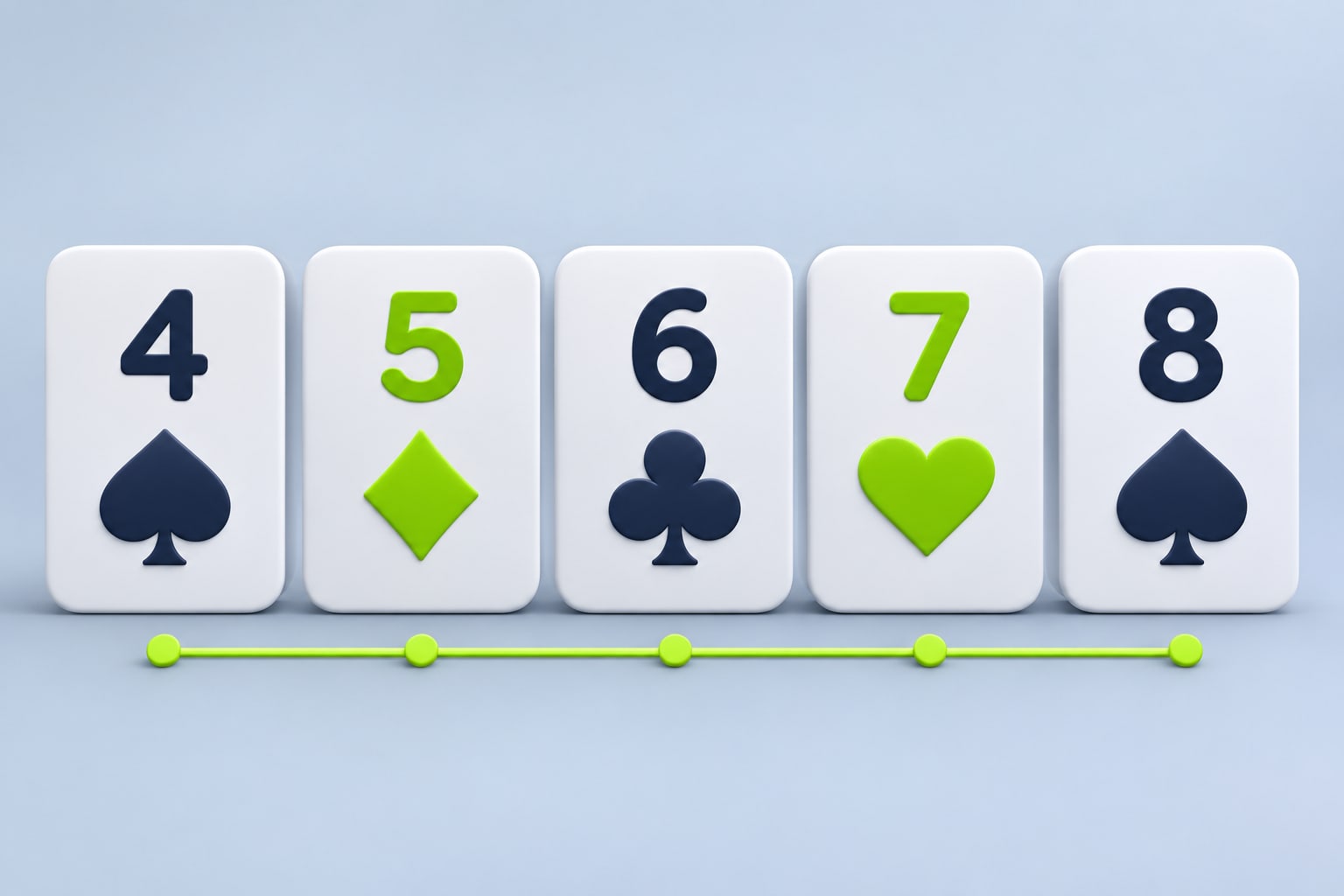
Standard high-poker hands
A straight needs five consecutive ranks
The same five cards must form one legal sequence. Suits can be mixed.
Ace can be low
A five-high straight. The ace counts below 2.
Ace can be high
An ace-high straight. The ace counts above K.
Q–K–A–2–3 does not wrap into a straight. If all five consecutive cards share a suit, the hand is a straight flush. Explore: Straight Flush · Straight Draw.
Five consecutive ranks
A straight consists of five cards in consecutive rank order, such as 4, 5, 6, 7 and 8. The suits can be mixed. If all five cards also share one suit, the hand belongs to the stronger straight-flush category under standard high-poker rankings. A pair is not needed, and repeating a rank does not help complete the sequence. For example, 4, 5, 6, 7, 7 contains only four distinct ranks in sequence and is not a straight. The definition concerns the final five-card hand being evaluated. In games offering more available cards, the rules determine which five can legally be selected.
Where aces fit
An ace can complete the high end of 10, J, Q, K, A or the low end of A, 2, 3, 4, 5 in standard high poker. The latter is called a wheel or five-high straight. An ace does not normally connect the top and bottom of the ranking in a circular sequence: Q, K, A, 2, 3 is not a straight. The wheel's highest card for comparison is five, despite containing an ace. This distinction prevents a common mistake when two straights meet. Variant rules can differ, so a special deck or unusual game needs its own ranking instructions rather than an assumption based on ordinary Hold'em.
Comparing two straights
Under standard rankings, the straight with the higher top card wins. A nine-high straight beats an eight-high straight regardless of the suits used. Two players with the same ranked sequence have equal straights; an unused sixth card does not act as a kicker to break that tie. For example, one player making 5, 6, 7, 8, 9 and another making the same sequence cannot claim victory merely by holding an ace outside the selected five cards. In a shared-pot game, tied best hands generally divide the relevant pot, subject to normal allocation rules. Separate side pots can still produce different distributions among eligible players.
Using community cards correctly
In Texas Hold'em, the best five-card hand can use zero, one or two hole cards. A straight already on the board can therefore be available to everyone still contesting the pot, although a player may have a higher straight or stronger category. Omaha requires exactly two hole cards and exactly three community cards. A board that appears to show a straight does not automatically give every Omaha player that hand. This is a construction rule, not a change in the definition of a straight. Before comparing ranks, first confirm that each player can legally form the claimed five-card combination using the cards permitted by that particular variant.
A straight draw is unfinished
Four cards arranged near a sequence are a draw rather than a made straight. An open-ended draw can be completed at either end, while an inside draw needs a missing interior rank. For a simplified example, 5, 6, 7 and 8 can be extended by a four or a nine; 5, 6, 8 and 9 need a seven. Actual poker decisions require more than counting those ranks. Some cards may be visible, some apparent completions may also improve an opponent, and the price of continuing matters. Making a straight is not necessarily the same as making the winning hand. Keep completion probability separate from the probability of winning the pot.
Poker ranking versus machine payout
In conventional high poker, a straight beats three of a kind and loses to a flush. Video poker uses the same familiar category in many variants, but the amount paid for it comes from the machine's paytable. A casino table-poker side bet can use another payout schedule entirely. Do not transfer a video-poker credit award into a live poker pot calculation or assume every straight receives a bonus. Identify whether the question is hand ranking, a draw decision or a fixed payout. That distinction makes the term useful across games while avoiding claims that a strong-looking sequence must produce a profit in the round being played.