A four-card straight is an incomplete poker straight: four cards that could combine with another suitable rank to form five in sequence. The available completing ranks depend on whether the draw is open-ended, inside or restricted by an ace.
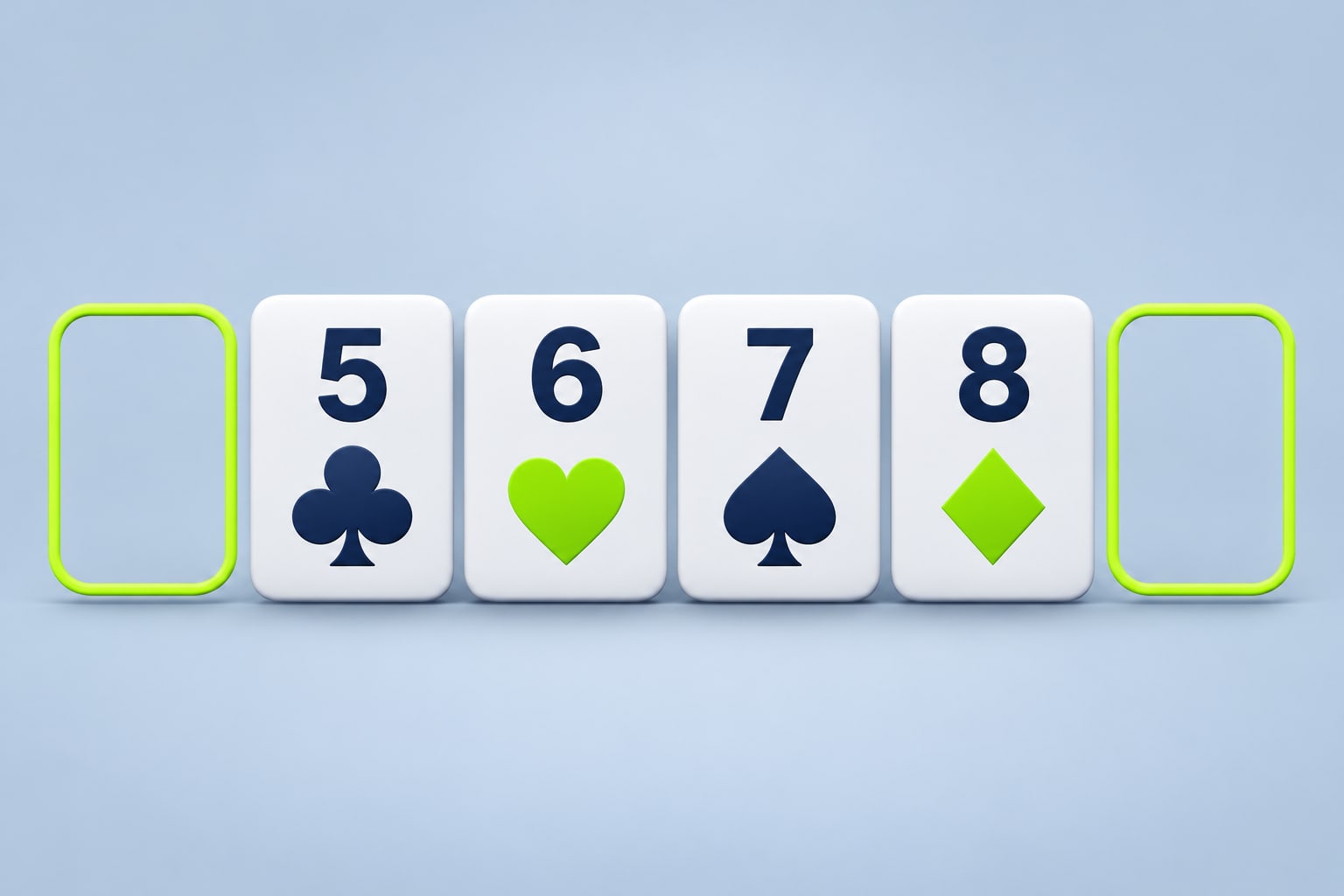
Visual explainer
The gap changes the number of completing cards
Compare two alternative standard-deck draws. In each, four cards are held and an unrelated king is discarded.
Open-ended: 5, 6, 7, 8
Inside: 5, 6, 8, 9
These counts assume all completing cards remain available. A–2–3–4 needs a five only: aces do not wrap around from king to two.
Completion counts do not rank the holds against every other option or guarantee a winning poker hand. Related: Belly Buster · Outside Straight or Straight Flush.
Four cards describe a draw, not a made straight
A four-card straight is shorthand for four cards that can become a five-card straight when a suitable additional rank is obtained. Under ordinary five-card high-poker rankings, four connected cards alone are not a completed straight and do not receive the straight's ranking. The phrase is most useful when discussing drawing hands in video poker or possible improvements in poker. List the ranks to make the meaning precise. A hand containing five, six, seven and eight has different completion possibilities from one containing five, six, eight and nine. Both are incomplete, but the missing-rank structure matters.
An open-ended example has two completing ranks
The ranks five, six, seven and eight can form a straight with either a four or a nine. This is an open-ended draw because a card can extend the sequence at either end. In a standard deck there are four cards of each rank, so eight cards could complete that sequence if all fours and nines remain available. This count is conditional, not automatic knowledge about an opponent's cards. Suits do not need to match for an ordinary straight. If all four held cards share a suit, some completions may also form a straight flush, a separate and stronger category.
An inside draw has a gap to fill
Five, six, eight and nine require a seven to form the straight five through nine. There is only one completing rank in this example, so there are four possible completing cards in a full standard deck before accounting for known cards. This structure is commonly called an inside straight draw or gutshot. Jack, ten, eight and seven similarly require a nine. Do not count both ends simply because the four cards span a short range. Write the intended five-rank sequence and identify the missing positions. That simple check prevents confusing an inside draw with an open-ended one.
Aces need special care
In standard high poker, an ace can be low in ace-two-three-four-five or high in ten-jack-queen-king-ace. It does not wrap around to connect king-ace-two-three-four. Consequently, ace-two-three-four has only five as its completing rank, while jack-queen-king-ace needs ten. These edge-of-ranking examples do not have the same two-ended completion structure as five-six-seven-eight. Poker variants can use different hand rankings, so establish the rules before transferring a calculation. Also remember that repeated ranks do not fill separate positions in a straight: two sevens still supply the rank seven only once when constructing the sequence.
The chance depends on the actual drawing situation
Consider a hypothetical five-card video poker deal of five of clubs, six of hearts, seven of spades, eight of diamonds and king of clubs. If you hold the four connected cards and replace only the king, forty-seven unseen cards remain. With every four and nine still available, eight of those forty-seven complete a straight. Replacing the seven with nine would create an inside draw needing a seven, giving four completing cards out of forty-seven under comparable assumptions. These are one-card draw calculations. A hold'em flop with two community cards still to come requires a different calculation and can involve additional winning or losing possibilities.
A drawing label does not dictate the best play
In video poker, the best hold depends on the complete paytable and all five dealt cards, including competing pairs, flush possibilities and high-card awards. In poker against other players, the price of continuing and whether a completed straight would actually win also matter. A possible straight is not necessarily the best possible straight, and a board can permit a flush or full house. Use the phrase four-card straight to describe the structure, then analyse the relevant game separately. For a hand history, record which cards are private, which are shared and how many draws remain before estimating a completion chance. It neither guarantees a payout nor justifies increasing the stake to recover money already lost during the session.