A straight flush is a five-card poker hand whose cards are consecutive in rank and all of the same suit. A royal flush is the highest straight flush; ranking and payout should still be checked against the game’s rules.
Standard high-poker recognition
Sequence and suit must match together
A straight flush requires the same five cards to be consecutive and all one suit.
Straight flush
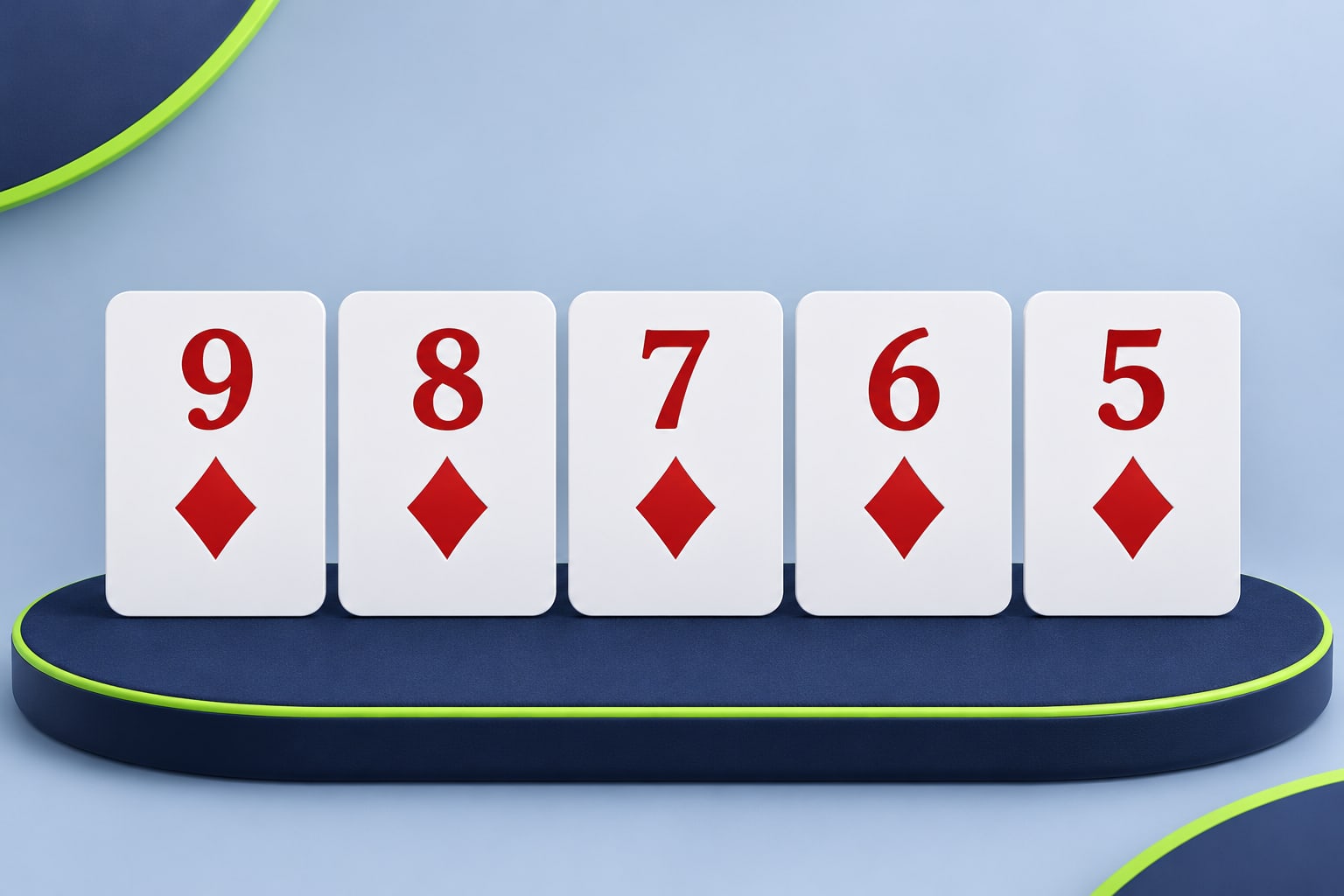
Five consecutive ranks, all diamonds: nine-high straight flush.
Straight only
The ranks still run 5–9, but the club breaks the single-suit condition.
A royal flush is the ace-high straight flush. Poker strength and a casino game’s payout are separate questions. Explore: Straight · Flush · Paytable.
Both a sequence and one suit
A straight flush combines two conditions in the same five cards: consecutive ranks and a single suit. Nine, eight, seven, six and five of diamonds form a nine-high straight flush. Five diamonds with gaps in their ranks form a flush but not a straight flush, while consecutive ranks in mixed suits form a straight but not a flush. The word combination is important when more than five cards are available. It is not enough to find a straight somewhere among seven cards and a flush in a different overlapping group; one legal five-card hand must satisfy both conditions together.
How the ace can be used
Under ordinary high-poker rules, an ace can be high in ace, king, queen, jack, ten, or low in five, four, three, two, ace. When all five cards share a suit, the first is a royal flush and the second is a five-high straight flush. The ace does not normally wrap a sequence through the middle, so queen, king, ace, two, three of one suit is not a straight flush under those rules. Some casino variants use special ranking or wild-card provisions, so identify the actual game before applying a familiar chart without checking its exceptions.
Comparing two straight flushes
In standard high poker, the highest card in the sequence determines which straight flush is stronger. A ten-high straight flush beats a nine-high straight flush, and the ace-low version counts as five-high. Suits normally do not break an otherwise equal hand at showdown in games such as Texas hold'em. If players have the same best five-card straight flush, the relevant pot is shared according to the game's rules. A sixth or seventh card does not become an extra kicker for this comparison. The complete five-card sequence already determines the hand's rank. For example, nine through five beats eight through four, even when the lower sequence uses spades.
Use only cards permitted by the variant
In Texas hold'em, the best five-card hand can use the available private and community cards according to hold'em rules, including a complete hand on the board. Other variants impose different requirements on the number of private and shared cards used. A tempting run of suited cards visible across the table is not enough unless it forms a legal hand for that player. This distinction prevents a common mistake when moving between games with similar-looking community-card layouts. First identify which cards may be combined, then check their ranks and suits, and only then compare the resulting hand with other eligible hands.
Poker ranking and casino payout are separate
A straight flush is a very strong hand under ordinary high-poker rankings, but its financial result depends on the game. In poker against other players, the pot depends on the betting and any split or side-pot rules. In video poker, the displayed paytable sets the award, and a royal flush is commonly listed separately from other straight flushes. A casino table-game side bet may use yet another schedule. Do not transfer a payout multiple from one product to another simply because the hand has the same name. Ranking describes strength; a paytable or pot structure determines the amount received.
A draw is not a completed straight flush
Four suited cards in a useful sequence can be described as a straight-flush draw, but they are not already a straight flush. The missing card still has to arrive under the game's dealing rules. Whether retaining or pursuing that draw is the best decision depends on the variant, available alternatives and applicable payout or pot information. A visually attractive possibility is not a guaranteed result. Record the completed hand separately from the draw that preceded it, and avoid increasing a later stake merely because an earlier attempt came close. The definition concerns five actual qualifying cards, not the promise of a rare future award.