To fill a poker hand is to obtain the card or cards needed to complete a drawing combination. “Fill up” commonly refers specifically to making a full house; completing a draw does not guarantee that it wins.
Visual explainer
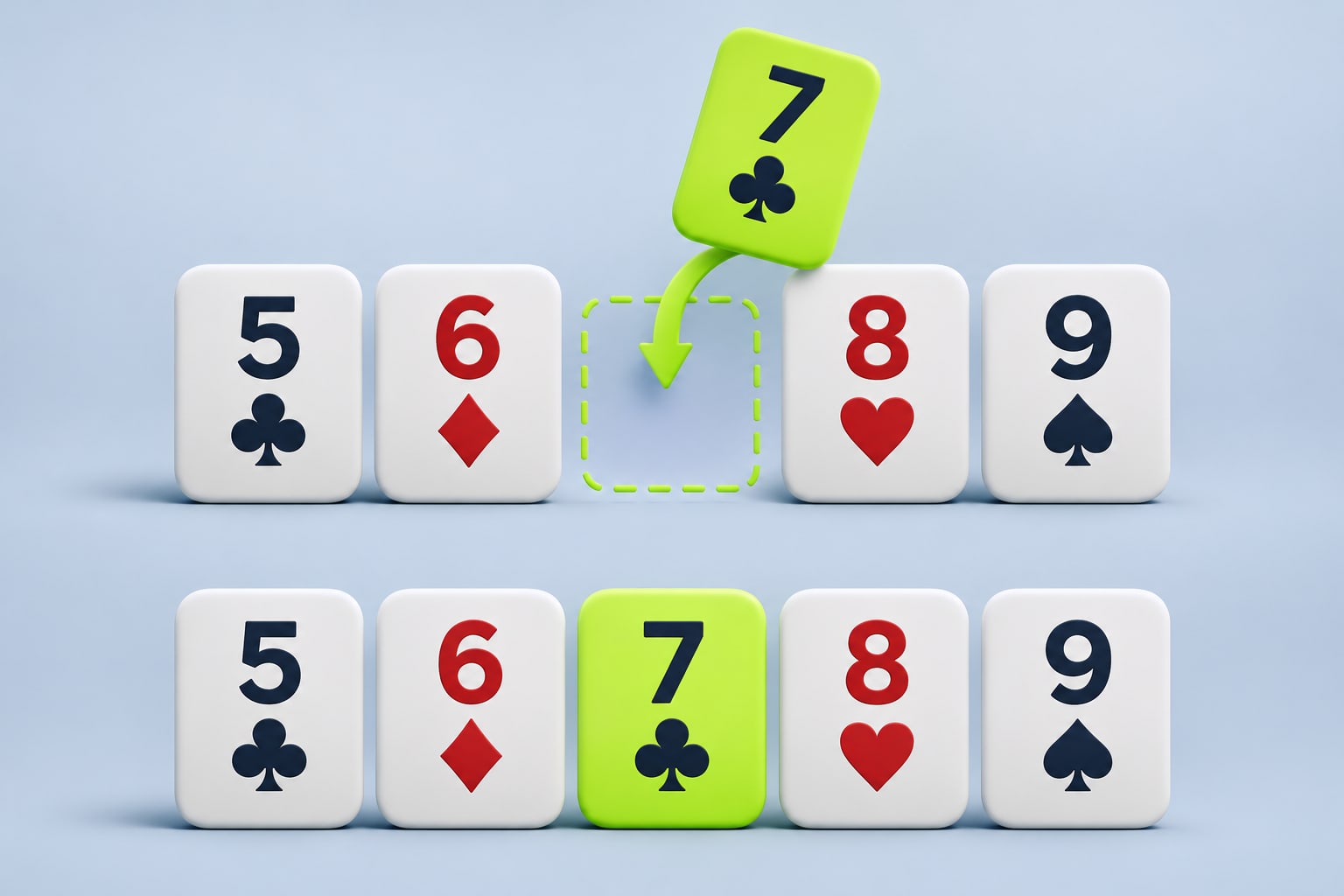
Filling the gap completes a straight
Illustrative rank pattern under ordinary high-poker rules; suits do not form a flush.
1 · Four ranks available
2 · A seven arrives
3 · Completed pattern
A king would leave this gap unfilled. Completing the straight does not guarantee victory against a higher straight or a stronger hand category.
This describes a pattern becoming complete, not a recommendation to pay for a draw. Related: Four Card Inside Straight · Straight.
Completing a drawing combination
To fill a hand in poker is to obtain a missing card or cards that complete the combination being pursued. A player might fill a straight by receiving the missing rank or fill a flush by receiving another card of the required suit. The phrase describes an improvement relative to the earlier cards. It does not, by itself, specify the final category or establish that the hand wins. In a hand history, say what was filled and on which card. That makes the account clearer than saying a player filled when the reader does not know the original draw.
A straight example makes the meaning visible
Suppose a player has the ranks five, six, eight and nine available and then receives a seven. The seven fills the internal gap, making the sequence five through nine. Before that card arrived, the four ranks did not constitute a completed straight under ordinary five-card high-poker rules. If the player instead received a king, the specific gap would remain. The example explains the verb without implying that calling a bet to chase the seven was necessarily profitable. The cost of continuing and the chance of winning after completion are separate questions from whether the card successfully filled the draw.
Fill up often means a full house
In common poker usage, fill up refers more specifically to completing a full house. For example, a player with three sevens can fill up if the available cards also provide a pair of kings, producing sevens full of kings. The exact construction must still be valid for the poker variant being played. A board pair can help one player make a full house while creating a different result for someone else. State the three-of-a-kind rank and the pair rank when comparing full houses. Saying that both players filled up does not establish a tie or identify which full house is higher.
The completed draw may still be beaten
A made straight can lose to a higher straight or a stronger category. A flush can lose to a higher flush, and a full house can lose to a higher full house or four of a kind. The board and opponents' eligible cards determine which possibilities matter. Consequently, a card can fill the intended draw without being a clean winning card. In community-card poker, the same new card is available to other players and can improve them as well. Separate the event of completing your own combination from the event of winning the pot when estimating what a future card would accomplish.
Video poker uses a paytable rather than an opponent
In video poker, filling a draw normally leads to a payment determined by the game's paytable, provided the final category qualifies. There is no opposing poker hand to beat in the standard single-player format. However, the correct hold still depends on all available alternatives and their expected returns. A completed low-paying draw does not prove that the original decision was best, just as missing a high-value draw does not prove that it was wrong. For a hypothetical one-card draw, count the eligible replacement cards in the actual remaining deck and use the correct award for each possible final category.
Keep description separate from prediction
A report that a player filled on the river describes a past result; a statement that they will fill is a prediction that may be wrong. Missing several earlier draws does not make the next one owed to the player. Likewise, increasing the stake after a miss does not improve the probability of the required rank appearing in an independent fresh deal. Use the term as a concise account of how a hand developed. For an explanation, retain the starting cards, the new card and the final valid combination. Those details show what changed without turning ordinary poker slang into a promise of future success.