A gutshot is an inside straight draw needing one specific rank to complete a straight. In a standard deck that rank has up to four cards, but not every apparent completion card necessarily makes the winning hand.
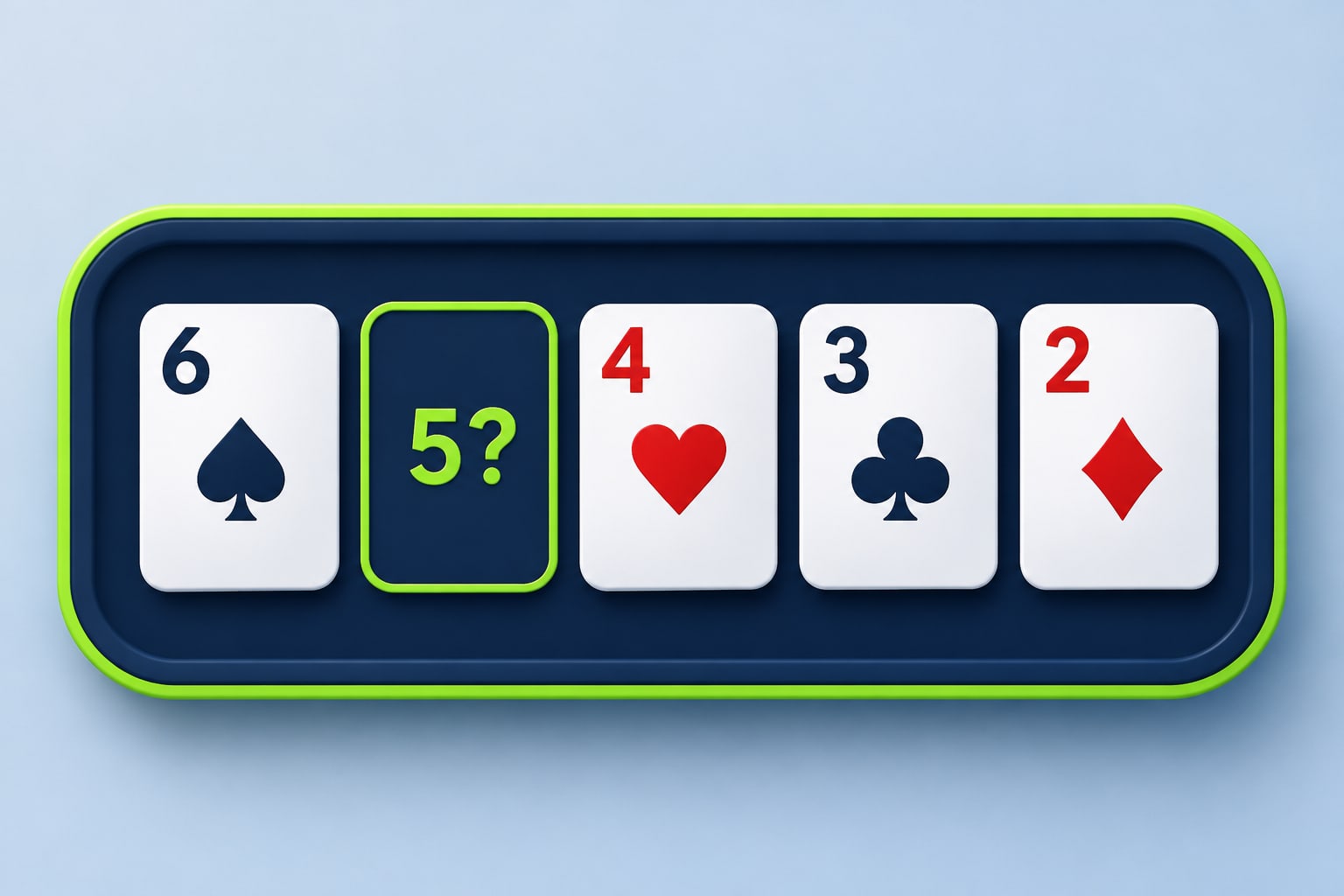
Visual explainer
A gutshot needs the missing inside rank
Hold’em example: your two cards are 6♠ and 4♦. The flop is 3♣, 2♥ and K♠. A five on the turn completes a six-high straight.
Completion rank
Any five
Up to four fives can fill this inside gap in a standard deck.
Known cards
5 of 52
Two private cards plus three flop cards leave 47 unseen cards, with no other exposed cards known.
Next-card chance
4 / 47 ≈ 8.51%
Assuming all four fives remain possible, this is the chance of a five on the turn.
The K on the flop is outside this straight. A seven on the turn does not fill the gap between four and six.
This counts straight completion on one next card, not the chance of winning the pot or of completing the draw across both turn and river. Related: Draw · Straight.
The missing rank is inside the sequence
A gutshot is a poker draw to a straight with a gap inside the required sequence. For example, six, four, three and two need a five to make six, five, four, three, two. The missing rank is specific: adding a seven does not complete that straight. Gutshot is also called an inside straight draw or belly-buster in informal poker language. It describes a potential improvement, not a completed straight. The exact cards that may be used still depend on the variant, so the apparent sequence must be checked against the game's rules for combining private and community cards.
One rank can mean several possible cards
A standard single deck contains four fives, one in each suit. In the example, any available five can complete the rank sequence, so a simple gutshot is often described as having four outs. An out is a card that improves the hand in the relevant way. That shorthand assumes all four cards remain possible from the player's information. Known exposed or discarded cards can change the count. A game using a modified deck, wild cards or special hand-construction rules may require a different calculation. Do not turn the phrase four outs into a universal rule without checking the underlying card set and situation.
An illustrative one-card calculation
Suppose a hold'em player knows five cards on the flop and assumes four suitable completion cards remain among forty-seven unseen cards. The chance of receiving one of those four on the next card is four divided by forty-seven, about 8.51 percent. That calculation concerns one next card under the stated information, not an automatic right to see both remaining community cards. Further betting can require another payment. It also does not prove the completed straight will win. The example is useful because it separates the number of potential cards, the number unseen and the exact event whose probability is being calculated. Using forty-six unseen cards on a later street gives a different denominator.
Completion cards may not all be clean outs
A card that completes a straight can also complete an opponent's stronger hand or leave the player sharing the same straight. A particular suit might complete a flush for someone else, for example. The board and possible opposing holdings therefore matter when deciding whether all apparent outs are clean winning outs. The distinction is between making a named hand and winning the pot. A gutshot description only identifies the draw. It does not provide a complete equity estimate against an opponent's range or tell the player how much money can be expected from later action.
Different from open-ended and backdoor draws
An open-ended straight draw can normally be completed at either end of a four-rank sequence, while a gutshot needs an internal rank. A double gutshot can have two separate internal completion ranks and should not be treated as an ordinary four-out example. A backdoor straight draw needs two further cards rather than just one. These labels describe different structures and therefore different possible outcomes. Count the actual ranks rather than relying on how close the cards look when arranged on screen. Suits, duplicated ranks and variant-specific restrictions can further affect which apparent combinations are legal.
The draw alone does not decide whether to call
Whether continuing is worthwhile depends on the price, pot, possible future action, strength of completion cards and other available options. Calling simply because a straight is possible ignores those conditions. Folding a gutshot can be appropriate even though the next card later happens to complete it, because a decision should be judged from the information and price available at the time. Equally, hitting the draw does not validate every earlier payment. Keep the cost of pursuing the draw within the wider spending boundary, and avoid treating a missed gutshot as a reason to raise the next hand's stake in pursuit of recovery.