A four-card flush is a drawing hand containing four cards of one suit. It is one suited card short of a five-card flush; whether to keep it in video poker depends on the full hand and paytable.
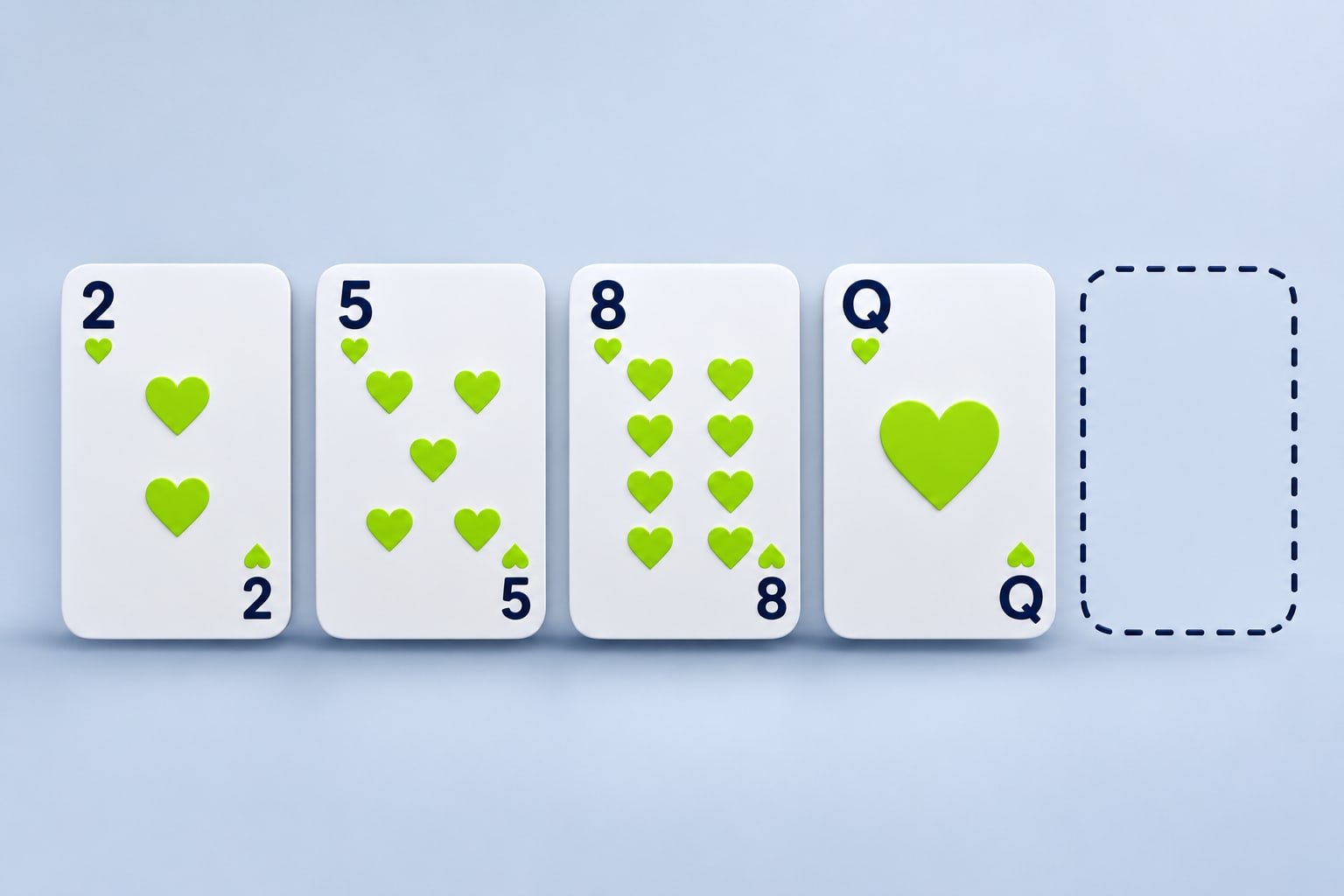
A draw rather than a completed flush
Four-card flush describes four cards sharing one suit, such as two, five, eight and queen of hearts. In ordinary five-card poker rankings, those four cards alone do not make a flush. A fifth heart is needed to complete the category. The expression is particularly useful in video poker because the player decides which dealt cards to hold before replacement cards arrive. It identifies a possible draw, not a guaranteed payment. The remaining fifth card, any pairs already held and the exact paytable can all affect the best decision. A visually attractive group of suited cards is only part of the analysis.
Visual explanation
Four hearts are one card short
Single 52-card deck; the fifth card is discarded and one replacement is drawn from the 47 undealt cards.
Keep the four hearts; discard K♣
13 hearts − 4 held = 9 available hearts; 9 ÷ 47 ≈ 19.15%
This is the chance of completing a flush on that one draw under the stated assumptions. It is not a universal strategy instruction; paytables and alternative holds matter. See video poker.
Counting the available suited cards
In a standard 52-card deck there are 13 cards in each suit. If an initial five-card hand contains four hearts and one non-heart, nine hearts remain among the 47 undealt cards. Holding the four hearts and drawing one card therefore completes a flush-category hand on nine of 47 possible replacements, about 19.15%, assuming the usual single-deck draw without replacement. Some of those completions might qualify for a higher paying straight flush or royal flush if the held ranks allow it. The probability describes drawing the suit; it does not by itself calculate the total expected value of the hold.
Why the fifth card still matters
The card outside the four-card flush may form a pair with one of the suited cards. For example, four hearts including a queen plus a queen of clubs offers both a flush draw and a pair of queens. You cannot keep the four-card flush and keep both queens in a five-card draw while also drawing a replacement. The choice needs a strategy appropriate to the paytable. Other hands might contain three cards to a royal flush, an incomplete straight flush or different high-card opportunities. Compare the competing holds rather than assuming every four-card flush deserves identical treatment.
Paytables change the decision
A strategy chart reflects the rewards assigned to all final hands, not just the name printed above the game. Increasing the flush payout can make a flush draw more valuable; changing the reward for other hands can alter the comparison as well. Wild-card games need additional care because a deuce or joker may have a different role from an ordinary suited card. A chart for one Jacks or Better schedule should not automatically be applied to Deuces Wild or a bonus-poker variant. Verify the complete paytable, deck rules and credit column before relying on a particular hold recommendation.
Four to a flush in community-card poker
Players also talk about being four to a flush in games such as hold'em, where hole cards combine with a shared board. The number of cards still to come and the possibility of opponents making stronger hands matter there. A completed flush might lose to a higher flush, a full house or another superior hand, depending on the board. Also, money won is determined by opponents and betting rather than a fixed video-poker payout row. Do not transplant the simple one-card video-poker calculation into a two-card turn-and-river situation without adjusting the available cards and the question being asked.
Reading and recording the hand
Check the suit symbols carefully, especially on a small mobile display or a four-colour deck. Two red suits are not the same suit: hearts and diamonds cannot be mixed to make a flush. Before pressing Draw, confirm which cards are actually marked Hold. If studying a questionable decision later, record all five original cards, the paytable and the chosen hold. That preserves enough information to compare alternatives accurately. A missed flush is not proof that the original hold was wrong, just as completing a flush does not prove it was best. Evaluate the decision using its possible outcomes before the draw.
In a standard non-wild game, a flush needs all five cards in one suit regardless of their printed colours or ranks.