A four-card inside straight is a draw containing four ranks of a potential five-card straight with a missing rank inside the sequence. It is commonly described as an inside-straight or gutshot draw.
Visual explainer
Find the missing rank inside the sequence
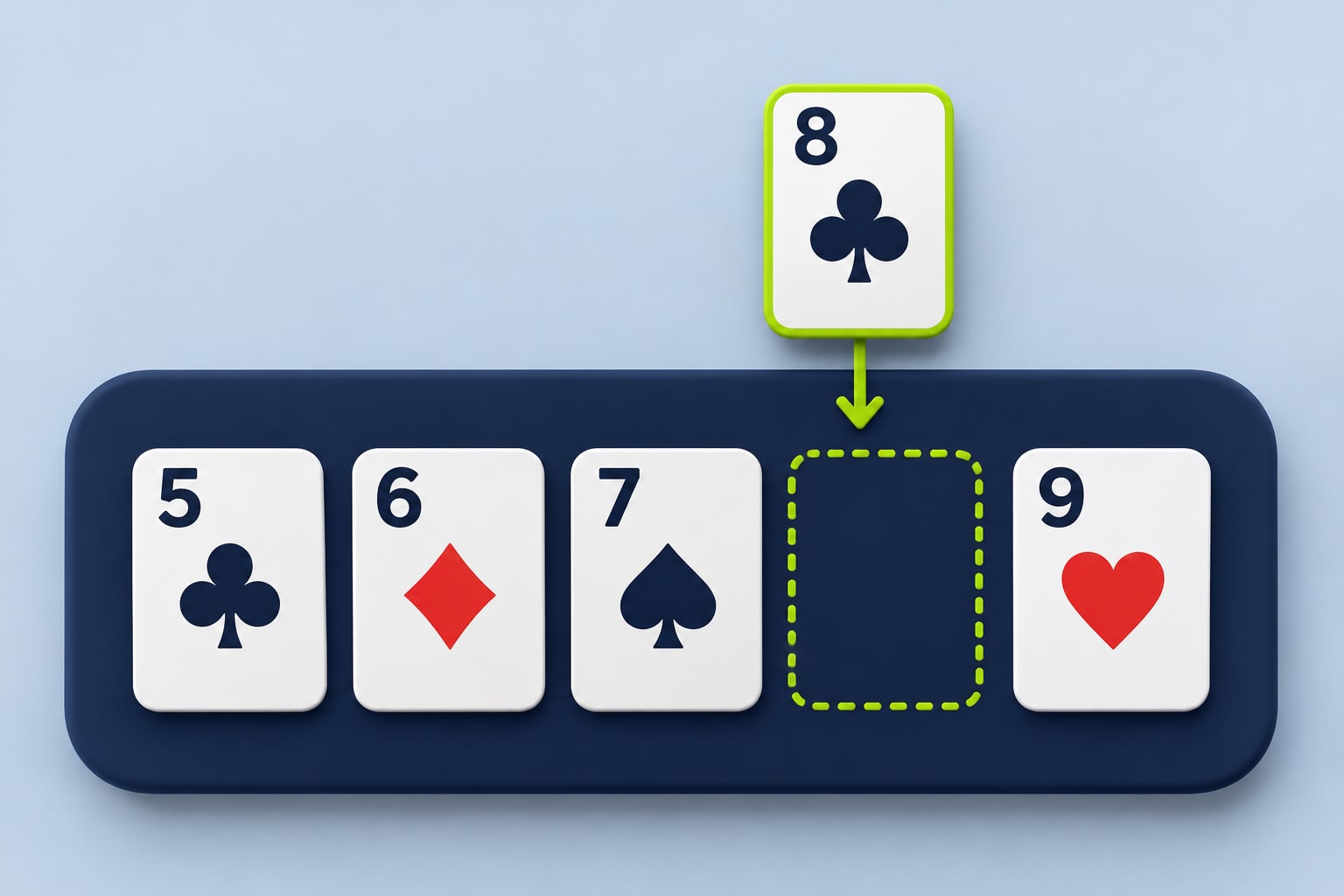
An ordinary single-deck video-poker example: hold 5♣, 6♦, 7♠ and 9♥; discard K♣ and draw one card.
Needed rank
8
An eight fills the internal gap. A four does not complete this sequence.
Available completions
4 of 47
8♣, 8♦, 8♥ and 8♠ remain among the 47 replacement cards.
Four possible cards, one missing rank. These are straight completions—not a guarantee that this hold has the best expected return.
Assumes the original five cards are excluded from the replacement pool and no wild cards. Related: Straight Draw · Video Poker.
Recognising the internal gap
Consider cards with ranks five, six, seven and nine. An eight fits the internal gap and produces five consecutive ranks. A four does not complete this particular straight, because the nine would still leave a break in the sequence. This is why an inside draw differs from an open-ended arrangement such as five, six, seven and eight, which can be completed at either end. The phrase describes a possible future hand, not an already completed straight. In a game using normal five-card poker rankings, four connected or nearly connected cards do not themselves qualify for a straight payout. The missing card must actually arrive and be usable.
Counting ranks and counting cards
One missing rank can correspond to four cards in a standard 52-card deck: one in each suit. For the five-six-seven-nine example, each of the four eights can complete the rank sequence, assuming it remains available. That does not mean every poker situation has four clean winning outs. Some cards may already be exposed, another player may hold one, or completing the straight may also complete an opponent's stronger hand. Distinguish cards that form a straight from cards that make the best hand at showdown. In a simple video-poker calculation, the discarded card is also unavailable to the replacement draw, so the original five cards must all be considered.
A one-card video-poker example
Imagine a standard single-hand draw game deals five of clubs, six of diamonds, seven of spades, nine of hearts and a king. If the player holds the first four cards and discards the king, four eights remain among the 47 unseen cards available for the replacement. In that specific model, the chance of making a straight on the draw is four out of 47. This calculation says nothing by itself about whether that hold is optimal. A paytable, alternative holds and other possible awards determine expected value. Changing the original fifth card can change the available deck and the alternatives, so an example should not become an unconditional playing rule.
Why video-poker strategy needs more detail
A four-card inside straight can contain high cards that have separate value in a game paying for high pairs. Suits can also matter if an alternative hold creates a flush or straight-flush possibility. A strategy chart for one paytable may therefore distinguish several superficially similar inside draws. Wild-card games require additional adjustments because some missing ranks can be supplied by wild cards and their awards may differ. Read the full dealt hand and the exact chart category before deciding what to retain. The glossary term is a descriptive starting point. It does not mean that keeping all four cards is always better than keeping a pair, selected high cards or another combination.
Using the term in community-card poker
At a hold'em table, an inside draw can be assembled from private and community cards rather than from four cards held in one person's hand. The betting decision then depends on the amount required to continue, the pot, remaining streets, opponents and the prospect of stronger hands. A turn card that misses the draw does not make a river completion certain. Nor does a completed straight guarantee the entire pot if another player can make a higher straight, flush or full house. Assess the actual board and the cards needed rather than calling any hand with an eight somewhere in it a successful gutshot. Exact ranks remain essential.
Avoiding confusing terminology
Some writers use inside straight broadly for incomplete straight patterns, including edge cases where only one rank completes a sequence. When precision matters, state the cards and the missing rank instead of depending solely on the nickname. Do not confuse this term with a four-card inside straight flush, which also requires matching suits for its premium completion. The ordinary inside-straight draw can use mixed suits. Learning to separate these categories helps interpret rules, strategy tables and hand discussions consistently. Practise with visible example cards and no wager first. A clearer description can improve understanding, but it does not alter the randomness of the next card or guarantee a profitable decision.