Trips means three of a kind. In common hold’em usage, it specifically means using one private card with a matching pair on the board, whereas a set uses a private pair with one matching board card.
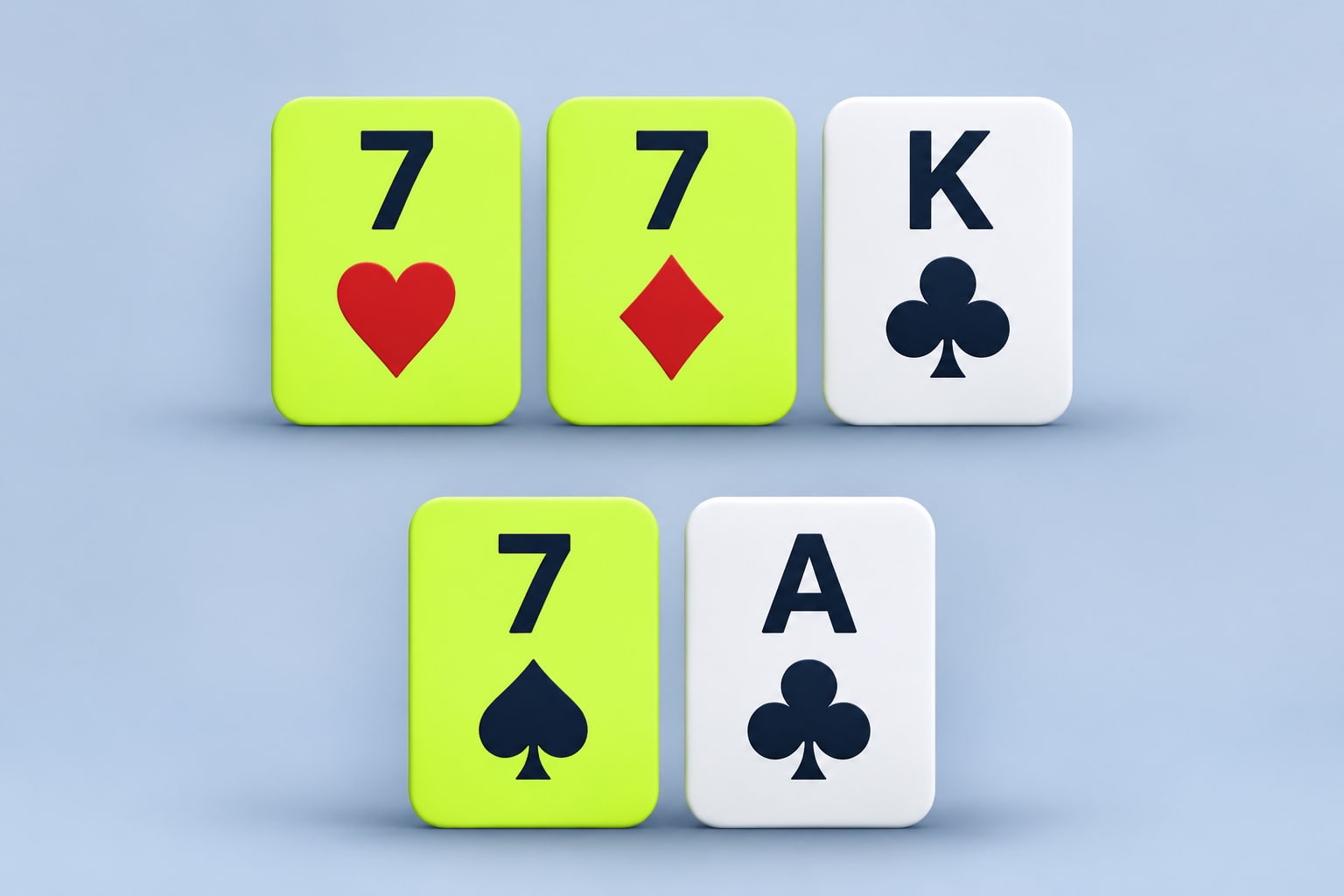
Visual explainer
Trips uses the pair on the board
Texas hold’em example with a complete board: 7♥, 7♦, K♣, 4♠, 2♣.
Player A: 7♠ and A♣
7–7–7–A–K
Three sevens with ace and king kickers.
Player B: 7♣ and Q♦
7–7–7–K–Q
Three sevens with king and queen kickers.
Player A wins this comparison: both have three sevens, so compare the highest remaining card in each best five-card hand. Ace beats king.
These distinct cards form one possible legal deal. A different board could change the result. Related: Set · Texas Holdem.
Three cards of the same rank
Trips is poker slang for three of a kind: three cards sharing one rank. In general conversation, the word may be used broadly for that category. In Texas hold'em analysis, players often distinguish trips from a set by how the three matching cards are formed. Trips commonly uses one private card and two matching community cards, while a set uses a private pair and one matching community card. The two structures belong to the same hand category under standard high-poker ranking. Their different names explain where the cards came from, rather than creating separate categories with different automatic payments. In ordinary poker, the pot is settled by comparing eligible hands.
A clear hold’em example
Suppose a player holds seven of spades and ace of clubs, while the flop shows seven of hearts, seven of diamonds and king of clubs. The player has three sevens using one private seven and the pair on the board. That is the common hold'em meaning of trips. If the player instead held two sevens and the board contained only one seven, the usual description would be a set. These examples require distinct physical cards, and the remaining board cards can still change the final hand. The label describes the current structure, not a guarantee that the player will win the pot.
Kickers can decide between matching trips
When two players share the same three-of-a-kind rank, the remaining cards in their best five-card hands can decide the winner. On a board containing two sevens, one player might hold seven-ace and another seven-queen. If the remaining board cards do not supply better shared kickers or another category, the ace can matter. Write out each best five-card combination before comparing it. Do not assume that the player who announced trips first wins, or that three of a kind always produces a split when the board is paired. The same hand category can still have different strengths within it.
A paired board is information for everyone
Trips formed with two community cards is partly visible to every player because the pair is on the board. Other players can recognise the possibility of a matching private card, and someone else may also hold that rank. A set formed from a private pair is less directly visible, although the board can still support many strong hands. This difference can matter when interpreting betting, but it is not a universal instruction to bet or fold. Opponents' possible holdings, the price of continuing and the actual board must be considered. A structural label alone does not determine the correct action.
Three of a kind can be overtaken
Under standard high-poker rankings, straights, flushes, full houses and stronger categories beat three of a kind. A later community card can also improve trips into a full house or four of a kind. Track the complete board rather than treating the first strong-looking flop as the final result. If the board itself contains three cards of one rank, every remaining hold'em player can use those shared cards, but their full five-card hands may differ. That situation is another reason to clarify whether trips is being used broadly for the category or narrowly for the one-private-card construction.
Do not transfer the shorthand blindly
Other poker variants use different card-construction rules, and a game's side bet can use Trips as a product label with its own qualifying hands. Such a label does not automatically follow the hold'em distinction described here. Check the exact game and paytable before assuming a payment is due. For an educational hand history, list the private cards, board and stage of play, then identify the best valid five-card hand. Trips is useful shorthand once those facts are clear. It does not establish an exact winning probability, make further betting compulsory or turn an uncertain hand into secured winnings.