A set is three of a kind made with a pocket pair and one matching community card. It has the same standard hand-category rank as trips, although the way it is formed differs.
Visual explainer
A set starts with a pocket pair
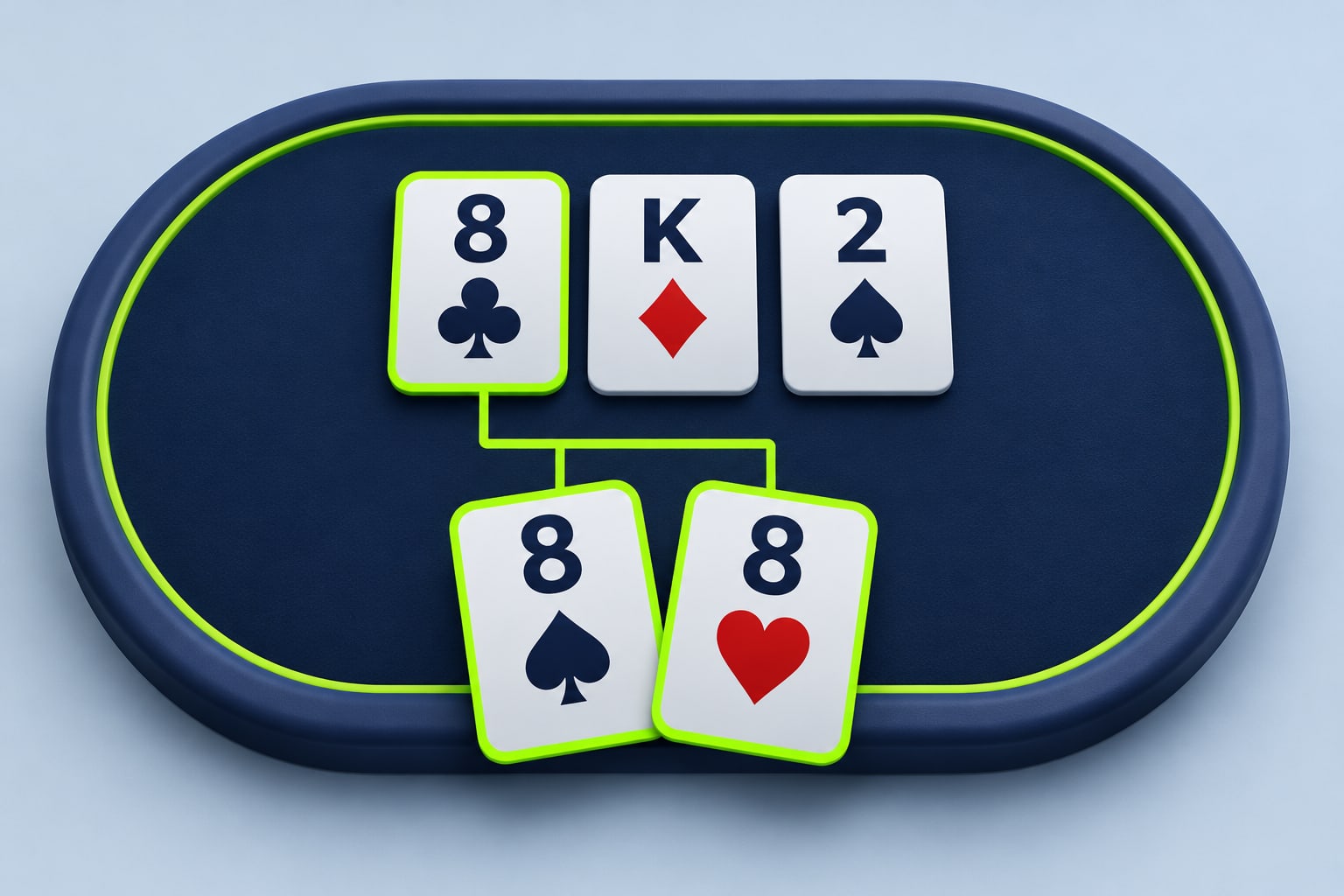
Texas hold’em example. The two private eights combine with one eight on the flop.
Your private cards
8♠ · 8♥
Both matching cards begin in your hand.
Flop
8♣ · K♦ · 2♠
One shared eight completes three of a kind.
On this K–8–2 flop: kings would be top set, eights middle set and deuces bottom set. “Set” describes the card arrangement, not a separate hand-ranking category.
Later community cards can change the best hand. Related: Trips · Texas Holdem.
A particular way to make three of a kind
A set is three of a kind formed from a pair in a player's hole cards plus one community card of the same rank. In Hold'em, holding 8♠ and 8♥ on a flop of 8♣, K♦ and 2♠ gives a set of eights. The remaining two cards in the best five-card hand act as kickers unless the hand improves to another category. Set is useful vocabulary because it describes how the three matching cards are distributed between private and shared cards. It does not create a separate rank above ordinary three of a kind. The hand's value still depends on its rank and the complete board.
How a set differs from trips
Trips commonly describes three of a kind made with one hole card and a matching pair on the board. For example, a player holding 8♠ and A♥ on a board containing 8♣ and 8♦ has trips rather than a set under this convention. Both hands belong to the three-of-a-kind category, but their information structure differs. A paired board is visible to every player, while a pocket pair matching one board card can conceal the strength more effectively. Terminology is sometimes used loosely in conversation, so inspect the cards when precision matters. A commentator calling a hand trips does not change the legal five-card result at showdown.
Top, middle and bottom sets
On an unpaired flop containing three different ranks, a set can be described as top, middle or bottom according to which board rank it matches. On K, 8, 2, kings form top set, eights middle set and deuces bottom set. These descriptions compare the sets possible on that board; they do not guarantee that a set is the strongest category possible. A coordinated board can also allow a straight, and suited cards can create flush possibilities. If two players hold different sets, compare the rank of the three matching cards. Top set beats a lower set while the relevant hands remain in that category.
The chance of flopping matching cards
With a pocket pair in ordinary Hold'em, two cards of that rank remain among the 50 unseen cards before the flop. Under the usual random-deal model, the probability that the three-card flop contains at least one of them is 1 − (48/50 × 47/49 × 46/48), about 11.8%. This figure includes the rare case in which both remaining matching cards appear and make four of a kind. It should therefore not be described as the probability of exactly one matching flop card without qualification. The calculation also does not say how often the resulting hand wins the pot or whether calling a preflop bet was profitable.
Improving and being overtaken
A set can improve to a full house when another board rank pairs, or to four of a kind when the fourth card of its own rank appears. Those possibilities do not ensure victory. Later cards can give an opponent a straight, flush, higher full house or another stronger legal hand. A paired board also requires careful comparison rather than an assumption that every player with three matching cards has the same result. In Omaha, exactly two hole cards must be used, so the pocket-pair construction can form a set, but the final best hand must still use exactly three board cards. Always build the legal five before comparing it.
Why the distinction is useful
The word set makes a hand history more informative by showing that two of the matching cards were private. It can help explain why opponents may not have recognised the strength immediately, but it does not establish a universal betting instruction. Stack sizes, board texture, price and possible opposing hands still matter. A player who misses the flop with a pocket pair has not earned a matching card on the next hand, and a set that loses does not justify chasing. Use the term to describe the actual card construction, then assess the decision separately. Clear vocabulary supports analysis; it does not turn a strong holding into a guaranteed financial result.