Transversale simple is French roulette terminology for a street bet covering one row of three numbers on the betting layout. A standard winning street bet pays 11 to 1 profit, with the original stake returned separately.
Visual explainer
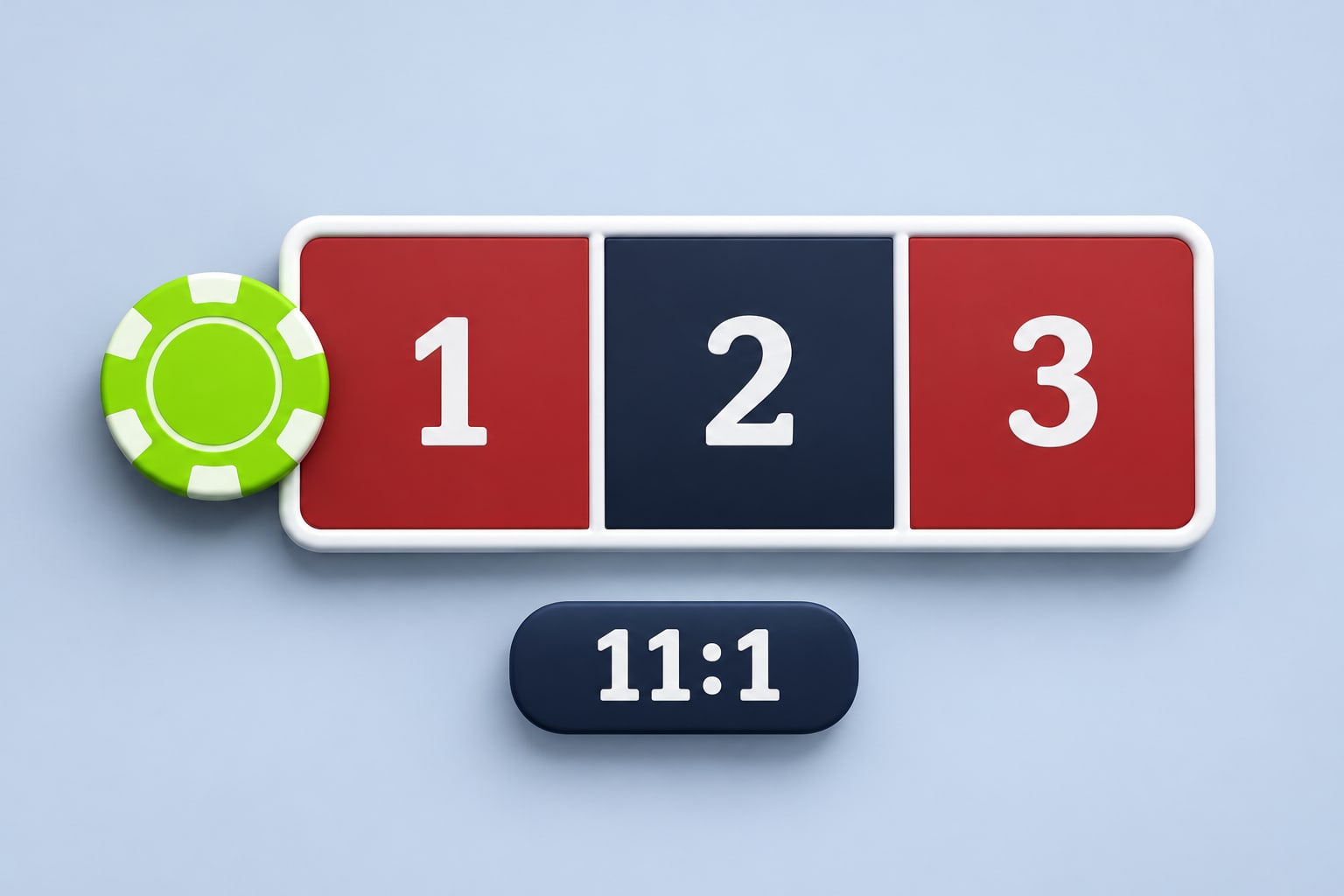
A transversale simple covers one row of three
Illustrative street bet on 7, 8 and 9 in a conventional roulette number grid.
Coverage
3 numbers
One row; not three adjacent wheel pockets.
Winning payout
11 to 1
Profit, with the original stake also returned.
1 · Stake
2 · One covered number wins
3 · Any uncovered number wins
On a fair single-zero wheel, the win chance is 3/37 ≈ 8.11%. Only one winning number needs to land.
The grid shows coverage, not a chip-placement instruction. Confirm the three highlighted numbers before accepting a digital bet. Related: Three Number Bet · Six Number Bet.
One complete three-number row
The ordinary roulette betting grid arranges numbers one through thirty-six in twelve rows of three. A transversale simple covers all three numbers in one such row, such as one, two and three or four, five and six. English-language rules commonly call this a street bet. The three numbers are connected by their position on the betting layout, not by adjacency around the physical wheel. Wheel order and table order are different arrangements. Identifying the row is therefore the first step when reading a French betting description or confirming what an electronic betting area will cover before placing chips.
Where the chip goes
On a conventional physical layout, the chip is placed on the outside edge at the end of the selected three-number row. It does not sit in the middle of one numbered square, which would indicate a straight-up wager, or on the boundary between two individual numbers, which would indicate a split. Table orientation can make the street edge appear on a different side to the observer, so use the row relationship rather than memorising left or right. Online, hovering or selecting the area may highlight the three covered numbers. Check that highlight or the bet details before confirming the amount.
A payment example
A two-dollar street wager on one, two and three wins if any of those three numbers appears. At the standard eleven-to-one profit rate, the profit is twenty-two dollars and the original two-dollar stake is returned, giving twenty-four dollars received. If any uncovered number appears, the two-dollar wager loses. This separates profit from total return: describing the result as twenty-four dollars profit would overstate it by the original stake. The phrase twelve for one can describe the same total-return relationship, but the displayed rules should make the convention clear. Always check whether an odds expression includes or excludes the returned wager.
The wheel determines the probability
On a fair single-zero wheel with thirty-seven pockets, an ordinary three-number street wins on three of those pockets. Its probability is three divided by thirty-seven, approximately eight point one one percent. With a one-dollar stake paying eleven dollars profit on a win, the expected net result is three thirty-sevenths times eleven dollars minus thirty-four thirty-sevenths times one dollar, or a loss of one thirty-seventh of a dollar. That is about a two point seven zero percent house edge. A double-zero wheel has thirty-eight pockets, so the same three covered numbers and payment produce different mathematics. The bet name alone does not identify the wheel version.
Distinguish the related French terms
A transversale simple covers one row of three, while a six-number or double-street wager covers two adjacent rows under its own payment rule. A corner covers a block of four numbers, and an en plein wager covers one number. Special bets involving zero may have their own labels and placement rules; they should not be assumed from the ordinary twelve-row grid. These distinctions are useful when reading a multilingual interface. Similar terminology can describe different coverage, so count the actual selected numbers and read the displayed payout rather than choosing a wager solely because its French name sounds familiar.
Coverage does not create a prediction
Covering three numbers gives a different hit frequency and payment from covering one number, but it does not make a particular row due after a series of misses. Previous independent spins do not move probability into an unhit street. Placing wagers on several streets also increases the total stake; the cost is not limited to the amount on a single chip position. Confirm the combined bet before spinning and compare it with the session limit. Understanding transversale simple should make the selected coverage and payment transparent, rather than turn a visual pattern in recent results into an unsupported prediction about the next winning pocket.
Related glossary terms
Sources and further reading
- Synonym:
- Street Bet