A three number bet in roulette usually means a street: one wager covering a row of three numbers on the betting layout. A standard winning street pays 11 to 1.
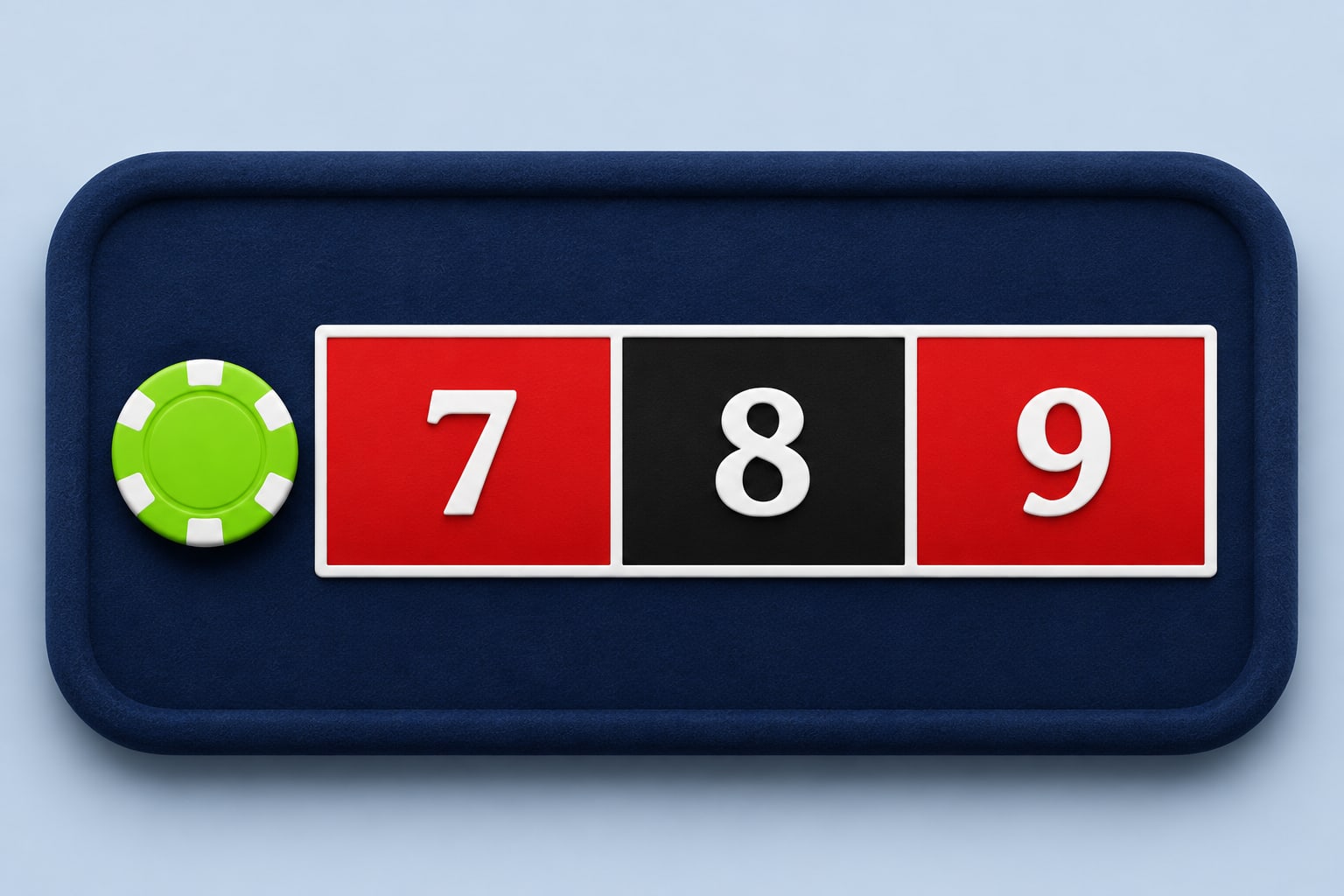
Visual explainer
One street covers one complete row
Example street: 16, 17 and 18 on a conventional roulette layout.
One row, three outcomes
Standard profit payout
11 to 1
A winning $2 street earns $22 profit and returns $24 including the stake.
The chip goes at the outside edge of this row. Three numbers scattered elsewhere on the layout do not make this street bet.
Check the accepted highlight and game rules. Fair single-zero chance: 3/37, about 8.11%. Related: Street Bet · Sixaine.
Which three numbers are covered
The standard roulette layout places the numbers one through thirty-six in twelve rows of three. A street bet covers one complete row, such as seven, eight and nine, or twenty-eight, twenty-nine and thirty. It is not a free selection of any three numbers. The grouping follows the printed betting layout rather than the order of pockets around the wheel. Three neighbours on the wheel can be scattered across several rows of the layout and require different wagers. When a guide says three number bet without further detail, the usual intended meaning is this ordinary street bet; check the displayed selection before confirming it.
Placing and checking the wager
On a physical table, the chip is placed at the outside edge of the chosen row, where the street position is marked by the layout. Online, the interface may highlight all three covered numbers when the pointer or selected chip reaches the correct position. That highlight is more useful than guessing from a small screen. A chip placed slightly inside a number box or on another boundary can represent a different bet. Before the betting period closes, check the actual selection and the total stake. If the placement is unclear at a live table, ask the dealer to identify the covered numbers while betting is still open.
Understanding 11 to 1
A standard street win pays eleven units of profit for each unit staked, with the original stake also returned. A two-unit winning bet therefore produces twenty-two units of profit and twenty-four units returned in total. If none of the three selected numbers lands, the two-unit stake is lost. The wording matters: eleven to one describes the profit, whereas twelve for one describes the same total return including the original stake. Do not compare two displayed payouts without checking which convention each uses. A winning animation may show the combined amount credited to the balance, which can look larger than the profit stated in the rules.
Probability and the zero pocket
On a standard single-zero wheel, a street covers three of thirty-seven equally likely pockets. Its chance of winning on one spin is therefore three divided by thirty-seven, approximately 8.11 percent. For a one-unit stake, the expected net result is three thirty-sevenths multiplied by eleven, minus thirty-four thirty-sevenths multiplied by one. That equals a loss of one thirty-seventh of a unit, approximately 2.70 percent of the stake. The calculation describes an average over many comparable wagers, not a deduction imposed after every spin. A particular short session can finish far above or below that average, including losing the entire amount set aside for play.
Other wheels and zero combinations
A double-zero wheel has thirty-eight pockets, so the same ordinary street covers three of thirty-eight outcomes while normally keeping the same eleven-to-one payout. That changes the expected loss to approximately 5.26 percent. Additional-zero layouts or special roulette variants require their own calculation. Bets involving zero can also have special names and permitted combinations, such as a trio on some layouts. Do not assume that every three-number grouping around the zero area is available on every wheel. Read that game's betting diagram and paytable. The ordinary rows from one through thirty-six provide the clearest reference when learning what a street covers and how it pays.
Keeping coverage separate from an advantage
A street wins more often than a single straight-up number because it covers three pockets, but its profit payout is correspondingly smaller. Broader coverage does not remove the house advantage. Two adjacent streets can also be covered with a six-number line bet, often called a sixaine, which has a different standard payout. These are alternative ways to distribute a stake, not methods of predicting the next result. Previous spins do not make a missed street due to land on an independent fair wheel. Choose the wager only after understanding its coverage, possible loss and payout, and keep the total committed across all chips within a preset limit.