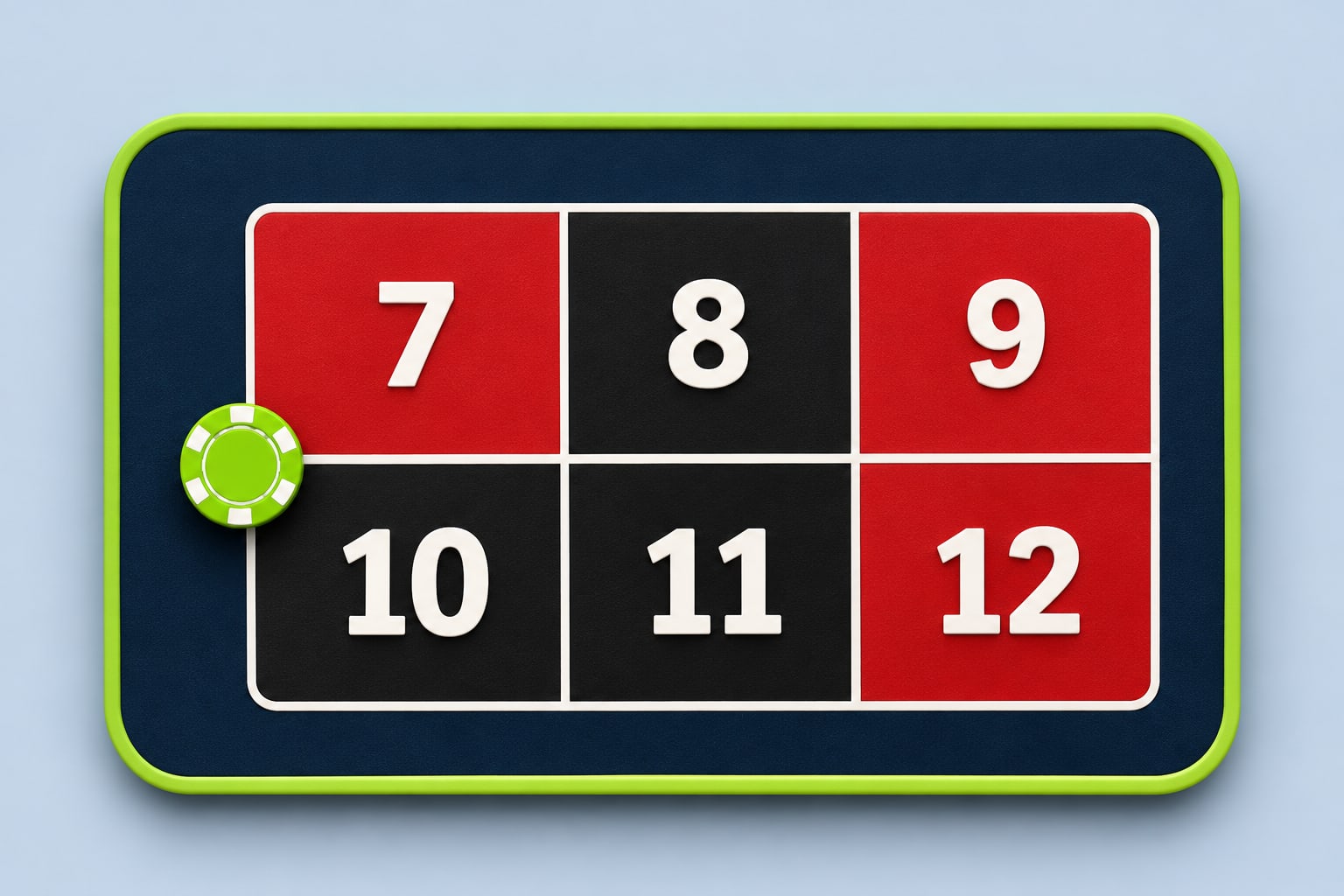
A six number bet in roulette covers two adjacent rows of three numbers. Also called a six line, double street or sixaine, a standard winning wager pays 5 to 1.
Visual explainer
A six-number line combines two adjacent layout rows
Illustrative covered numbers: 7–12. Compare equal total stakes and ordinary payouts.
One $2 six-number line
Total returned: $12.
Two $1 streets
Other street: −$1.
Combined: $10 net profit.
Total returned: $12.
Both commit $2 and cover the same six numbers. Both lose $2 if an uncovered number lands. Splitting the chips does not change this payout comparison.
This relies on 5-to-1 six-line and 11-to-1 street payouts. The six numbers are adjacent on the grid, not necessarily around the wheel. Related: Three Number Bet · Roulette.
How the numbers are grouped
The ordinary roulette layout arranges numbers one through thirty-six in rows of three. A six number bet combines two neighbouring rows, such as seven, eight and nine with ten, eleven and twelve. One chip position therefore covers all six numbers. The expression does not mean any arbitrary collection of six choices, and it does not mean six neighbouring pockets around the wheel. Wheel order and layout order differ. To confirm the intended selection, read the six actual numbers highlighted by the interface or identified by the dealer. A familiar label is useful, but the covered outcomes are what determine whether the wager wins on the next spin.
Where the chip belongs
The standard placement is on the outside edge of the number grid at the boundary between the two chosen rows. That differs from the position for a single street, which covers only one row. A physical chip that sits ambiguously between positions should be clarified before betting closes. On a phone, enlarged controls or a highlighted selection can help distinguish the two wagers. After adding or removing chips, check the total committed amount rather than assuming that the visible chip count equals the stake. A selected chip denomination of five units means each placement adds five units, even though the graphic shows just one chip.
Calculating the winning return
A standard six-number line pays five units of profit for every unit staked, with the original stake also returned. A three-unit winning bet therefore earns fifteen units of profit and returns eighteen units in total. A losing bet loses the three-unit stake. This is the difference between five to one and six for one: both can describe the same award when the second wording includes the returned stake. Before comparing a paytable with a balance change, establish whether the displayed amount is profit or total return. Neither wording means that five or six separate numbers must land; only one winning pocket is produced by an ordinary roulette spin.
Single-zero probability
On a standard single-zero wheel, six of the thirty-seven pockets satisfy this wager. The chance of a win is six divided by thirty-seven, approximately 16.22 percent. For a one-unit stake, the expected net result is six thirty-sevenths multiplied by five, minus thirty-one thirty-sevenths multiplied by one. This gives a loss of one thirty-seventh of a unit, approximately 2.70 percent. The figure is a long-run mathematical average under the stated rules. It does not predict how many winners will occur in six spins, and it does not mean the casino removes precisely that percentage from every individual wager. Short sequences can differ sharply from the average.
Comparing coverage choices
Two separately placed street bets can cover the same six numbers, but compare equal total stakes. Two one-unit streets commit two units in total; if either wins at eleven to one, the other loses, producing ten units of net profit overall. A two-unit six-number line also produces ten units of profit when it wins at five to one. This equivalence depends on the ordinary payouts and the same covered numbers. It does not make either arrangement an advantage play. A double-zero wheel changes the outcome count to thirty-eight while normally keeping the same payout, increasing the standard house edge to approximately 5.26 percent for this wager.
Common interpretation errors
Six-number coverage should not be confused with a dozen, a column or an announced wheel-sector bet. Each describes a different collection of outcomes and can use a different number of chips. Special roulette variants may alter payouts or add conditions, so use the actual table rules rather than transferring calculations blindly. Recent results also do not make the selected pair of rows due to win on an independent fair wheel. Covering more numbers trades a smaller profit payout for more frequent wins; it does not guarantee a smoother session or prevent a long losing run. Decide the total session budget before placing repeated wagers, regardless of which coverage pattern is chosen.