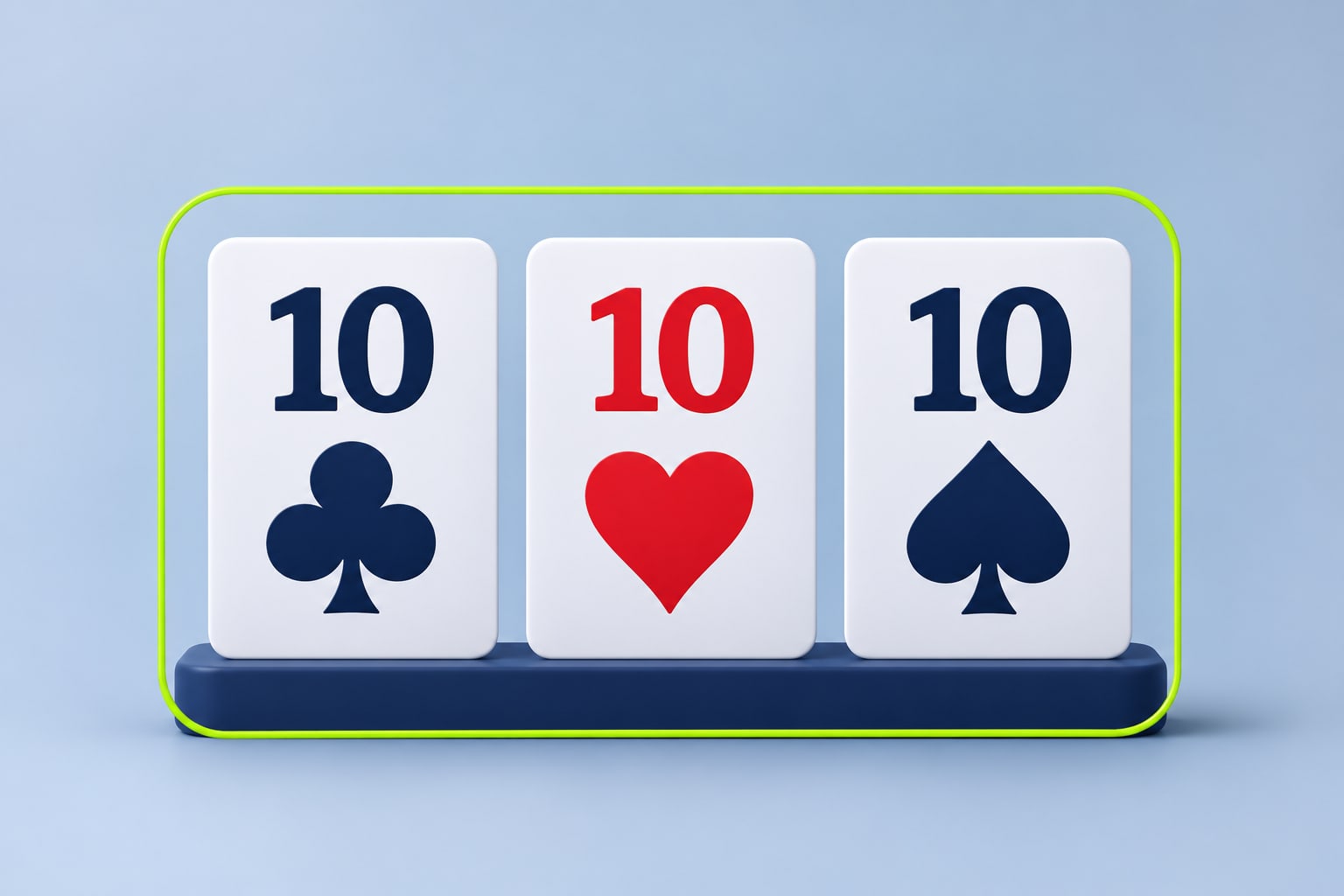
Thirty days or thirty miles is an old poker nickname for three tens. It describes a card combination, not a points total, a betting limit or a special rule.
Visual explainer
Three tens: nickname versus complete hand
“Thirty days” or “thirty miles” describes three tens. The other cards still matter.
Three of a kind
Full house
Under standard high-poker rankings, the full house is stronger. The nickname does not override the complete legal five-card hand.
Examples show final hands; card-use rules depend on the poker variant. Related: Three of a Kind · Full House.
Recognising the nickname
Poker has accumulated many informal names for cards and combinations. Thirty days and thirty miles belong to that vocabulary: each refers to three cards ranked ten. The expression can appear in an older glossary, a narrated hand or conversation at a table. It does not create a separate category in the official hand rankings. If a player announces the phrase at showdown, the dealer must still inspect the actual cards and apply the game rules. A colourful description cannot replace a complete five-card hand, settle a disputed pot or establish which cards a player is entitled to use in that particular poker variant.
Three tens in a complete hand
Consider ten of clubs, ten of diamonds, ten of hearts, ace of spades and six of clubs. Under ordinary high-poker rankings, this is three of a kind, tens, with an ace and a six as the remaining cards. The hand beats two pair but loses to a straight. If the last two cards instead form a pair, the complete hand is a full house rather than merely three of a kind. Four tens make four of a kind. Although someone might casually mention the three tens within a larger combination, the strongest legal five-card hand determines the result, not the nickname used to describe part of it.
Comparing two hands containing tens
The rank of the three matching cards is considered before the accompanying cards when comparing ordinary three-of-a-kind hands. Three jacks therefore beat three tens even when the tens have an ace beside them. When players can share the same three tens through community cards, the remaining cards can decide the winner. On a board containing three tens, a player might improve the shared hand with an ace or another high card. Sometimes the board itself supplies the best remaining cards and the pot is split. Read the full board and each player's permitted combination before deciding that possession of any particular side card must win.
A set and trips are formed differently
In hold'em, a pocket pair of tens combined with one ten on the board is usually called a set. One ten in the player's hand combined with two tens on the board is usually called trips. Both can produce three of a kind, but they reveal different information to opponents and interact differently with the other available cards. For example, a paired board makes it possible for more than one player to share the three matching ranks. The old nickname does not distinguish these arrangements. When discussing a hand accurately, say which tens were private cards, which were community cards and what else was on the board.
Why the game variant still matters
A nickname cannot tell you how a hand should be assembled. Hold'em generally allows a player to use any suitable combination of private and community cards, while other poker variants impose different requirements. Stud uses each player's own available cards, with some information visible to opponents. Wild-card games can also change which combinations are possible and how they are ranked or paid. Before using an example from one variant to judge another, confirm the card-selection rules. Three tens may be a made hand, part of a stronger hand or insufficient for a particular paytable award; the phrase alone provides no answer to those different questions.
Reading old terminology without adding myths
The useful meaning of this expression is narrow: it identifies three tens. There is no need to invent a guaranteed strategy, a numerical scoring system or a story about travel to make sense of it. Older poker literature contains overlapping nicknames, and their use is not consistent across every room or generation. If another player uses an unfamiliar expression, ask for the actual ranks rather than relying on an assumed translation. For practical hand analysis, record the cards, suits, position and betting sequence. Those details explain the decision far better than an amusing name, and they prevent a historical expression from being mistaken for a current house rule.