A full house is a five-card poker hand containing three cards of one rank and two of another. Compare the three-of-a-kind rank first, then the pair if necessary.
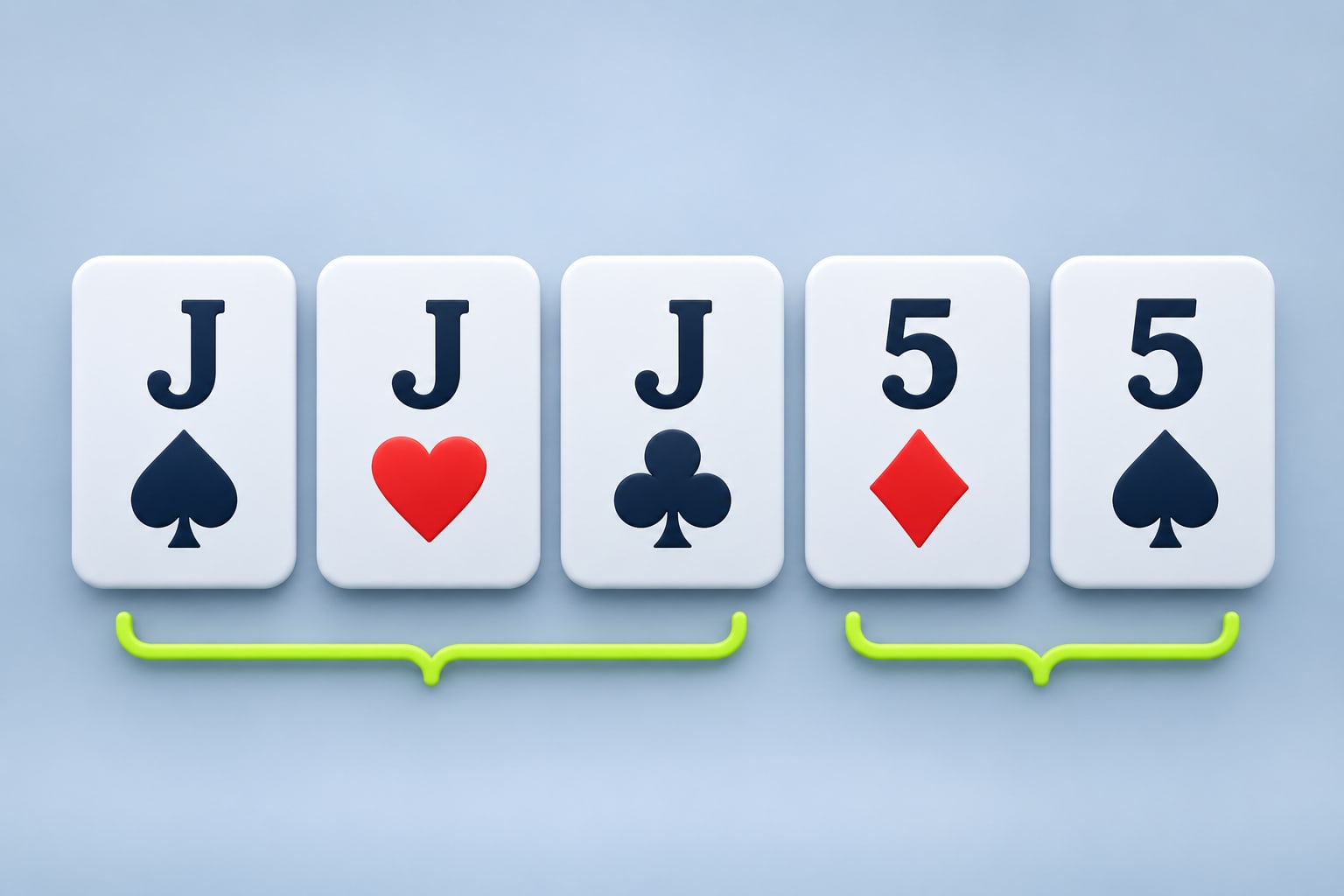
Standard high-poker comparison
A full house compares the three first
Each hand contains three cards of one rank and a pair of another rank.
Jacks full of fives
This hand wins: three jacks outrank three tens.
Tens full of aces
The higher pair of aces does not overcome the lower three-of-a-kind.
Compare the pair only if the three-of-a-kind ranks tie. There is no sixth-card kicker in this five-card hand. Explore: Flush · Straight Flush.
Recognizing the combination
A full house combines three of a kind with a pair of a different rank. J-J-J-5-5 is jacks full of fives: the three jacks supply the first part of the name, and the two fives supply the second. Players also call a full house a boat. All five cards contribute to the combination, so there is no spare kicker to compare afterward. The suits do not determine which full house is stronger under ordinary poker rankings. Three jacks and two fives remain the same ranked hand whether their permitted suits are hearts, clubs, diamonds or spades in a standard deck.
Where it ranks in standard high poker
Under conventional high-hand rules, a full house beats a flush, straight, three of a kind, two pair, one pair and high card. It loses to four of a kind and a straight flush, including a royal flush. These rankings should not be transferred automatically to every named poker variant: games using a shortened deck, wild cards or different hand categories can publish a different order. Identify the particular game before applying the familiar hierarchy. A full house is a strong completed hand in standard high poker, but its category alone does not prove that no opponent can hold a stronger legal combination.
Comparing two full houses
Compare the rank of the three matching cards before considering the pair. Jacks full of twos beats tens full of aces because three jacks outrank three tens; the attractive pair of aces cannot reverse that comparison. If both hands use the same three-of-a-kind rank, compare the pair. Kings full of nines beats kings full of fours. If both five-card hands have the same ranks, they are equal under ordinary high-hand comparison, and suits do not break the tie. A sixth card cannot act as an extra kicker. This is why selecting the correct five cards matters when more than five cards are available.
Community cards and game restrictions
In Hold'em, a player may form the best five-card hand using any allowed combination of the two hole cards and five community cards. If the board itself contains a full house, every remaining player can use it, although someone may have a better hand. Omaha uses a different restriction: exactly two hole cards and exactly three board cards must form the hand. A player cannot simply play a full house lying entirely on an Omaha board. Similarly, one matching hole card is not enough unless another legal hole card completes the required five-card combination. Count the private and community cards separately before declaring the result.
A draw example and video poker payouts
Suppose a five-card draw holding is K-K-8-8-2 and the player discards only the two. With no information about other cards, four of the 47 unseen cards are kings or eights that would complete a full house: two remaining kings and two remaining eights. The chance is therefore four out of 47 in that simplified draw. This does not establish the best decision for every paytable or poker situation. In video poker, a completed full house receives the award printed for the selected game and stake. Different full-house payouts can materially change a game's expected return, even when the displayed card combination is identical.
Avoiding common reading errors
A hand containing three pairs is not a full house unless a valid five-card selection also contains three cards of one rank. Likewise, three of a kind plus two unrelated side cards is only three of a kind. When several hands look similar, name the triplet first and the pair second, then compare them in that order. Distinguish making a full house from winning a pot: another full house, quads or a straight flush may still beat it. Check the game rules, evaluate the complete legal hand, and use the actual paytable or pot settlement rather than assuming that a strong nickname guarantees a particular payout.