Quads is poker shorthand for four of a kind: four cards of the same rank. In standard high poker it beats a full house and loses to a straight flush, while video-poker awards depend on the paytable.
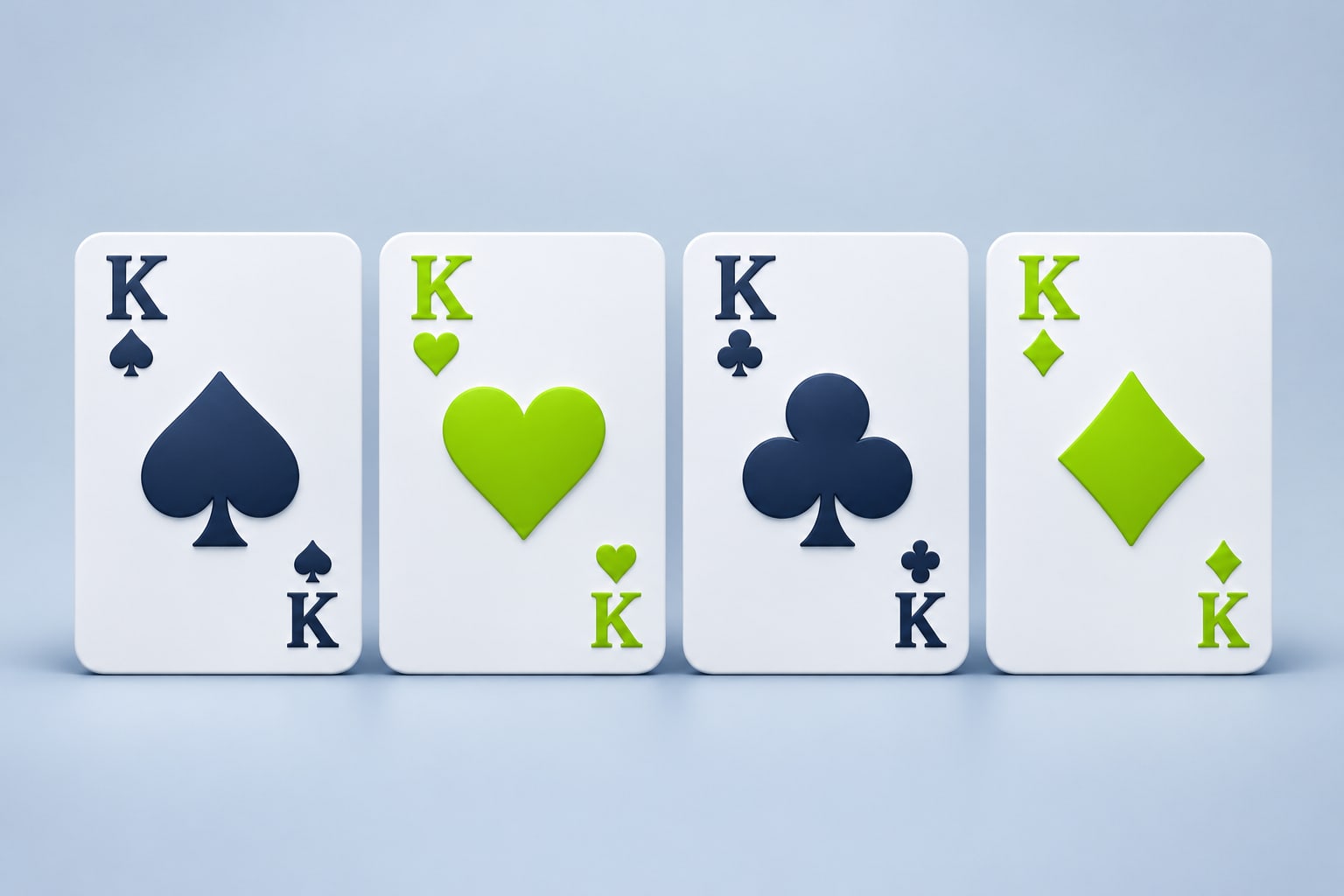
Four matching ranks
Four kings, four sevens or four aces are examples of quads. In a standard single deck, the four cards of a rank come from the four different suits. Their ranks match even though their suits do not. A five-card poker hand containing quads has one additional card, often called the kicker. The four matching cards establish the hand category, while the kicker can matter when otherwise equal quads must be compared. In wild-card games, substitutes can create four of a kind under special rules, so a natural-card description should not automatically be applied to every video-poker variation. The announced category should match the cards actually available at showdown.
Where quads rank in ordinary poker
Under standard high-hand rankings, four of a kind is stronger than a full house and weaker than a straight flush. The rank of the four matching cards is compared first: four queens beat four jacks. If players share the same four-of-a-kind rank, compare the fifth card in their best legal five-card hands. Suits do not ordinarily break an otherwise exact tie at showdown. Games with different ranking systems, wild cards or special paytables can change the relevant evaluation, so identify the game before importing the ordinary hierarchy into a result with a similarly named hand.
Quads on a shared board
In Texas hold'em, the community cards can contain all four cards of one rank. Every remaining player can then use those quads, and the best available fifth card determines whether someone wins outright or the pot is split. For example, if four nines appear on the board and a player can use an ace as the fifth card, that player beats an otherwise comparable king kicker. If the board itself supplies the best possible kicker available to all, the players can tie. The presence of quads therefore does not guarantee that only one player has the hand or that the entire pot belongs to its first observer.
Video-poker quad awards vary
In video poker, a four-of-a-kind result is paid by the displayed schedule rather than by taking a pot from opponents. Some games pay the same amount for every natural quad rank. Bonus variants can pay more for aces or low ranks, and some add special awards when the fifth card meets a kicker requirement. A generic statement that quads pay a certain number is incomplete without the game, denomination and credit level. Read all separate quad rows before choosing a hold strategy. A change in these awards can change which cards are worth keeping before the replacement draw.
Four cards versus a draw toward four
Holding three of a kind is not the same as already holding quads. In a normal single deck, one card of that rank remains somewhere among the unseen cards, but the chance of drawing it depends on the number of cards drawn and the known cards. Other improvements, such as a full house, may also be possible. In player-versus-player poker, the cost of continuing and the possibility of an opponent's stronger hand matter as well. Avoid treating a near miss as if it were part of the final payout. Only the completed legal hand and the applicable rules determine the result.
Recognizing a strong hand without assuming a win
Quads are a powerful category in ordinary high poker, but the board, legal card-use rules and competing hands still need to be read. A straight flush can beat them, and shared quads can lead to a kicker decision or a split. In casino games, a special payout may require particular natural ranks or a qualifying fifth card. Check the exact final cards rather than relying on a celebration animation or a nickname. The rarity of a hand does not justify increasing future stakes to try to repeat it. Each new wager creates fresh exposure under the game's rules and available information.