A four-card straight-flush draw contains four suited cards that can be completed to five consecutive ranks. Its value depends on the gaps, high cards, discarded card and video-poker paytable.
Visual explainer
Two ends or one inside gap
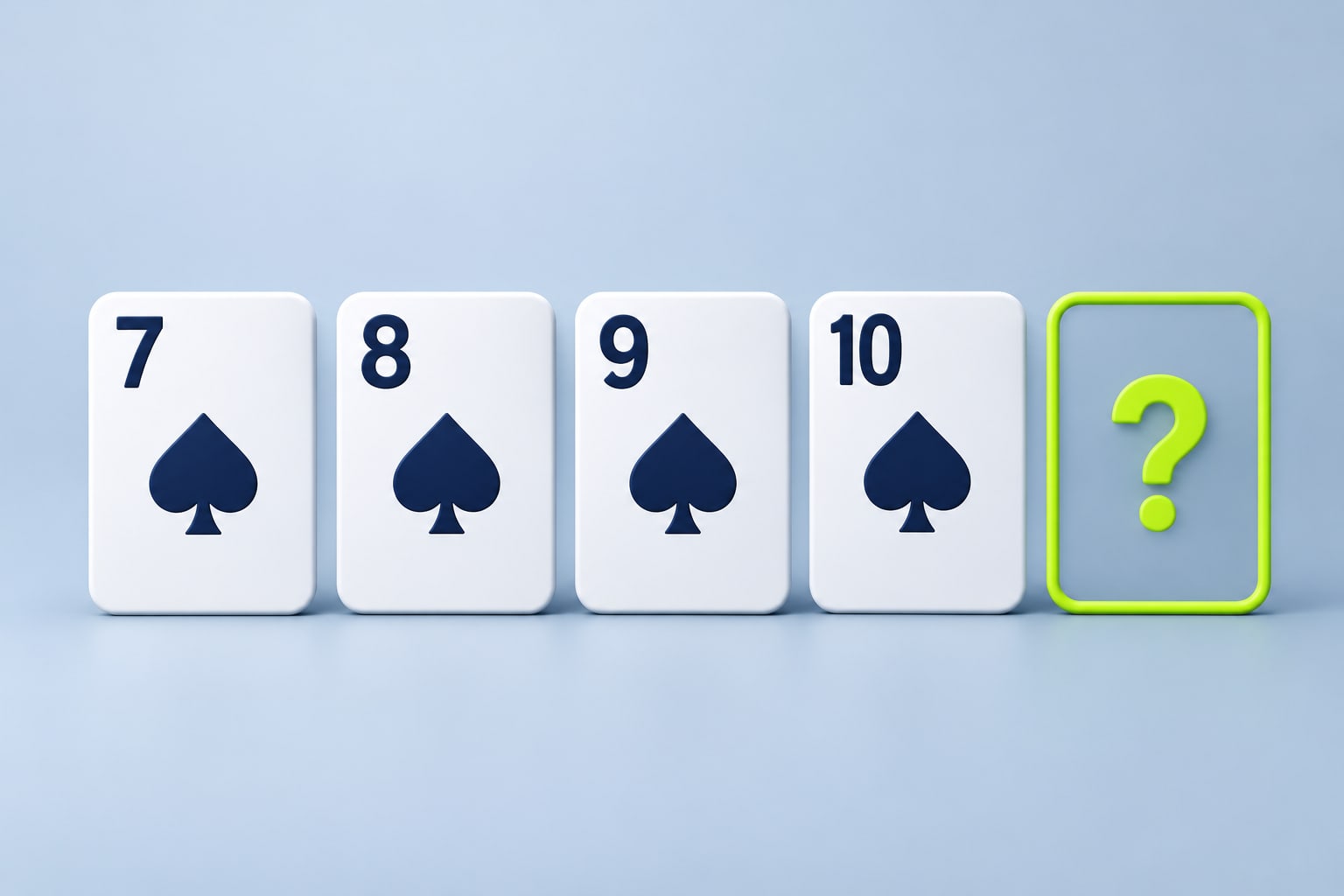
Standard one-card draw examples. Each initial hand includes the four shown spades plus an unrelated 2♥, which is discarded. All 47 undealt cards are possible replacements.
Open-ended
7♠ 8♠ 9♠ 10♠
6♠ or J♠ completes a straight flush. Two completion cards: 2 / 47 ≈ 4.26%.
Inside gap
7♠ 8♠ 10♠ J♠
Only 9♠ completes a straight flush. One completion card: 1 / 47 ≈ 2.13%.
The replacement needs the correct rank AND suit. An off-suit completion can make a straight, but not a straight flush.
Other draws may earn other awards. These percentages count straight-flush completion only; the preferred hold depends on all five original cards and the paytable. Related: Straight Flush · Penalty Card.
Four suited cards with a sequence possibility
A four-card straight-flush draw contains four cards of one suit that can become a five-card straight flush with an appropriate addition. Seven, eight, nine and ten of spades form a simple example. The phrase describes an incomplete hand, not an already paying straight flush. Four cards of one suit are not enough unless their ranks can fit within a legal five-card sequence. For instance, two, five, nine and king of spades cannot form a straight flush with only one additional card. Both the suit pattern and the rank spacing are essential to identifying the draw correctly.
Open-ended and inside possibilities
Seven-eight-nine-ten of one suit can be completed by a six or jack of that suit, giving two straight-flush completion cards in an ordinary deck. Seven-eight-ten-jack of one suit needs the nine of that suit, leaving one such completion. The second example has an internal gap. These differences can affect expected return, although other final hands may also pay. An ace can be low in ace-two-three-four-five or high in ten-jack-queen-king-ace under standard rankings, but it does not connect king-ace-two-three-four into a straight. Check edge cases instead of treating every group of apparently nearby ranks as equivalent.
Counting a standard one-card draw
If a five-card initial deal contains seven, eight, nine and ten of spades plus an unrelated off-suit card, holding the four spades leaves 47 possible replacement cards. Two of those replacements complete a straight flush, so that category occurs with probability two in 47, about 4.26%, under the stated single-deck rules. Other spades can complete an ordinary flush, and certain off-suit ranks can complete an ordinary straight. A full expected-value calculation includes all paying outcomes with the correct category priority. It should not add overlapping categories as if a straight flush also received a separate ordinary flush payment unless the game's rules explicitly do so.
The original fifth card is relevant
The discarded card remains excluded from the usual video-poker replacement deck. If it would otherwise have helped one of the competing draws, it can act as a penalty card. A hand containing five suited cards can also present a choice between keeping a made flush and breaking it to pursue a higher category. That choice cannot be resolved from the words four-card straight flush alone. Record all five ranks and suits, then compare the expected returns under the correct schedule. The same four-card pattern can be part of different complete deals with different available replacement cards and different alternative holds.
Strategy depends on the payout schedule
A straight flush can have a different reward across video-poker variants, and changes to ordinary flushes, straights or pairs can also affect the preferred hold. Wild-card games require separate treatment because their hand categories and card roles differ. A strategy chart for one Jacks or Better game is therefore not a universal instruction for every four-card straight-flush draw. Use a chart or analyser matched to the full paytable and credit setting. A simplified chart may group similar patterns together, whereas a detailed optimal strategy can include exceptions based on gaps, high cards and discarded-card effects.
Avoid judging the hold by one draw
Missing the straight flush is the usual result for many such draws, even when holding it is mathematically preferred. A correct decision can end in a non-paying hand, and an incorrect decision can be rewarded by a fortunate card. Evaluate the choice before the replacement is known. On the screen, confirm that all intended suited cards are marked Hold and that no extra card has been retained accidentally. If the pattern is difficult to recognise, practise without money or pause to inspect it. Understanding the draw helps interpret strategy; it does not make the rare completion likely enough to justify chasing losses or increasing the stake.
Always distinguish an incomplete drawing hand from the completed five-card category shown on the paytable.