A royal flush is ten, jack, queen, king and ace of the same suit. It is the highest straight flush and the strongest hand in standard high poker without wild cards.
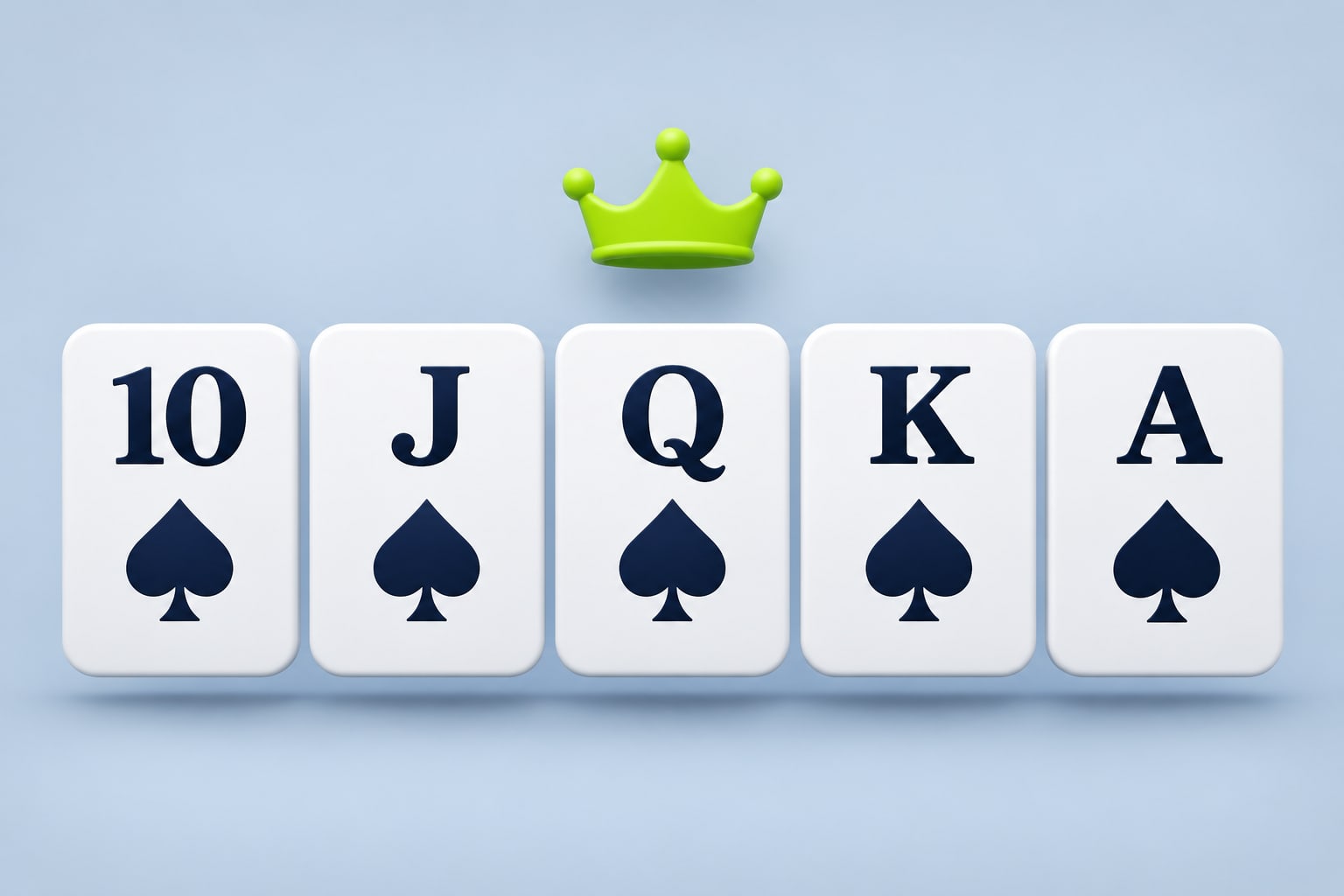
Visual explanation
Ten through ace, all one suit
An ordinary royal flush without wild cards.
All five cards are spades
Ranks
10–J–Q–K–A
The five highest consecutive ranks.
Suit
All the same
A mixed-suit 10–J–Q–K–A is a straight, not a flush.
Any of the four suits can form a royal flush; suits do not rank one royal above another in ordinary high poker. Awards depend on the game. See video poker.
The five required cards
A royal flush consists of the ten, jack, queen, king and ace of one suit. It is also called a royal straight flush or simply a royal. The cards form both a straight and a flush, with the ace at the high end of the sequence. Under standard high-poker rankings without wild cards, no hand ranks above it. The suit may be spades, hearts, diamonds or clubs. The name identifies the same pattern in each case. A mixed-suit ten-to-ace sequence is a Broadway straight rather than a royal flush, so both the ranks and the suits must be checked.
A particular kind of straight flush
A straight flush contains five consecutive ranks in one suit. The royal is its highest possible version, rather than an unrelated type of card structure. Nine, ten, jack, queen and king of hearts make a king-high straight flush, which is extremely strong but is not a royal. Ace, two, three, four and five of hearts make a five-high straight flush under standard rules. The ace does not allow sequences to wrap around from king through ace to two. A hand such as queen, king, ace, two and three of one suit is a flush, not a royal or a standard straight flush.
Use only cards the game permits
A royal must be constructed according to the game's card-selection rules. In Texas Hold'em, a royal on the five community cards can be used by all remaining players, producing a shared high hand. In Omaha, each player must use exactly two hole cards and exactly three board cards. A royal-looking board therefore does not give every Omaha player a royal. A player holding only the ace of the relevant suit cannot simply combine it with four board cards under Omaha rules. Naming the visible pattern is only the first step; checking whether the player can legally use those five cards is essential.
The suit does not create a higher royal
In standard high poker, a royal flush in spades does not outrank one in hearts merely because spades are sometimes treated as the most prestigious suit in artwork. Ordinary showdown hand comparisons do not use suit prestige to break equal hand ranks. Particular procedures may use suits for other purposes, but those procedures should not be confused with the ranking of a five-card poker hand. Also distinguish a completed royal from four cards toward one. Four suited high cards remain a draw until the missing card arrives, and the potential top hand does not receive a completed hand's ranking in advance.
Video poker awards depend on the paytable
In video poker, a royal often receives the largest listed standard-hand award, but its payment is determined by the exact schedule and stake setting. Some tables increase the royal's effective return at a particular coin count, making it important to read the selected column. A displayed number may be credits rather than currency. For example, an award of 4,000 credits at a denomination of 0.25 represents 1,000 currency units. That conversion does not establish the award on every machine. Progressive versions and special features can change the amount, and wild-card games may list natural and wild-assisted royals separately.
Rarity does not make a royal due
The chance of a royal depends on the game and the stage being considered. An initial five-card deal, a final video poker hand after strategic discards, and a seven-card poker holding are different probability problems. A player who has gone a long time without a royal is not owed one on the next independent deal. Nor does seeing another player's royal make it unavailable in a newly shuffled independent game. Use probabilities matched to the actual rules and decision point. The term describes a precise completed hand; it does not predict its arrival, justify increasing stakes, or guarantee that pursuing a royal is the best available decision.