An outside, or open-ended, straight draw has four consecutive ranks that can be completed at either end. If those four cards share a suit, a same-suit card at either end completes a straight flush. The draw is not yet a made hand.
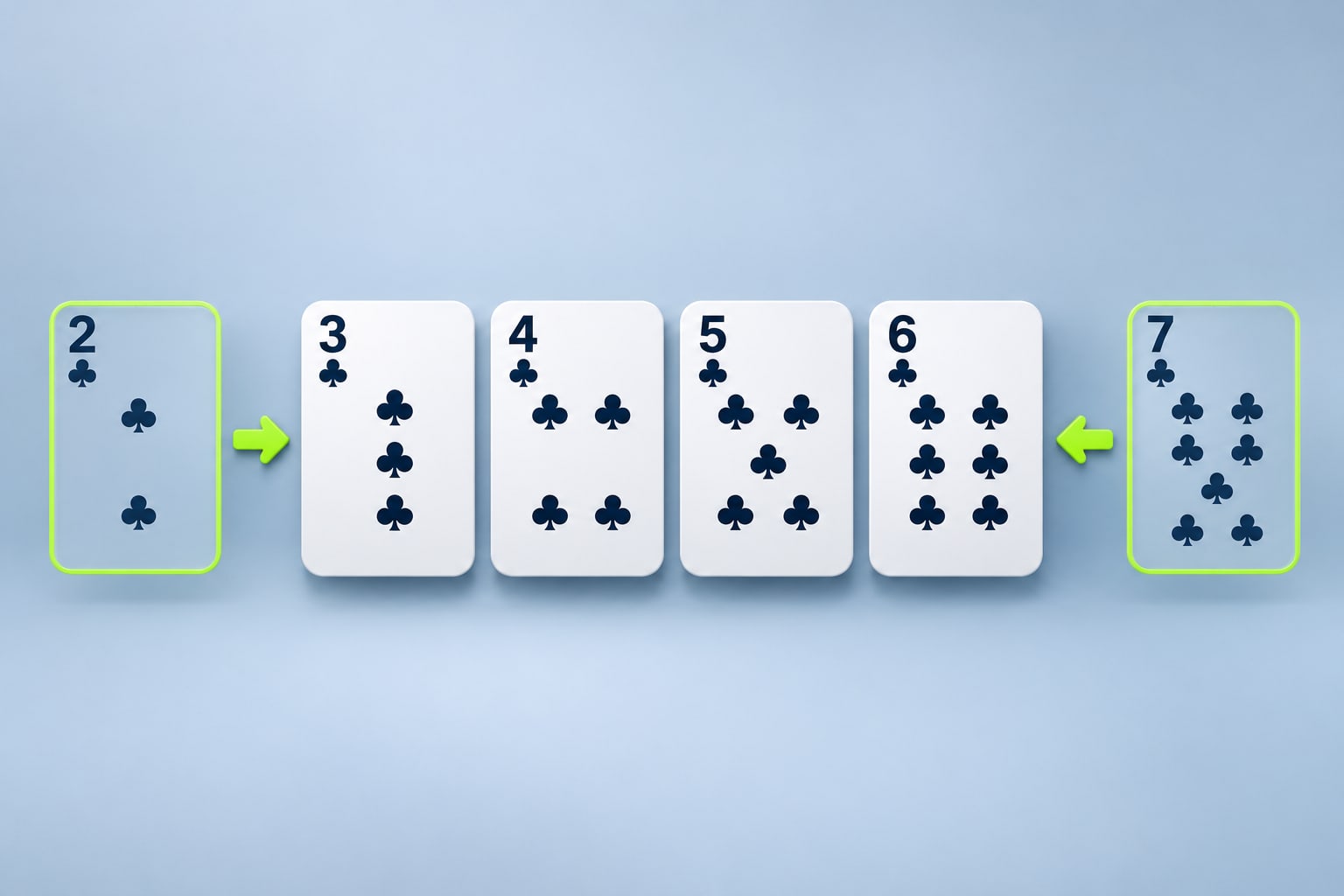
Visual explainer
An outside draw has two open ends
Hold 3♣, 4♣, 5♣ and 6♣; discard K♦ in an ordinary single-deck, one-card video-poker draw.
Straight flush
2 cards
2♣ or 7♣ completes the suited sequence.
Ordinary straight
6 cards
A two or seven of hearts, diamonds or spades completes an unsuited straight.
2 + 6 = 8 straight-completing cards out of 47. The two straight-flush cards are already included in those eight; do not count them twice.
Other clubs can complete a flush. This illustration counts outcomes, not the best hold for every paytable. Related: Four Card Inside Straight · Straight Flush.
Two ranks can complete the sequence
An outside straight draw contains four consecutive ranks with room for a completing card at either end. Three, four, five and six can become a straight with a two or a seven. The word outside distinguishes those endpoint completions from an inside draw with a missing rank in the middle. It describes a drawing possibility, not an already completed five-card straight. The full game context still matters: community-card poker, draw poker and video poker have different information and decision structures. Identify the four ranks first, then examine which completing cards are actually available and what rules govern the final hand.
Same-suit cards create a straight-flush possibility
If the three, four, five and six are all clubs, the two of clubs or seven of clubs completes a straight flush. A two or seven of another suit completes an ordinary straight instead, while another club may complete a flush without extending the consecutive sequence. These outcomes are not interchangeable on a paytable. The suits therefore matter when the phrase includes straight flush. A description that gives only ranks is enough to recognise an outside straight pattern but not enough to establish a same-suit draw. Educational examples should show both rank and suit whenever the distinction affects the claimed completion.
Count available cards rather than just rank names
In a standard deck there are four cards of each rank. A simple outside straight draw can therefore have eight rank-completing cards before accounting for known unavailable cards or other game-specific constraints. The same-suit straight-flush target in the clubs example has only two exact completing cards: the two of clubs and seven of clubs. Do not count those two again as separate straight outs when combining categories; they are already among the eight cards that complete the straight. A card can satisfy several descriptions at once, but it remains one physical card and one possible next-card outcome.
A one-card video poker example
Suppose the initial five-card hand is three, four, five and six of clubs plus the king of diamonds in an ordinary single-deck video poker game. Holding the four clubs leaves forty-seven cards available to replace the discarded king. Two of those cards complete a straight flush, so that particular probability is two in forty-seven under the stated rules. Eight cards complete a straight of some kind, including those two straight-flush cards. Other clubs can produce a flush. This example concerns one replacement card and does not apply unchanged to a poker situation with two community cards still to come or to a game using wild cards.
Endpoints and known cards can change the count
Ace-related sequences require care because an ace can be low in ace, two, three, four, five or high in ten, jack, queen, king, ace, but ordinary poker straights do not wrap around through king, ace, two. Four cards at the end of the rank range are therefore not automatically an eight-out open-ended draw. Known discarded or exposed cards can also reduce available completions in the relevant game. In opponent poker, completing a straight does not necessarily mean winning the pot if a stronger hand is possible. Distinguish cards that improve a hand from cards that are certain to make it the best hand.
Recognition is only one part of the decision
A draw's name helps organise the analysis, but it does not by itself tell a player to call, raise or discard particular cards. Poker decisions depend on the price of continuing and possible opponent hands; video poker holds depend on the full paytable and competing outcomes. Use the calculation appropriate to the game instead of transferring a shortcut between formats. A missed draw is an ordinary possible result, not evidence that the next attempt must succeed. Confirm the total wager and the selected hold before continuing, and keep the possible losing outcome in view alongside the attractive completed straight or straight flush.