Rank is a card’s identity within the ordered set of values, such as seven, jack or ace, separate from its suit. Hand rank refers to the relative strength of an entire poker hand.
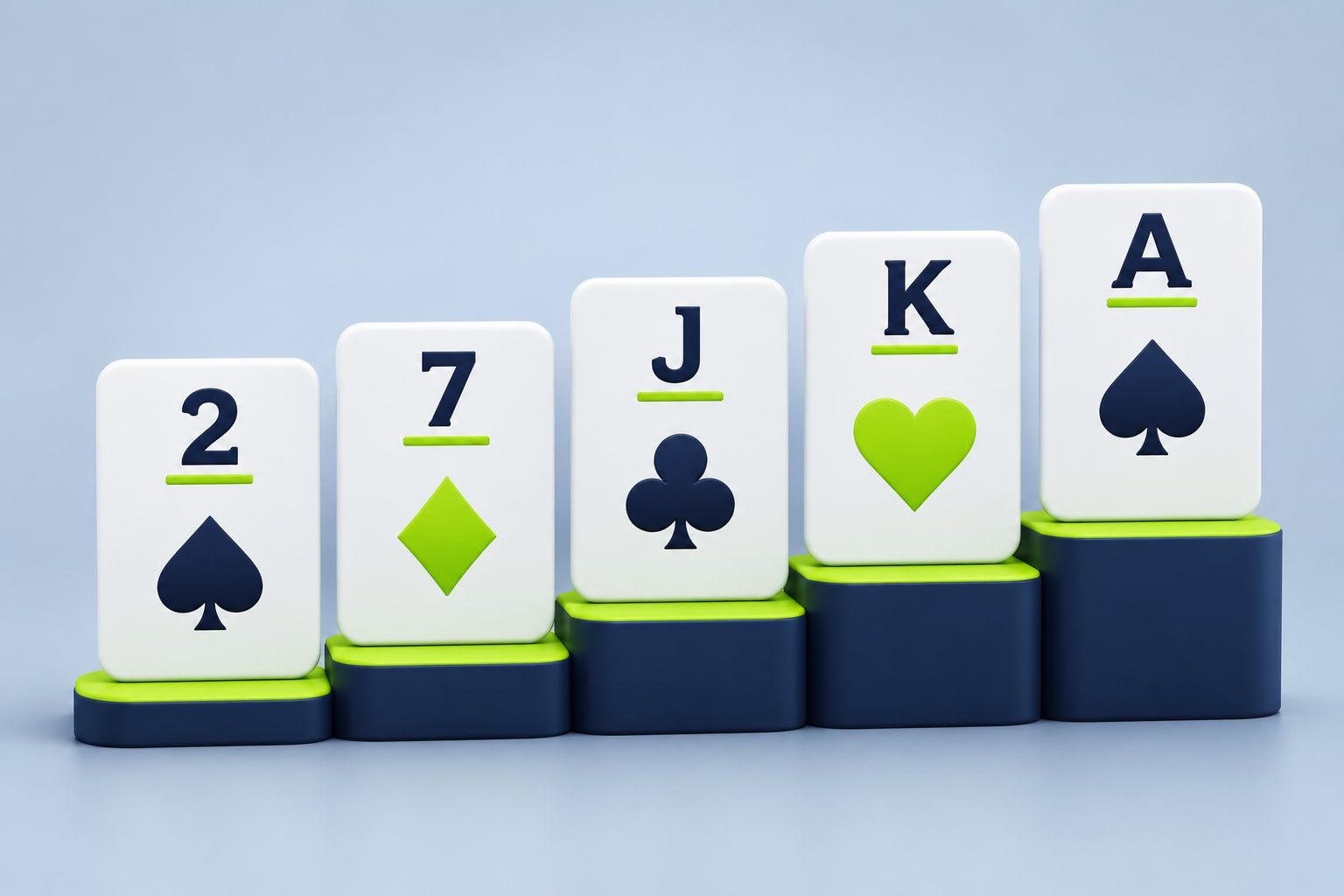
Visual explainer
Card rank and hand rank are different
A card has a rank and a suit. A poker hand has a category determined by its full combination.
Card rank
Queen
All four cards above share the same rank; their suits differ.
Poker hand rank
One pair
Q♠ Q♥ 9♦ 6♣ 2♠ is a pair of queens in standard high poker.
A queen counts as 10 in blackjack. That point value does not change its rank into a ten.
Aces and hand ordering depend on the game rules. Related: Face Cards · Three of a Kind.
Rank and suit identify different features
A standard 52-card deck contains thirteen ranks in each of four suits. The ranks are two through ten, jack, queen, king and ace; the suits are clubs, diamonds, hearts and spades. The seven of clubs and seven of hearts share a rank but have different suits. The seven of clubs and king of clubs share a suit but have different ranks. This distinction matters whenever rules refer to matching cards, consecutive cards or suited cards. A pair in ordinary poker requires two cards of the same rank, whereas two cards of the same suit are simply suited and do not automatically form a pair.
Rank is not always a point value
A card's printed rank remains the same even when different games assign it different scoring values. In blackjack, a jack, queen and king each count as ten, but they are still three distinct ranks. An ace can count as one or eleven for a blackjack total without becoming a different card. Poker normally compares ranks in an ordering rather than adding their numerical values together. Consequently, calling rank just the number on a card is incomplete: picture cards and aces have ranks too, and the scoring value used in a particular game is a separate rule that must be checked rather than assumed.
How rank forms poker combinations
Matching ranks create familiar poker categories. Two sevens form a pair, three sevens form three of a kind, and four sevens form four of a kind in a standard deck. Consecutive ranks can form a straight when five appropriate cards are present. Suits contribute differently: five cards of one suit can form a flush even when their ranks are not consecutive. A hand can combine these properties, as with a straight flush. These descriptions identify the pattern, but a game's rules still determine which cards may be used. Omaha, for example, requires exactly two private cards and three community cards for each five-card hand.
The ace depends on the rules
Under conventional high poker rankings, the ace normally ranks above the king. It can also act below the two in the special five-high straight A-2-3-4-5. It cannot wrap around the sequence to make a straight such as K-A-2-3-4. Lowball creates another distinction: ace-to-five games treat the ace as low, while deuce-to-seven games treat it as high. These are not changes to the physical card's identity; they are changes to the ordering and evaluation rules. When moving between variants, identify how aces, straights and flushes are treated before comparing two hands or describing one as the lowest possible combination.
Card rank versus hand rank
Hand rank describes the relative strength of a complete poker holding, rather than the identity of one card. Under standard high-hand rules, a flush belongs to a higher category than a straight. Within a category, individual card ranks settle many comparisons. A pair of kings beats a pair of queens, and equal pairs may require comparison of the remaining cards, called kickers. In a standard five-card comparison, only the best permitted five cards matter. Suits generally do not break ties between otherwise equal poker hands, although a game's separate procedures may use suit ordering for matters such as selecting an initial dealer.
Reading instructions precisely
When a rule says to match rank, look for the same card identity rather than the same suit or scoring total. When a paytable lists qualifying hand ranks, look for the whole required combination. For example, jacks or better in video poker concerns a qualifying pair of jacks, queens, kings or aces; one isolated high card does not meet that requirement. If a game uses a shortened deck, wild cards or special rankings, consult its own rules before applying standard assumptions. Clear separation of rank, suit, point value and hand category makes card-game instructions easier to follow and helps explain why superficially similar cards can produce different results.