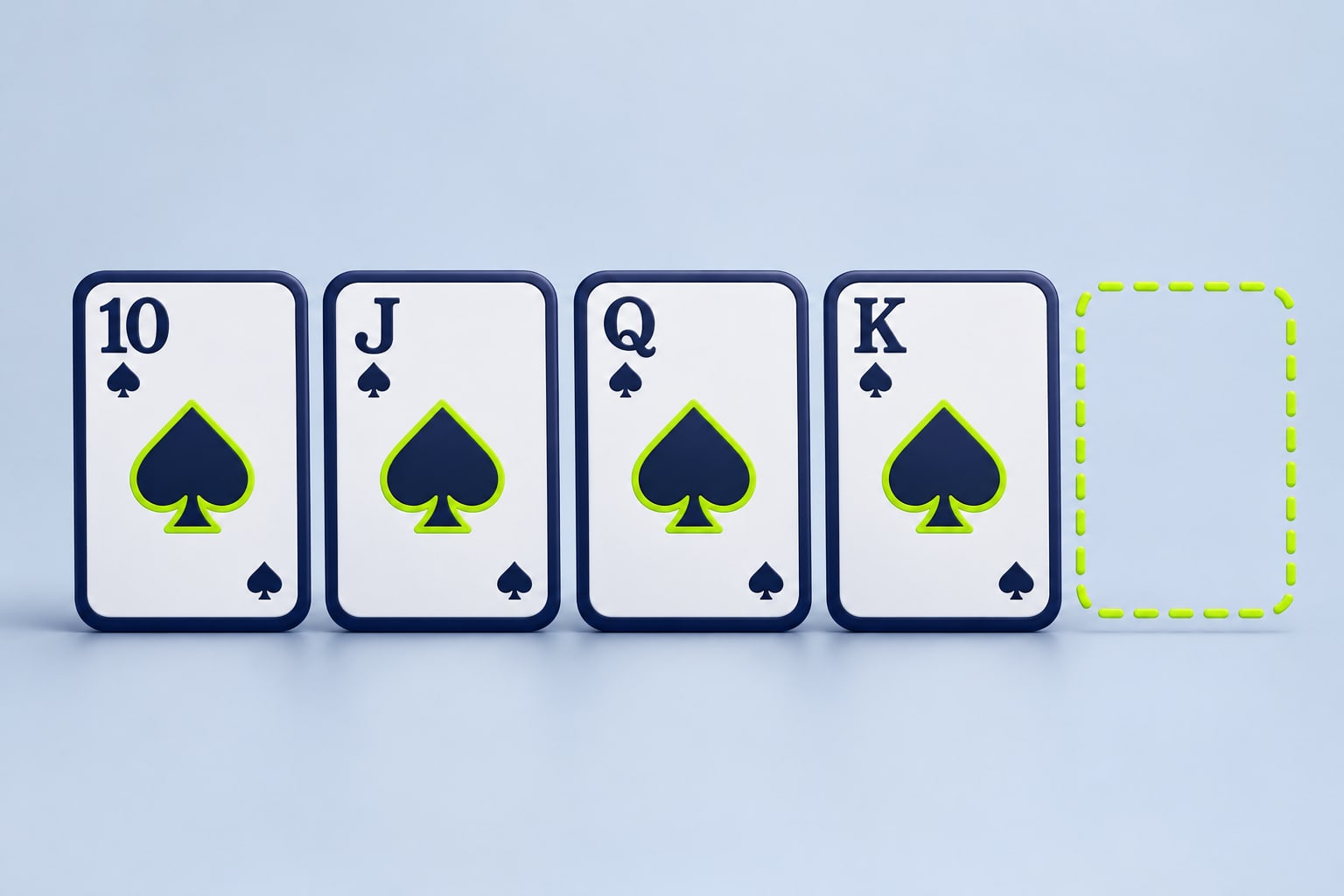
A four-card royal flush means four of the five same-suit cards needed for a royal flush: ten, jack, queen, king and ace. It is a draw or partial holding, not a completed royal flush.
Visual explainer
Four held cards; one exact card missing
Standard 52-card draw-video-poker example: the original five cards are 10♠ J♠ Q♠ K♠ and 3♦. Hold the four spades and discard 3♦.
Possible replacements
47 cards
The five original cards are excluded from the replacement pool.
Royal completion
1 / 47 ≈ 2.13%
Only A♠ completes this royal on the one-card draw.
An ace of another suit does not complete the royal. A 9♠ makes a different straight flush, not a royal flush.
Other replacement cards may produce other awards. This is a completion calculation, not a strategy recommendation; check the game’s paytable and draw rules. Related: Royal Flush (Also, Royal Straight Flush or Royal) · Draw.
Four required cards and one missing card
A natural royal flush contains ten, jack, queen, king and ace, all in the same suit. A four-card royal holds four members of that set and needs the exact missing card to complete it. Ten, jack, queen and king of spades therefore need the ace of spades. A king of hearts does not substitute for the missing spade, and a nine of spades creates a different possible straight-flush result rather than a royal. The phrase is common in video-poker strategy, but it must not be mistaken for a separately ranked four-card poker hand under ordinary five-card rankings. A game can display a draw suggestion without crediting any award for the incomplete combination.
The one-card video-poker draw
In a conventional single-deck draw-video-poker game, a player dealt four cards to a natural royal can hold them and discard the fifth card. If the missing royal card is among the forty-seven cards not in the original five-card deal, one of those forty-seven replacement cards completes the royal. That gives a one-in-forty-seven completion chance for that particular one-card draw. The calculation assumes an ordinary fifty-two-card deck and the standard replacement procedure. It does not apply unchanged to wild-card decks, unusual redraw rules or community-card poker, where visible cards and legal card-use requirements can differ.
Other replacement cards can still pay
Failing to draw the missing royal card does not always mean the final hand pays nothing. Depending on the four held cards, the replacement can produce a flush, a straight, a straight flush or a paying pair under the game's schedule. The value of holding four to a royal comes from the complete set of possible outcomes and their awards, not only the jackpot chance. Some four-card royal holdings have different secondary possibilities from others. This is why a strategy calculation uses the exact cards and paytable rather than assigning every visually similar partial royal the same value without analysis.
Compare the full holding decision
A starting hand can present competing choices. The fifth card may complete an existing flush or straight, or the hand may contain another paying combination. Whether to break that made hand for a four-card royal draw depends on the particular game and payout schedule. A natural-royal award that changes at maximum credits can also affect the comparison. Use a strategy reference or analyzer that matches the exact table and wager level. Do not apply a memorable rule from Jacks or Better automatically to every bonus or wild-card variant, especially when special awards change the value of alternative holds.
In community-card poker
A hold'em player can also describe having four to a royal among the available cards. The player still needs the right future card and must use the best legal five-card hand at showdown. If the required card is already known to be unavailable, the apparent draw is not live. If the royal ends up entirely on the community board, all eligible remaining players can share that best hand. Other game formats impose different requirements on how many hole cards must be used. The phrase describes a possibility, while the actual board and card-use rules determine whether completion is possible and who benefits from it.
A rare target is not a reason to chase losses
A large royal-flush award can make the draw memorable, but each attempt still has a substantial chance of missing. Increasing the stake because several previous draws failed does not improve the next replacement-card probability. Likewise, a one-in-forty-seven chance does not promise one royal in every forty-seven attempts. Choose an affordable denomination and read the paytable before playing, then evaluate decisions using the correct expected returns. Four cards to a royal is useful strategy vocabulary because it identifies a specific draw. It is not a completed prize, a guaranteed recovery opportunity or evidence that a jackpot is becoming due.