Face down describes a card positioned with its back visible and its rank and suit concealed. It does not necessarily mean that any player has looked at or knows the card.
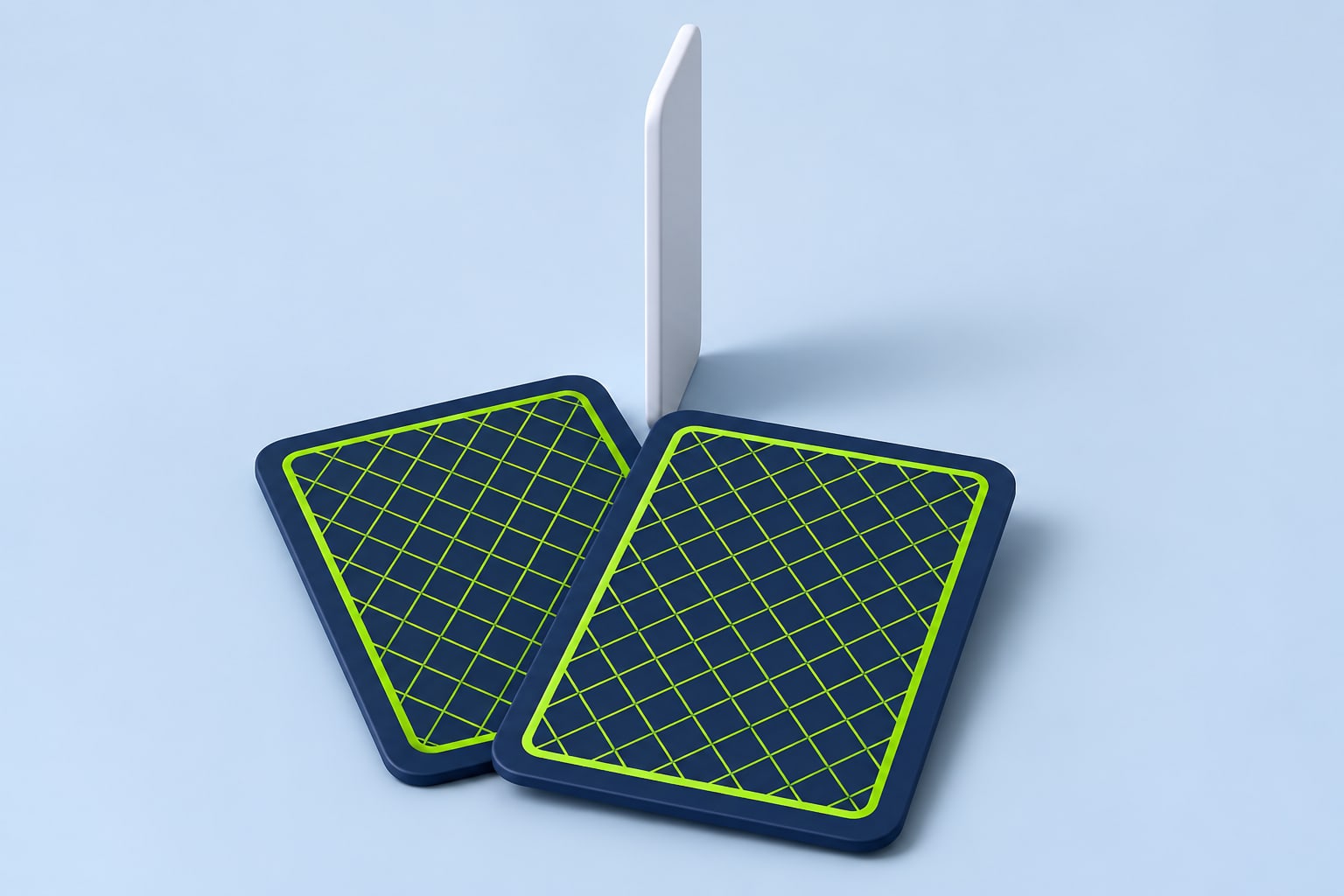
Visual explainer
Face down describes visibility, not who has looked
Three examples of cards with their backs facing observers.
Player’s hole cards
Dealer’s hole card
Undealt deck card
The visible card back reveals no rank or suit. “Face down”, “known to someone” and “discarded” are three different descriptions.
Never infer permission to look from the physical position alone. This diagram describes information access, not a technique for gaining hidden information. Related: Seven Card Stud Poker Game · Muck.
Orientation rather than ownership
A face-down card has its back showing instead of the face that identifies its rank and suit. The term describes orientation and visibility. It does not, on its own, establish who owns the card, who is allowed to examine it, or whether anybody knows its identity. A player's private cards may be face down on the table after that player has looked at them. Cards remaining in a shuffled deck are also face down, although their identities should not be known to players. Understanding this distinction prevents the mistaken assumption that every concealed card is already information held by one particular participant.
Private cards in community-card poker
In Texas Hold'em, each player receives two private hole cards. At a physical table, those cards are usually kept face down while the player looks at them discreetly. Community cards are then exposed face up for the remaining players to use according to the game rules. A face-down holding gives its owner information that opponents do not normally have, but it does not give the owner permission to exchange information with another player. At showdown, the procedure for revealing a hand depends on the applicable rules. A hand that has not yet been shown should not be confused with a hand that has already been folded.
Stud mixes visible and concealed cards
Seven-card stud illustrates why card orientation is part of a game's information structure. The opening deal normally gives each player two cards face down and one face up. Further cards are dealt in a prescribed mixture of exposed and concealed positions. Players can use the visible cards to assess possibilities, while the hidden cards remain uncertain to opponents. The final five-card hand is selected under the variant's rules, not simply from the cards that happened to be exposed. Seeing several strong face-up cards can therefore provide information without revealing the complete hand. Razz and other stud variants can use similar dealing structures with different hand rankings.
Face-down cards in blackjack
Some blackjack procedures include a dealer hole card dealt face down, while other procedures do not deal the dealer's second card until later. Whether a dealer checks for blackjack, and when, depends on the specific game. Players' own cards may be dealt face up or face down in different formats. Do not infer the full rule set from one hidden card. Read the rules for dealer checks, player handling and settlement, and follow the dealer's instructions. Concealment is part of the intended game procedure; it is not an invitation to seek unauthorized views of a card or interfere with the dealing process.
Online displays and accidental exposure
An online game may show a card-back graphic where a physical game would place a face-down card. That graphic tells the viewer the card is concealed at that stage; it does not reveal how the software stores or determines the result. Likewise, a live camera view that does not show a card's face should not be treated as evidence that the card has no assigned value. If a card is accidentally exposed at a physical table, the dealer or floor staff apply the relevant procedure. Players should not invent their own remedy, assume the hand is automatically void, or continue based on an unsupported interpretation.
Keeping terminology separate
Face down is the opposite of face up, whereas folded, dead, private and undealt describe different properties or states. A folded hand may be lying face down, but a face-down hand is not necessarily folded. An undealt card may be concealed, but concealment does not mean it belongs to a player. When reading rules or a hand history, ask three separate questions: where is the card, who may inspect it, and whether it remains part of a live hand. Those details explain the actual situation more accurately than visibility alone and help prevent avoidable misunderstandings when several concealed cards are present at once.