Seven-card stud is a poker game in which each remaining player receives up to seven personal cards, normally three face down and four face up. In the standard high-hand version, the best five-card poker hand wins at showdown.
Visual explainer
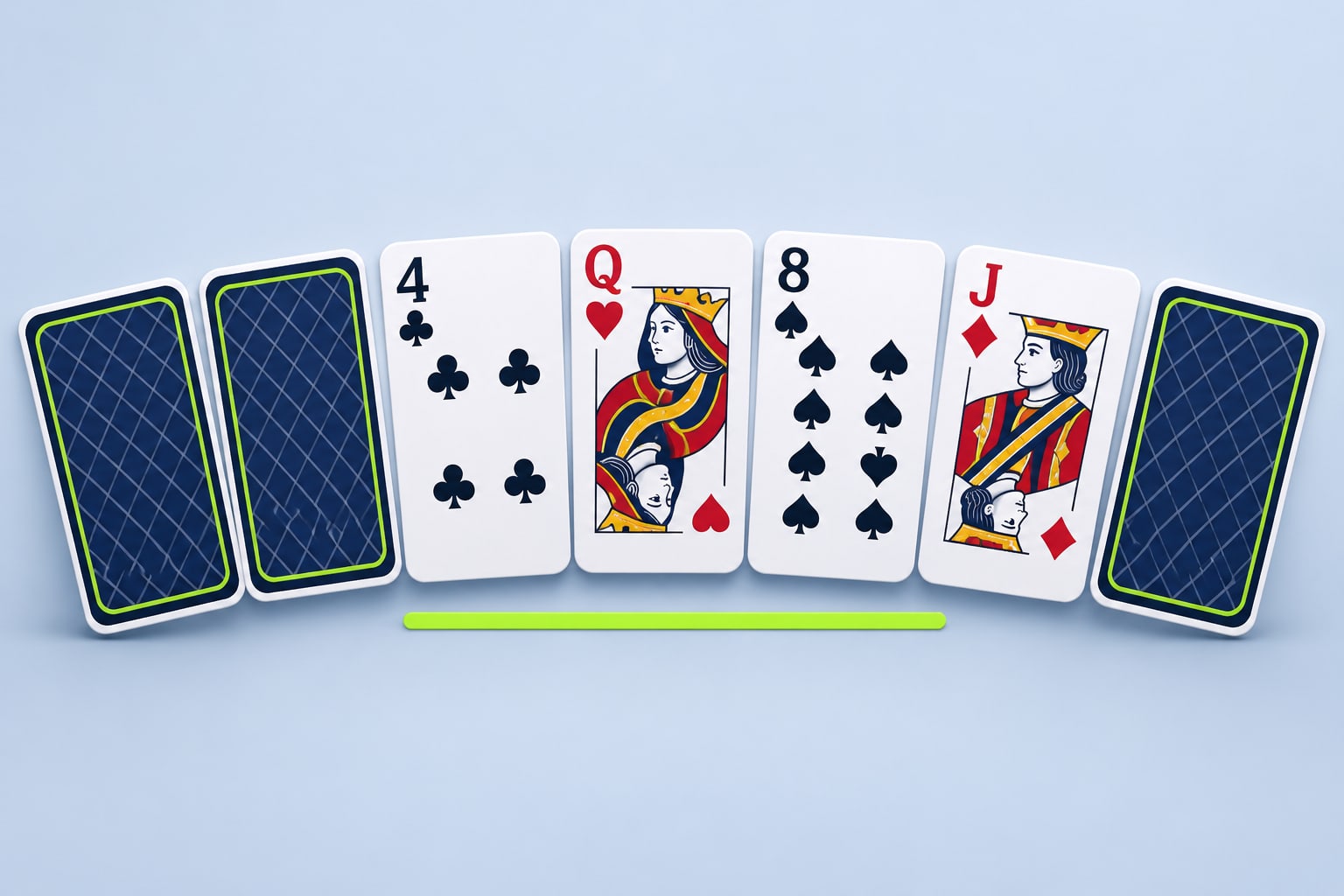
Seven cards arrive across five betting stages
Normal seven-card stud dealing pattern for a player who remains in the hand.
2 down + 1 up = 3 cards.
Add 1 up: 2 down + 2 up.
Add 1 up: 2 down + 3 up.
Add 1 up: 2 down + 4 up.
Add 1 down: 3 down + 4 up.
At a standard high-hand showdown, select the best five-card hand from the seven personal cards. Seven cards are available; the ranked hand still uses five.
Special procedures can apply if the deck runs short. Related: Third Street · Fifth Street.
Personal cards rather than an ordinary community board
Seven-card stud gives each player a combination of private and exposed cards. Unlike the usual hold'em structure, players do not build their hands from a shared five-card board. Each player's exposed cards provide public information about that particular hand. A participant who folds stops receiving later cards, so not every player necessarily reaches seven. The standard high-hand game uses ordinary poker hand rankings, but related stud variants can award low hands or split the pot. Establish the variant before applying a rule about which hand wins. The phrase seven-card stud describes a dealing structure, while additional wording can change the objective.
The initial three cards and opening action
After the required antes, the initial deal normally gives each participant two face-down cards and one face-up card. This stage is called third street, and the exposed card is commonly called the door card. In standard stud high, the lowest exposed starting card determines the bring-in under the table's tie-breaking rules. The bring-in starts the betting action, after which other players respond according to the betting structure. This differs from assuming that a hold'em-style small blind and big blind govern every poker game. Check the ante, bring-in and permitted bet sizes before interpreting the cost of entering the hand.
Later streets reveal more information
Fourth, fifth and sixth street normally add one face-up card to each remaining player's hand, with betting between stages. Seventh street normally adds a final face-down card. Thus a player reaching the end ordinarily has three private cards and four exposed cards. The public information develops gradually rather than appearing as one communal flop. In a fixed-limit game, the permitted betting increment commonly rises on later streets according to the rules. The player who acts first can also change as exposed boards develop. Follow the current street and visible cards instead of assuming one seat always opens every betting round throughout the hand.
Only the best five cards determine the high hand
Receiving seven cards does not create a seven-card ranking category. At showdown in the standard high version, each player selects the strongest five-card poker hand available from their seven cards. Suppose a player's cards include three queens, two sevens and two unrelated cards. The best five can form queens full of sevens, a full house; the unrelated cards do not need to be included. A visible four-card board is therefore only part of the information needed to identify the complete final hand. A player who appears strong from exposed cards can still be beaten once private cards are revealed under the showdown procedure.
Visible cards affect what remains possible
Because exposed cards are known to everyone, they can help describe which ranks and suits remain available. If several cards of a desired rank are already visible elsewhere, that matters when considering a draw. The information is still incomplete: opponents' private cards remain unknown, and a plausible drawing opportunity is not a guaranteed improvement. Avoid treating a high door card as proof of a hidden pair or a sequence of exposed cards as proof of a completed straight. A careful account separates what is seen from what is inferred. This distinction makes hand analysis more accurate without pretending that uncertainty can be removed from the game.
Check the table-specific details
The rules should explain betting limits, tie handling, exposed-card accidents and unusual situations such as too few cards remaining for the normal final deal. Do not improvise a remedy from another poker variant. Online, the table information and hand history should identify the game and relevant structure; live, ask the dealer before committing funds if something is unclear. Knowing the dealing sequence is the foundation for understanding a hand, but it does not ensure a positive result. Antes and later bets all contribute to the total amount at risk, so assess the whole hand's possible commitment rather than focusing only on the small opening ante.