A door card is the first face-up card dealt to a player in stud poker. It is public information about that player’s hand, while the initial face-down cards remain private. The term is especially common in seven-card stud.
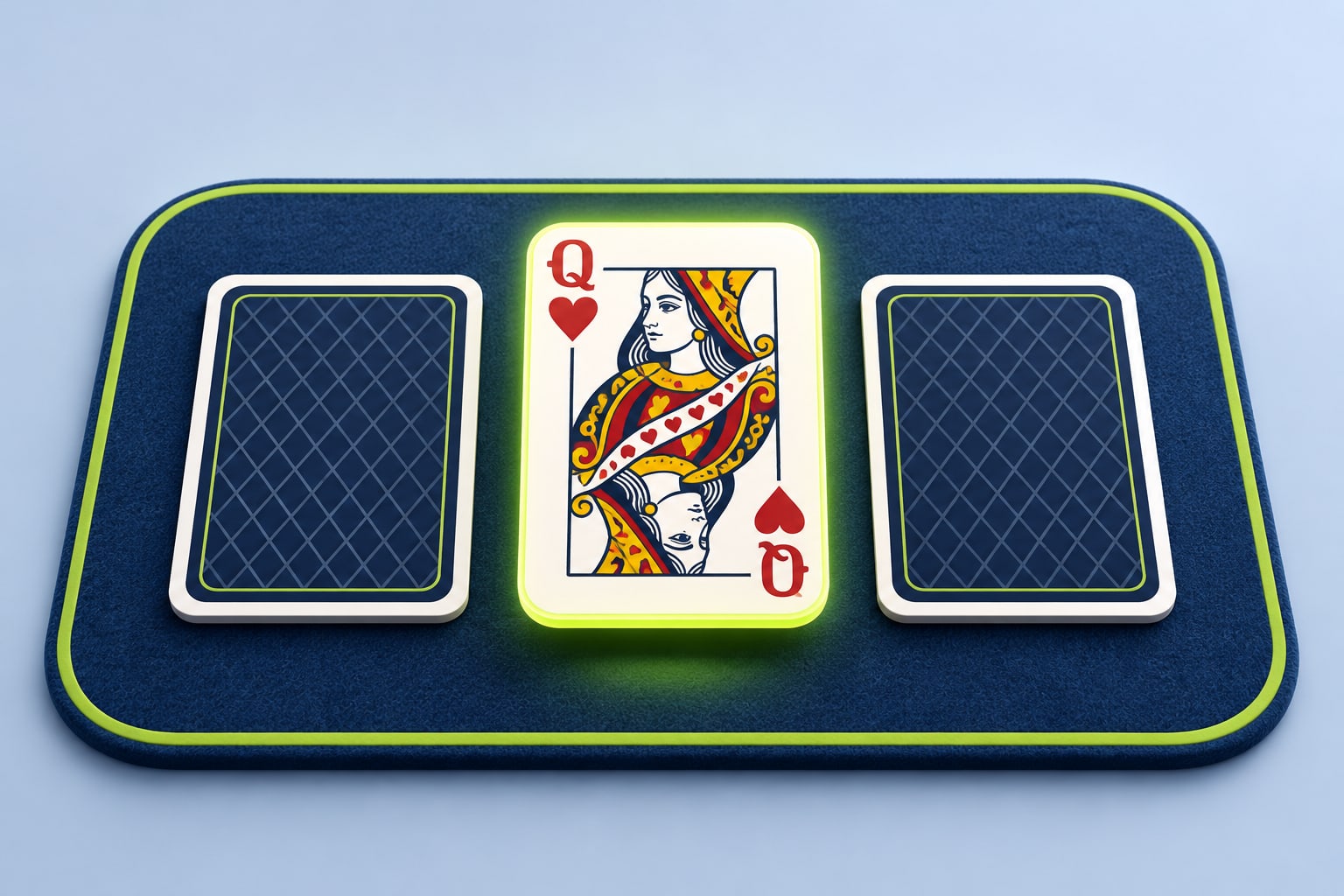
Visual explainer
The same door card can conceal different starting hands
Two alternative seven-card stud examples; these are not two players in the same deal.
Opponents see Q♥ in either example. That exposed queen alone does not prove a pair, and it belongs to its owner rather than a shared board.
Only the first face-up card is the door card. Related: Third Street · Seven Card Stud Poker Game.
The first exposed card
In ordinary seven-card stud, each player begins with three cards: two face down and one face up. The exposed card is commonly called the door card. Everyone at the table can see its rank and suit, while only its owner can normally inspect the two private cards. This makes the opening information different from a game in which all initial cards are hidden. The door card belongs to one player's hand; it is not a community card shared by everybody. Identifying whose exposed card is being discussed is therefore important when reading a hand history or following an explanation of the opening betting round.
A three-card example
Suppose a player receives a queen of hearts face up, with a queen of clubs and a seven of diamonds face down. The queen of hearts is the door card, and the player knows that the starting hand contains a pair of queens. Opponents can see only one queen and cannot infer the hidden pair with certainty from that exposed card. If the two private cards were instead a four and a nine, the same door card would be visible but the player's complete starting hand would be different. This example shows why an exposed high card is information rather than proof of a strong made hand.
Its role in the first betting round
Under standard seven-card stud high rules, the lowest exposed starting card determines who must begin with the bring-in, subject to the game's tie-breaking procedure. That is one practical reason the door card matters immediately. The amount of the bring-in and the permitted opening action come from the table structure. Other stud variants can use different opening rules, so do not transfer this rule automatically to every game whose name contains stud. The door card still describes the exposed starting card, but the consequences of its rank depend on the variant. Check the specific rules before assuming that a high or low exposed card must act first.
Later exposed cards change the picture
The door card remains part of the hand as later cards arrive, but it is no longer the only public information. In standard seven-card stud, the next several streets add exposed cards before the final private card. A player who initially showed a queen might later show another queen or a connected sequence, changing what opponents can observe. The first exposed card does not acquire special ranking power simply because it arrived first. At showdown, the relevant five-card hand is formed under the game's ordinary rules. Descriptions such as paired the door card identify a development in the hand rather than a separate winning category.
Visible cards and remaining possibilities
An exposed card also tells every observer that this exact card is unavailable elsewhere in the deck. If a player is hoping to draw a particular rank or suit, visible cards in other hands help describe which possibilities remain. That information is incomplete because private cards are still unknown. Seeing one queen on another player's board does not reveal where the other queens are, and it does not guarantee that a needed card will be dealt later. A careful analysis distinguishes known exposed cards, the player's own cards and genuinely unknown cards instead of treating all unseen cards as if they were certainly still available to draw.
Reading the term in context
Door card normally points to stud poker, whereas words such as flop or hole cards can refer to other structures. A writer may use the term casually for the first exposed card in another setting, so the named game remains important. In a live game, the face-up orientation makes the distinction visible; online, the interface indicates which cards are public. Do not reveal private cards merely to clarify the vocabulary. If the dealing sequence seems wrong, ask for the table's procedure before further action. Understanding the door card improves interpretation of the hand, but it does not remove uncertainty about opponents' hidden cards or the eventual result.