A live card is a card still considered available to improve a hand, especially in stud poker; the term can also describe an unpaired private card that could overtake an opponent if it pairs.
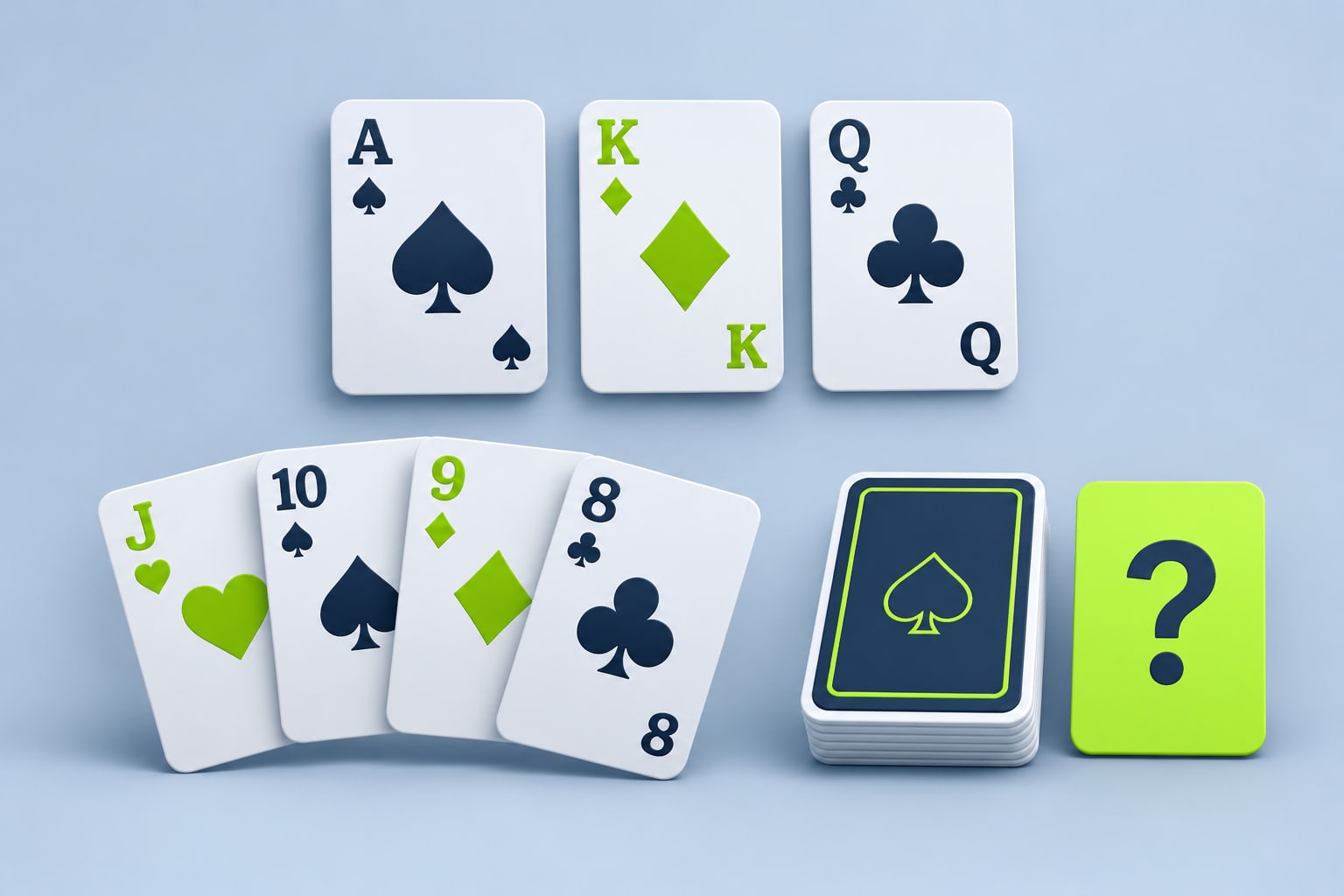
Available is more precise than undealt
Live card has several related poker meanings, so reducing it to a card that has not been dealt can be misleading. In stud discussions, players often call a useful rank or suit live when relevant cards have not been seen among exposed or folded cards. Those unseen cards are not guaranteed to remain in the deck: some may be concealed in opponents' hands or otherwise unavailable without your knowledge. The description concerns the information available to the player. A card known to be already exposed elsewhere cannot be drawn again from the same single pack, which makes tracking visible cards important when evaluating potential improvements.
Why exposed cards matter in stud
Seven-card stud reveals information through opponents' face-up cards, including cards that may later disappear into folded hands. Suppose you begin with two fives and would like another five to make three of a kind. If both remaining fives have already appeared face up elsewhere, that particular improvement is unavailable from the undealt cards. If neither has been seen, they may be described as live, although their exact locations remain unknown. This example concerns a standard single deck without wild cards. It illustrates why a remembered exposed card can affect an assessment even after the player who held it has folded and left the current action.
Live suits and drawing possibilities
The same reasoning applies to suited draws. A player hoping to complete a flush benefits from knowing how many cards of the relevant suit have already been exposed elsewhere. Seeing many of them reduces the number potentially available for future draws. However, the assessment still requires the cards in your own hand, the number of cards to come and the rules of the game. Saying that a suit is live is qualitative shorthand, not an exact probability. To calculate an actual chance, define which unseen cards are possible and how many future cards will be received rather than assigning a percentage to the label alone.
Another meaning in head-to-head comparisons
In hold'em commentary, a player may be said to have two live cards when neither private rank is duplicated by the opponent and either could pair to move ahead of an unpaired holding. For example, queen-jack against ace-king has two distinct lower ranks that can pair, although the outcome also depends on the board and possible straights or flushes. That expression does not mean the hands have equal winning chances. Nor does it guarantee that every queen or jack will remain a winning improvement after later community cards appear. Read the complete matchup rather than confusing live ranks with a promise that any particular card wins the pot.
Live cards are not always clean outs
An out is normally counted as a card that improves your hand to a winner under the assumptions being used. A card can be unseen and helpful without being a clean winning out. It might give you a pair while completing an opponent's flush, or improve both hands with the opponent still ahead. Likewise, hidden cards can reduce the true availability of an apparently live rank. Separate three questions: whether the card is known to be unavailable, whether receiving it improves your own hand, and whether the improved hand would actually win. Collapsing those questions into one optimistic count can overstate the value of a draw.
Applying the term carefully
When reviewing a hand, state what was known at the decision point rather than using cards revealed later as if they were available information. Note the game, exposed ranks, folded upcards where relevant and remaining streets. A live-card description can help explain why one draw looks more promising than another, but decisions also depend on the price of a call, opponents' possible hands and future betting. It does not require continuing with every draw. Keep the amount risked within a predetermined limit and avoid using a possible improvement as a reason to recover earlier losses. Useful card information narrows uncertainty; it does not remove it.