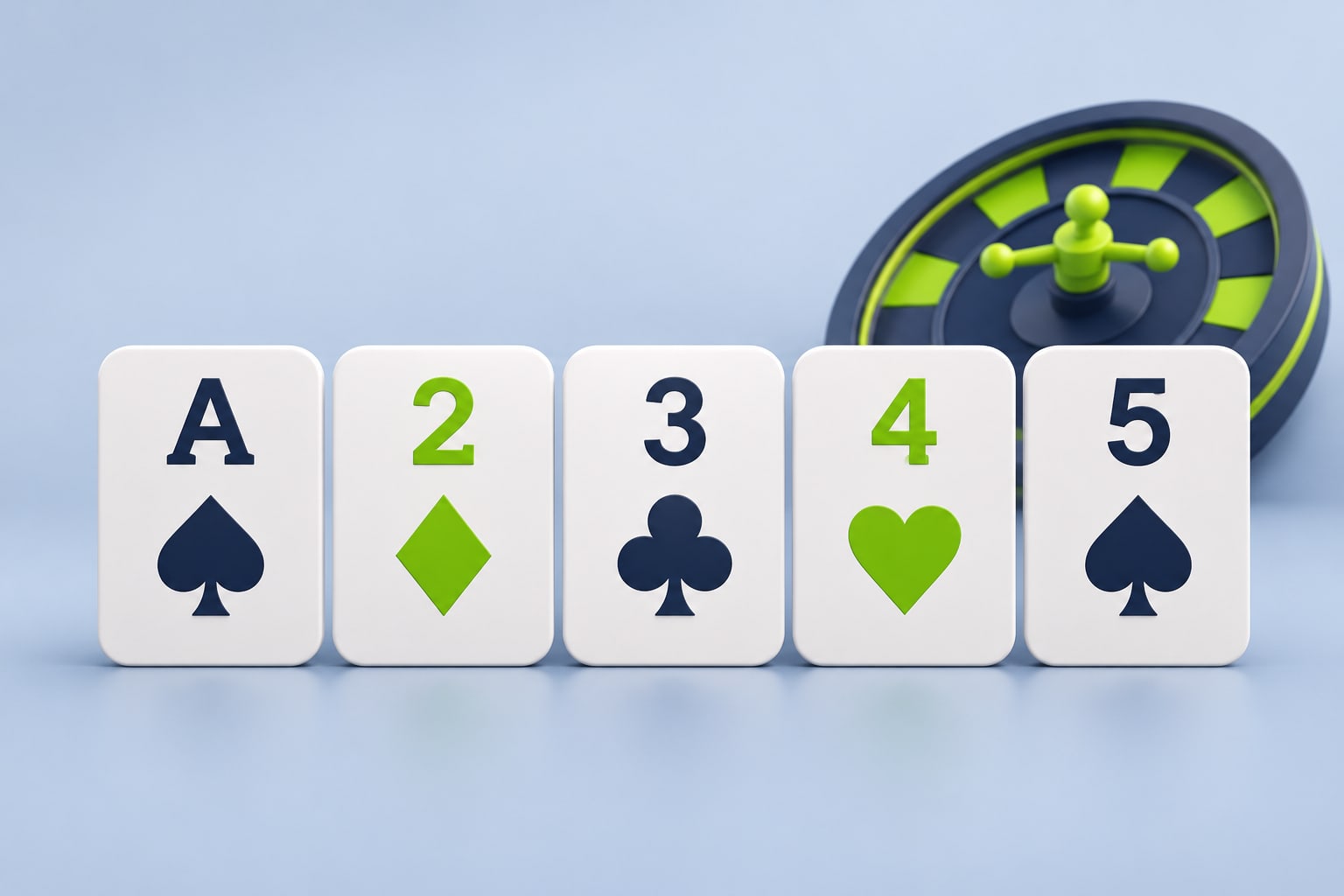
Wheel is poker slang for A-2-3-4-5. It can be the lowest straight in high poker or the best low hand under ace-to-five rules. In roulette, wheel means the spinning apparatus.
Visual explainer
A wheel: the same ranks, different ranking systems
These five mixed-suit cards form A–2–3–4–5.
Standard high poker
Ace-to-five lowball
Deuce-to-seven lowball
In high-low split games, check qualification and card-use rules separately. In roulette, “wheel” refers to the apparatus instead.
The nickname alone cannot establish a hand’s strength across different games. Related: Straight · Straight Flush.
What wheel means in poker
A wheel contains an ace, two, three, four and five. The name describes the ranks rather than the suits, so the cards can be a mixture of hearts, diamonds, clubs and spades. Players also call this combination a bicycle. However, identifying the five ranks is only the first step: its value depends on the poker variant being played. A wheel is a modest straight in ordinary high poker, an exceptionally strong low in certain lowball games, and a poor lowball holding under other rules. Always establish the hand-ranking system before treating the nickname as an assessment of strength at the table. For example, a hand-history reference to a wheel draw describes an incomplete possibility, not a completed five-card hand already held.
The lowest straight in high poker
In standard high-hand rankings, A-2-3-4-5 is a five-high straight. The ace acts below the two in this particular sequence. It loses to a six-high straight such as 2-3-4-5-6, regardless of which suits appear in either hand. The ace does not make the wheel ace-high. Nor can an ace connect both ends of the rank order: Q-K-A-2-3 is not a straight. When all five wheel cards share one suit, the hand is a five-high straight flush instead. That stronger category beats an ordinary straight, while still being the lowest straight flush under standard high-hand rules.
Why lowball rules change everything
In ace-to-five lowball, aces are low and straights and flushes do not count against a low hand. Consequently, five different ranks A-2-3-4-5 make the best possible low. Razz uses this approach, so a wheel remains an excellent low even when some or all cards share a suit. Do not transfer that conclusion to deuce-to-seven lowball. There, aces are high and straights and flushes count against the hand, making the same five printed ranks unsuitable as the ideal low. The words low poker alone are insufficient; check whether the game uses ace-to-five, deuce-to-seven, or another explicitly stated ranking method.
A wheel in a split-pot game
Omaha Hi/Lo offers another useful example. A qualifying low contains five different ranks of eight or lower, with an ace available as a low card. A wheel is the strongest qualifying low, but it does not automatically win the entire pot. Another player can make the same low, and a separate hand can win the high half. Omaha also requires exactly two hole cards and exactly three board cards for each five-card hand. Seeing A-2-3-4-5 somewhere among nine available cards does not prove that your legal combination is a wheel. Evaluate the high and low hands separately using the required card counts.
The roulette meaning
At a roulette table, the wheel is the physical or simulated device containing the numbered pockets into which the ball settles. This is a different use of the same word and has no connection with a five-card poker hand. A single-zero roulette wheel has 37 pockets, while a double-zero wheel has 38. The sequence of pockets around the rim differs from the numerical arrangement on the betting layout. A bet on neighboring numbers around the wheel therefore differs from a bet on consecutive numbers shown on the felt. Check the actual wheel type and published rules rather than judging it from a decorative illustration.
Reading the term in context
A poker hand history describing someone making a wheel usually refers to completing the ace-through-five combination. A roulette instruction about watching the wheel refers to the apparatus. Neither expression, by itself, specifies a payout or an advisable wager. In poker, compare the legal five-card hands and consider whether a pot can be shared; in roulette, identify the wager, pocket coverage and payout separately. Practice recognizing the wheel without assigning it universal strength. The same cards can have very different consequences under different rules, and a memorable nickname does not replace the rules that determine a result or settlement.