In blackjack, spread usually means the range or ratio between a players smallest and largest initial bets. Card counters may vary bets with estimated advantage, but a spread alone is not a strategy or proof of profitable play.
Visual explainer
The same bet spread can produce different turnover
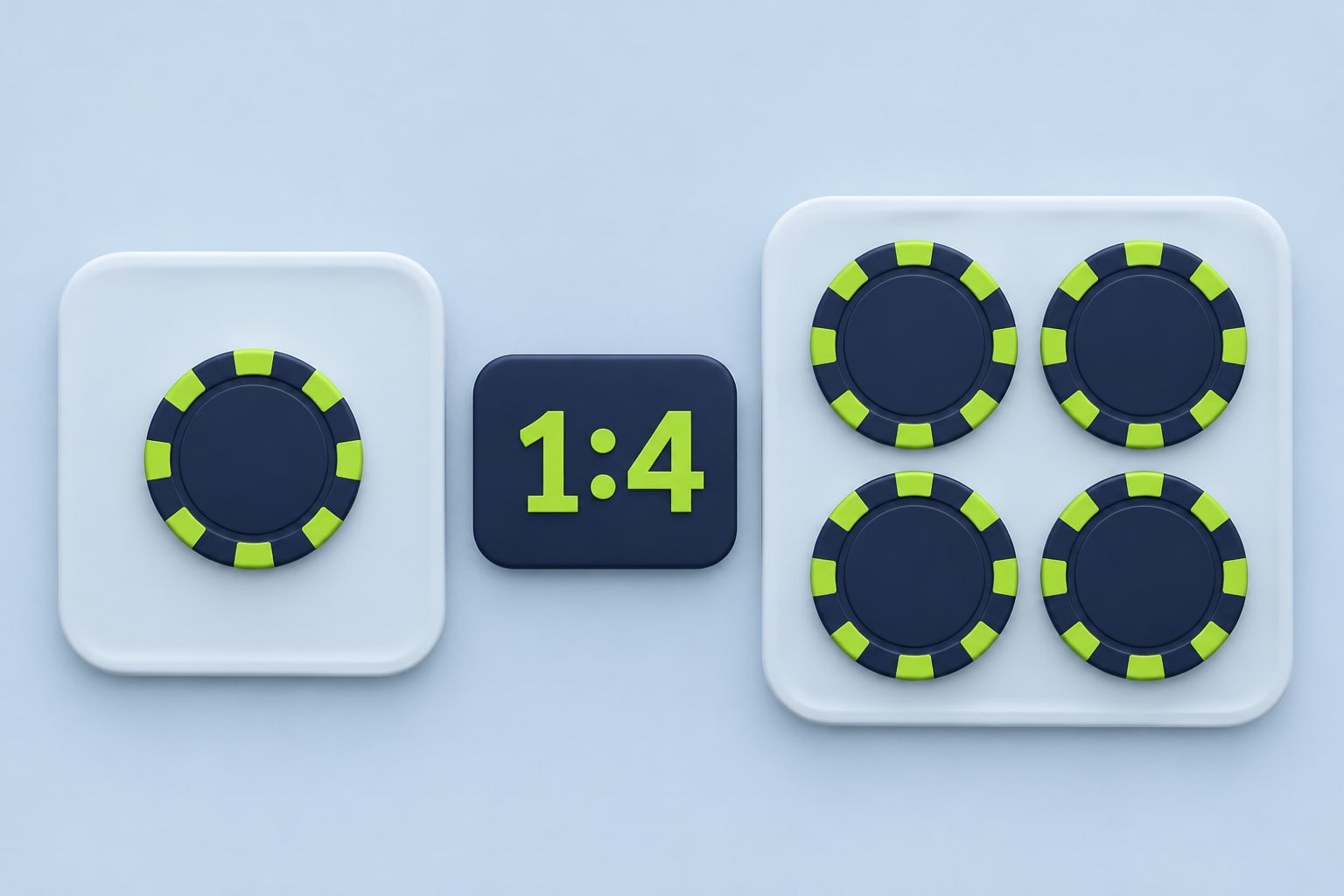
Two fictional sequences use a $10 minimum and $40 maximum initial blackjack bet: a 1-to-4 spread.
Five $10 bets + one $40 bet$90 total
Six initial wagers; average $15 each.
One $10 bet + five $40 bets$210 total
Six initial wagers; average $35 each.
The endpoints match, but bet frequency changes the total. Doubles, splits and side bets would add exposure and are excluded here.
A spread alone establishes neither an advantage nor a profitable strategy. Related: Money Put In Action · Double Down.
A range of initial wager sizes
Spread in a blackjack betting discussion usually describes the relationship between the smallest and largest initial wagers used by a player. A one-to-four spread could mean ten units at the low end and forty at the high end. It could also mean a different pair of amounts with the same ratio. The ratio alone therefore does not tell you the money at risk. State both the unit size and the range when discussing an actual session. The term normally concerns planned initial bets, so additional money committed through doubles or splits should be distinguished when calculating the total exposure of a particular round.
A ratio does not describe the whole betting plan
Two players can both use a one-to-four spread while placing their bets very differently. One might use the larger stake rarely; another might use it frequently. Their average wager and possible session outcomes would not be identical. A complete betting plan needs the conditions that select each amount, the number of hands played and the treatment of unusual situations. For a simple example, five wagers of ten units and one of forty total ninety units of turnover. Five wagers of forty and one of ten total two hundred and ten. Both sequences use the same endpoints, but their overall exposure is substantially different.
Why card counting discussions mention spread
Card-counting analysis considers how information about cards already dealt can affect the estimated composition of the remaining shoe. In that context, a player may vary initial bets according to an estimate of advantage. A spread is one constraint or feature of that approach, not the analysis itself. The game rules, dealing depth, counting accuracy and decision strategy also matter. A larger range does not automatically establish a positive expectation. Nor should a spread based on card information be confused with increasing stakes because the last few hands happened to win or lose. Those are different reasons for choosing a wager amount.
More money at the high end also means more risk
Increasing the largest bet expands the possible loss on a single initial wager and can increase fluctuations across a session. Even a theoretically favorable situation can lose. A player cannot infer a safe bankroll from the spread ratio alone because the actual amounts, frequency of large wagers and outcome variability are also relevant. Norm Wattenberger's published simulations illustrate spread effects under explicitly specified blackjack assumptions. Their figures should not be transplanted into an unrelated game with different conditions. Simulation results are conditional models, not a promise that a particular player using a similar-looking range will achieve the same outcome.
Do not confuse other uses of spread
Blackjack also has products or side bets whose names contain Spread Bet, and sports betting uses spread in an entirely different way. Those meanings do not follow from the ordinary bet-range definition. A casino's posted minimum and maximum limits are another related but distinct concept: they describe what the table permits, while a player's chosen spread describes the range actually used or planned. If a table allows five to five hundred units but a player wagers only ten to forty, the player's spread is not automatically the table's full range. Clarify which meaning is intended before comparing numbers or interpreting advice.
Record amounts and conditions accurately
For a useful blackjack session record, note the initial stakes, doubles, splits, total money committed and relevant game conditions. Do not describe a session as successful merely because the largest wagers happened to win in a short sample. Likewise, a loss does not by itself prove that a mathematical model was wrong; actual execution and random variation need separate consideration. Keep any personal spending limit independent of a desire to widen the spread. The term is valuable because it makes wager variation measurable. It becomes misleading when a simple ratio is presented as a complete explanation of advantage, risk or future profit.