A bet spread describes the relationship between a player’s smallest and largest initial wagers, commonly expressed as a ratio such as 1 to 4. It measures stake variation, not expected profit, and should specify whether multiple hands are included.
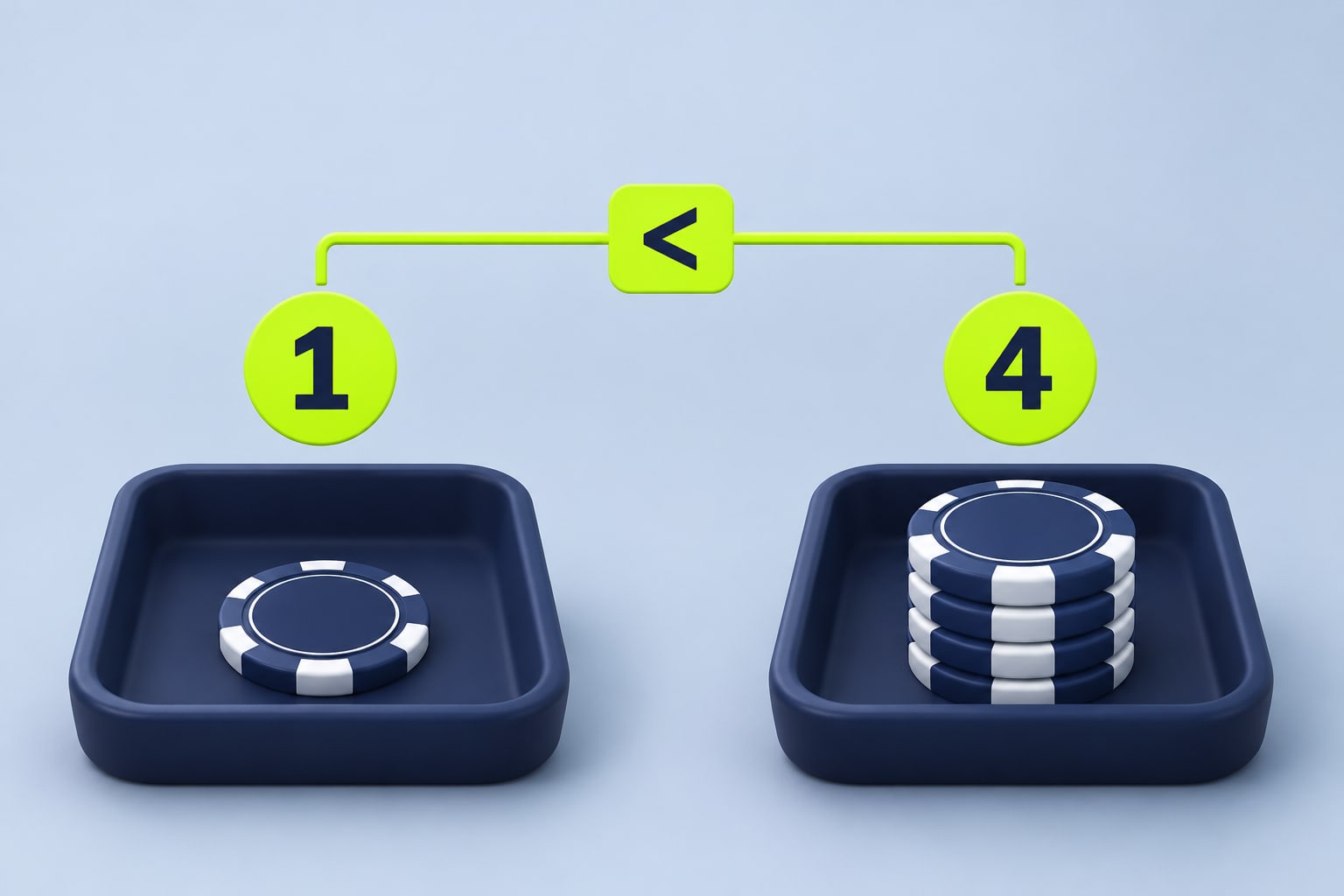
A ratio describing wager size
A bet spread expresses how far a player's wager sizes range between a stated minimum and maximum. In blackjack discussions, a one-to-four spread usually means that the largest initial wager is four times the smallest. It does not mean the player must make four bets, that every intermediate amount will be used or that the game pays four to one. The ratio describes the size range only. To make it useful, specify the unit value, the type of wager included and the period being described. A spread quoted without those details can hide a substantial difference in actual money at risk.
Visual explanation
A spread is largest ÷ smallest
Illustrative initial wagers ranging from $5 to $40.
Smallest initial wager$5
Reference: one unit.
Largest initial wager$40
Eight times the smallest wager.
$40 ÷ $5 = 8 → a 1-to-8 spread
State whether the figures include multiple simultaneous hands. Extra split or double-down money is separate from the initial-wager comparison. A spread does not create an advantage. See betting units.
Calculating a simple spread
Suppose the smallest initial wager is 10 units and the largest is 40 units. Dividing 40 by 10 gives four, so the spread can be written 1–4. If the smallest wager is 25 and the largest is 100, the same ratio applies, although every stake is larger. The ratio therefore cannot substitute for the actual amounts. A 1–4 range also does not specify how often the maximum is used. A session containing one large wager and many small wagers can have the same spread as a session that repeatedly uses the maximum, while producing very different total exposure.
Initial stakes and later additions
A blackjack hand can require additional money after the initial wager when the player chooses an allowed double or split. Discussions of bet spread commonly refer to initial wagers, but that convention should be made explicit. A 40-unit initial bet can become a larger total commitment during the hand. Counting only the first stake when assessing available funds understates the possible exposure. Conversely, treating a permitted double as a new initial-wager level can distort a record intended to describe opening stakes. Keep separate fields for the initial bet, additional wagers and total round commitment when accurate tracking matters.
Multiple hands need a clear description
Playing more than one hand introduces another dimension. A player might move from one hand at one unit to two hands at four units each. Describing that merely as a one-to-four spread hides the fact that the initial total on the layout has increased to eight units. State both the number of hands and the stake per hand. The hands also share game conditions, including the same dealer result in ordinary blackjack, so they should not be treated as completely unrelated wagers. A clear description helps distinguish per-hand limits from total exposure and avoids comparing two quite different staking arrangements as though they were identical.
A spread is not a betting advantage
The ratio alone says nothing about why stakes change or whether the selected wagers have positive or negative expectation. A player can vary bets randomly, after wins, after losses or in response to information believed to be relevant. Those are different strategies that happen to share a stake range. A wider spread does not automatically improve a player's prospects, and it can increase the size of losses. In an independent game with a fixed disadvantage, rearranging stake sizes around earlier results does not remove that disadvantage. Evaluate the underlying game and decision assumptions separately from the maximum-to-minimum ratio.
Limits, records and affordability
The table's permitted range and a player's chosen spread are different things. A table may allow much larger stakes than a player intends to use, while a personal limit may prevent the planned maximum even when the table permits it. Record actual amounts rather than allowing a ratio to make a large wager feel abstract. Consider the total committed across all hands and any possible additional actions. If a planned spread requires increasing a previously set spending limit, the plan has exceeded that limit. The term is useful for describing behaviour and comparing clearly defined stake ranges; it is not a reason to expand gambling expenditure or pursue a recovery.
Related glossary terms
Sources and further reading
- See also:
- Bet Max