Money put in action is the total amount wagered over a stated period or set of bets. It can include funds reused after earlier returns and is different from deposits, current exposure and net loss.
Visual explainer
The same funds can count toward turnover more than once
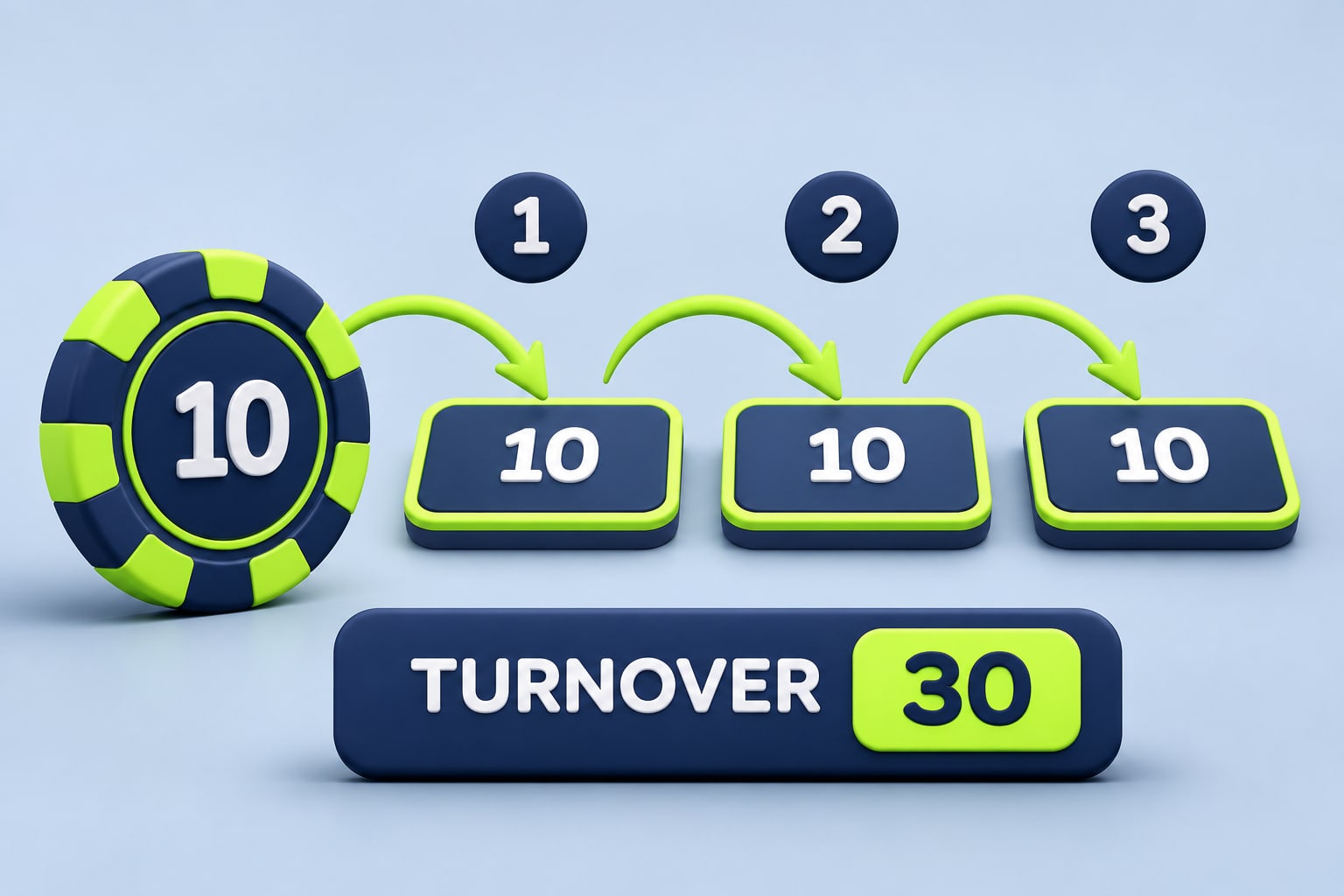
Fictional sequence: a $10 starting balance and three $10 bets, each returning exactly the stake.
Stake $10 → return $10. Cumulative wagers: $10.
Stake $10 again → return $10. Cumulative wagers: $20.
Stake $10 again → return $10. Cumulative wagers: $30.
Total wagered
$30
Sum of three stakes.
Closing balance
$10
No extra funding in this example.
Net result
$0
Returns of $30 minus stakes of $30.
Turnover is not a deposit total or a loss figure. Related: Wager · Handle.
Add the wagers over a defined period
Money put in action means the amount committed to wagers, usually accumulated over a session, day or other stated period. Related descriptions include turnover and amount wagered, though a report's precise accounting rules should always be checked. The measure concerns betting activity rather than the amount originally deposited. A player can reuse returned funds several times, causing accumulated wagers to exceed the starting balance. Define the period and the types of bets included before comparing figures. A total without that context can make a small session look larger or a large amount of repeated betting look smaller than it really was.
Reusing the same money increases turnover
Imagine a player begins with ten units and makes a ten-unit wager that returns ten units in total. They then repeat that transaction twice more. Across the three wagers, thirty units have been put in action, even though the player never had more than ten units available in this simplified example. If each return merely restores the stake, the final balance is still ten and net profit is zero. The turnover figure is thirty, the initial funding is ten and the final profit is zero. Those numbers describe different aspects of the same sequence and should not be substituted for one another.
Turnover is not the same as loss
Now consider five wagers of two units each. Total money put in action is ten units regardless of whether the combined returns are zero, eight, ten or fifteen units. Those returns produce different net results, but they do not change the fact that ten units were wagered. To calculate the net result for this simple set of bets, subtract the ten units staked from the total returned, using a consistent definition that includes returned stakes where appropriate. Deposits and withdrawals belong in a broader account reconciliation. Counting a withdrawal as a win without considering funding and remaining balance can misrepresent the session.
Count additional bets where the measure requires them
A game's initial wager may not be its total exposure. In blackjack, a double or split can add money to the hand, and side bets are separate commitments. A report that counts only the opening wager therefore differs from one that includes every amount risked. On a multi-line slot, the total spin stake may combine several line wagers or be shown directly as one amount. Check the denominator used by a house-edge figure before multiplying it by turnover. The expected-loss calculation must use the same wager base as the quoted percentage, otherwise the estimate can be systematically misleading.
Bonus progress can use a different eligible total
A promotion's wagering requirement may count only eligible play and may apply different contribution percentages to different games. That means total money wagered and qualifying bonus progress can diverge. If an illustrative rule credits a particular wager at ten percent, a ten-unit eligible wager adds one unit of progress under that rule, not ten. This example does not describe a current offer; the actual conditions control. Keep the raw wager history and the credited progress separate, and inspect exclusions, maximum stakes and expiry terms. Reaching a large turnover figure alone does not establish that every promotional requirement has been satisfied.
Use the measure without treating it as a target
Turnover can help explain why prolonged play creates more exposure even when the stake per round stays small. It is an accounting measure, not a goal that a player needs to reach outside a clearly understood condition they have chosen to accept. Increasing wagers just to make the number larger can increase potential losses. For personal records, retain the time period, total stakes, total returns and relevant starting and ending balances. For a review, state whether the figure includes bonus funds, side bets and extra stakes. That makes money put in action useful without confusing it with affordable spending, guaranteed loss or secured profit.