A pass line bet is a craps wager that wins on 7 or 11 and loses on 2, 3 or 12 on its come-out roll. If a point is established, it wins when that point repeats before seven.
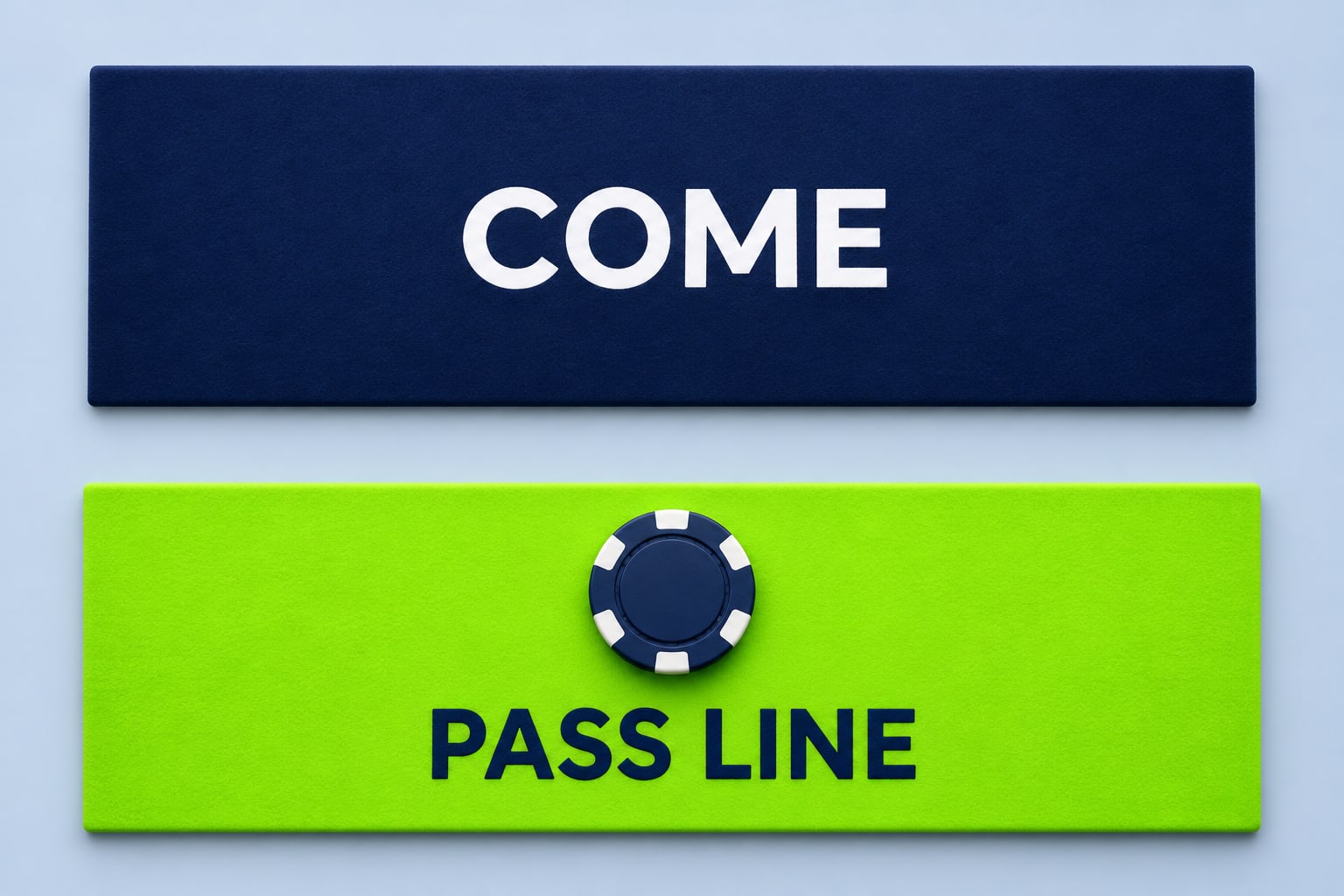
Visual explainer
Pass line: first establish which stage you are in
Under standard rules, a come-out seven wins, but a seven after a point loses.
7 or 11: win. 2, 3 or 12: lose. 4, 5, 6, 8, 9 or 10: establish the point.
Another six before seven wins. Seven before six loses. Other totals do not settle this bet.
Example: 6 → 9 → 3 → 6. The point is six throughout the middle rolls; the last six wins. A winning $10 line bet pays $10 profit plus the $10 stake.
Each other wager follows its own rules. Related: Disk or Puck · Don't Pass Bet.
The wager has two stages
The pass line bet is a basic craps wager whose winning condition changes after a point is established. It is normally placed before the come-out roll. On that first roll, seven or eleven wins immediately, while two, three or twelve loses immediately. A roll of four, five, six, eight, nine or ten establishes that number as the point. The wager then waits for either the point to repeat or seven to appear. This two-stage structure is essential. Saying that seven always wins a pass line bet is incorrect because seven becomes the losing result after a point has been established.
Following a complete example
Suppose a player places 10 units on the pass line before the come-out roll, and the shooter rolls six. Six becomes the point. A later nine does not settle this pass line wager, nor does a subsequent three. If six then appears before seven, the bet wins. If seven appears first, it loses. The point marker helps show which stage the table is in, but the player should still understand what it represents. Other bets on the table may settle during the intervening rolls. Their wins or losses do not necessarily change the outstanding pass line bet, which continues according to its own point condition.
Even-money payment and returned stake
The standard pass line bet pays even money, or 1 to 1 in profit. A winning 10-unit wager produces 10 units of profit plus return of the original 10-unit stake, for 20 units in total. The payment is the same whether the wager wins immediately on a come-out seven or wins later by making a point. It is not paid at the true odds of the particular point; that belongs to a separate odds bet. A 10-unit loss removes the original stake. Keep profit and total returned amount separate when reading a transaction record or comparing a dealer's payment with a written payout table.
Adding odds is a separate decision
Once a point is established, a casino may allow an additional odds wager behind the pass line bet, within its permitted limits. Standard odds payments vary with the point: 2 to 1 on four or ten, 3 to 2 on five or nine, and 6 to 5 on six or eight. Those payments reflect the relative ways to make the point before seven. The odds portion and original pass line stake should be recorded separately. Adding odds increases the total money exposed, even though the odds portion has no house edge under the standard fair-dice model. It does not make the original wager certain to win or reduce the amount that can be lost on that decision.
The role of probability
With two fair dice, seven has six ordered combinations and eleven has two, giving eight immediate winning combinations on the come-out roll. Two, three and twelve together have four losing combinations. The other 24 combinations establish points, after which the chances depend on the number chosen. Four and ten each have three combinations, five and nine four each, and six and eight five each. Combining both stages yields a standard pass-line house edge of about 1.41% per resolved original wager. This is an expected average, not a prediction of one roll or session. The apparent first-roll advantage is offset by the point stage.
Placement and common misunderstandings
Place the chip inside the marked pass line area and confirm the table's betting procedure before the roll. An established pass line wager is ordinarily a contract bet that cannot simply be removed after a point is set; check the game's exact rules. Do not confuse it with a come bet, which begins its own come-out-style sequence during an existing table point, or with a place bet on a chosen number. The don't-pass wager also has different come-out treatment rather than being a perfect mirror in every detail. Learning the pass line means following the wager's current stage, payment and exposure, while keeping the session within a predetermined spending limit.