In this blackjack glossary, deadwood refers to used or discarded cards that are currently out of the undealt card supply. The term is informal and context-dependent; it should not be confused with a dead hand or with deadwood scoring in rummy.
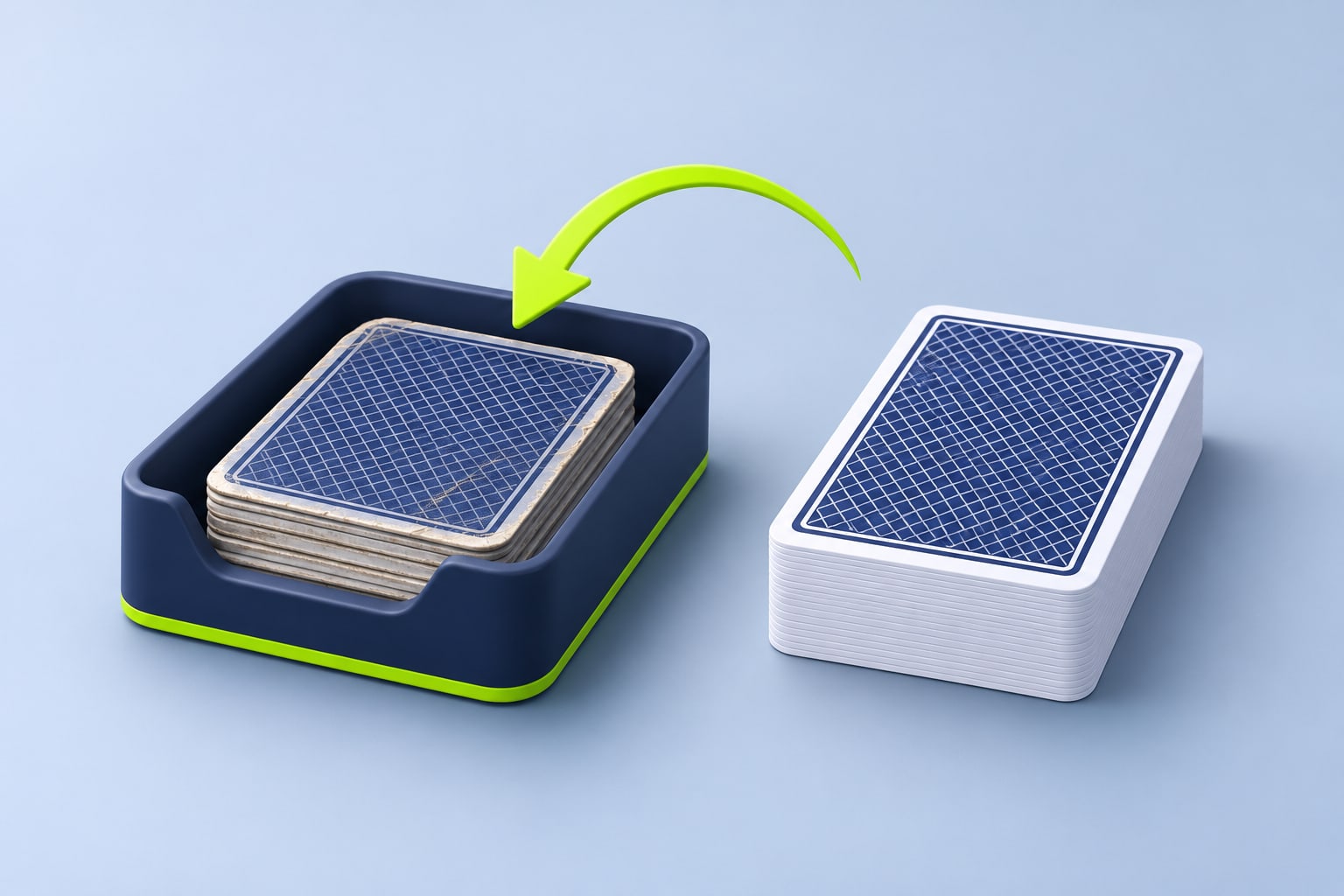
Used cards separated from undealt cards
In the blackjack sense used here, deadwood means cards that have already been used or discarded and are currently outside the undealt supply. The clearer everyday description is used cards or discards. The informal term is not a universal label across all card games, so its context should always be stated. It does not mean that the physical cards can never be used again. They may return after the appropriate collection and shuffle procedure. The important distinction is their current role in the game: they are no longer available as the next ordinary undealt card while they remain in the discard area.
Why a discard area matters
A physical blackjack table separates the cards being dealt from those whose immediate role has ended. A discard tray or rack helps maintain that separation and supports the dealer's handling procedure. Players should leave those cards and the equipment to the dealer rather than touching or rearranging them. The visible position of a card is part of understanding its status, but a player should not make a unilateral ruling based on a casual impression. If a card appears misplaced or the handling is unclear, ask the dealer or supervisor to explain the procedure. Keeping the issue specific is more useful than assuming an irregular-looking movement proves an incorrect result.
Discarded does not always mean unseen
Used cards may have been visible during a completed hand, while some procedural discards may not have been exposed to players. A count of cards in a tray therefore does not necessarily reveal the ranks of every card removed from the undealt supply. Separate knowing that a card is unavailable from knowing exactly which card it was. This distinction matters when someone claims that a visible stack provides complete information about the remaining cards. It does not. The amount of information depends on what was actually observed and on the dealing process, not merely on how large the discard stack appears.
Shuffling changes the relevant supply
In a game dealt from a finite pack or shoe, cards remain unavailable for subsequent ordinary deals until the applicable shuffle or reintegration procedure returns them. Other arrangements can handle cards differently, including continuous shuffling or software that starts a fresh virtual deal under its own rules. Do not assume a visible discard pattern on one table applies to every online or live game. Read the product's explanation of dealing and shuffling. A card's earlier appearance is useful context only within the actual process being used. A graphical stack on a screen is not, by itself, proof that a continuing physical shoe is being represented.
Different from a dead hand
A dead hand is a separate rules concept concerning a hand that is no longer eligible to continue or compete under the applicable procedure. It is not simply another name for all cards in the discard tray. Nor does the blackjack use of deadwood describe the unmatched-card scoring familiar from rummy games. Using the same word across different games can create avoidable confusion. Specify the game and the intended meaning when writing a rule explanation or asking about an incident. If the question is whether a particular hand still counts, ask that directly instead of relying on an informal label for used cards.
Useful vocabulary, limited conclusions
Recognising the difference between undealt cards, active hands and discards helps a player follow the table. It does not establish the next card, prove a winning opportunity or guarantee that a strategy will be profitable. A pile of used cards also cannot tell you the full rules, the dealer's future result or an opponent's private information. Treat the term as a description of card status. When comparing games, record the stated deck and shuffle arrangements rather than making assumptions from the tray alone. When a procedure is disputed, pause and seek clarification through the table's normal process rather than interfering with the cards or continuing under an unresolved misunderstanding.